
Civic Duty as Lived Responsibility

A normal night. Not a dramatic one.
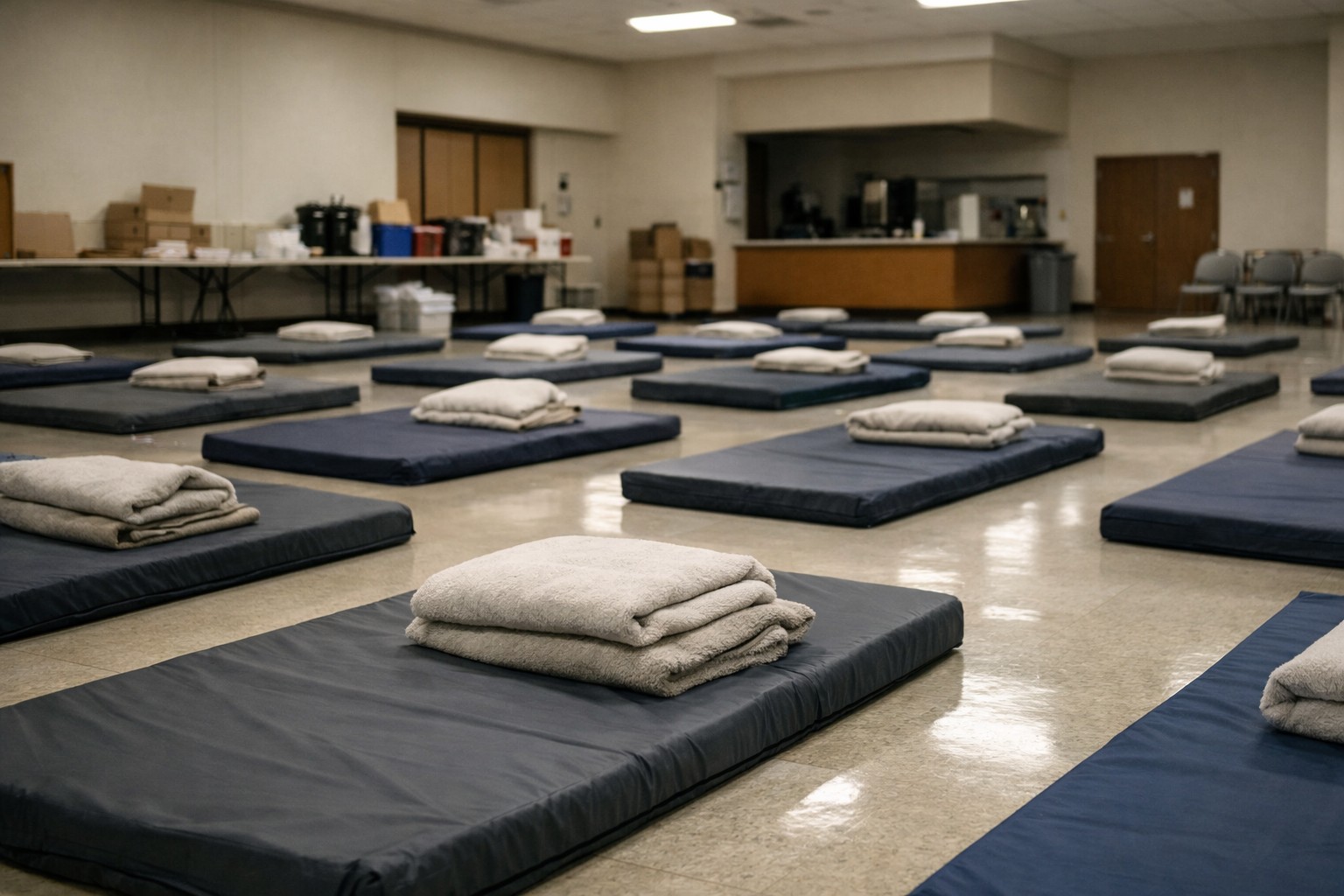
It has been cold in Tampa this week. Cold enough for the county to open its cold-weather shelters. That means mats laid out across large facility spaces, standard-issue blankets, and volunteers arriving in small waves as the evening settles in.
There is nothing especially dramatic about it. People sign in. Food is delivered and set out. Guests come through the door, some quietly grateful, some wary, some exhausted. Volunteers take their places. Around 1 a.m., one volunteer hands off a clipboard to another, exchanging weary smiles in the dim light of the facility. Throughout the night, others arrive to relieve them, rotating through overnight shifts to keep the shelters staffed until morning. By the next evening, it will happen again.
 This is not an emergency in the cinematic sense. It is routine. Repetitive. A little tiring. And that is precisely what gives it its shape. Civic duty rarely looks like a moment. It looks like a pattern.
What we mean when we say civic duty
We use the phrase civic duty easily, but we often leave it undefined. It can drift into something vague. Voting. Paying taxes. Caring in the abstract. But lived civic duty is more concrete than that. It shows up where responsibility and nearness meet. It looks like simple actions: driving to a shelter, ladling soup into bowls, signing guests in at the door. These ordinary tasks give shape to our responsibilities and ground the abstract into everyday life.
Marcus Aurelius wrote, “What brings no benefit to the hive brings none to the bee.” He wasn’t making a metaphor about kindness. He was expressing a fact about human life. We are not built to flourish alone. Our well-being is often, and uncomfortably, tied to others’. Reflect for a moment: can you recall a time when your own comfort or success was supported by the unseen efforts of those around you? Perhaps it was a neighbor who quietly cleared your sidewalk of snow, or a community worker who ensured your power stayed on during a storm. Understanding this interconnectedness makes the metaphor a lived experience.
Civic duty begins when concern becomes action. Not because it feels noble, but because shared life demands it. When a community faces a need, and some people have the capacity to respond, responsibility comes naturally. Not as heroism. As participation. Consider this: perhaps in your own neighborhood, there’s a local shelter that needs volunteers or a community garden that needs care. Maybe it’s as simple as checking in on an elderly neighbor or assisting in local food drives. These small gestures can bridge the gap between reflection and meaningful action.
This kind of duty does not ask whether the work is satisfying or visible. It asks only whether the need is real and whether we are positioned to help. Everything else is secondary.
The Stoic understanding of obligation
The Stoics did not treat civic duty as a feeling or a preference. They treated it as a consequence of what human beings are. To them, we are rational and social creatures by nature. That pairing matters. Reason without relationship collapses into self-absorption. Social life without reason drifts into impulse. Civic obligation arises at the intersection of the two.
Marcus Aurelius reminded himself that what benefits the community also benefits the individual. This was not idealism. It was realism. A person who lives only for private comfort eventually weakens the very conditions that make a stable life possible. Justice, in Stoic terms, is not abstract fairness. It is the habit of acting in ways that sustain the shared life we all depend on, even when the work is quiet and unseen.
The Stoics were also clear that obligation does not wait for perfect circumstances. Epictetus described life as a role we are given rather than a script we write ourselves. We do not choose every part we play, but we are responsible for how we play it. A citizen has different duties than a ruler. A neighbor has different duties than a stranger. What matters is not the scale of the role, but whether it is carried out with integrity. Repeated acts of care are not inconveniences to be endured. They are the training ground of character.
Later Stoic thinkers, like Hierocles, made this even more explicit, describing the moral life as a widening circle of concern. Care begins with the self, but it does not end there. It extends outward to family, community, and eventually to people we may never know. From this perspective, civic duty is not an optional expression of kindness. It is the natural extension of a life that takes seriously what it means to live among others.
Faith expressed through practice, not words
If the Stoics understood obligation as something that follows directly from shared life, the Wesleyan tradition approaches it as something that must be practiced deliberately. For many of us involved in this work, faith is not an additional motivation layered on top of civic duty. It is the discipline that trained us to recognize obligation in the first place.
In the Wesleyan tradition, belief is never meant to remain abstract. Faith is tested and expressed through action, especially in how we respond to others’ needs. John Wesley urged his followers to “do all the good you can,” not as an emotional appeal or an appeal to heroic sacrifice, but as a way of life. Doing good was meant to be ordinary, repeated, and steady. It was not reserved for ideal conditions or special moments.
That emphasis runs throughout the Christian scriptures. Care for the vulnerable is not framed as an optional virtue but as a responsibility. The measure of faith is not what is professed, but what is done. Feeding the hungry, welcoming the stranger, tending to those who have fallen through the cracks of society — these are presented not as extraordinary acts, but as faithful ones. They are simply what love looks like when it takes form.
What matters most in this tradition is not intensity of feeling, but consistency of response. Showing up again matters more than saying the right thing once. In that sense, faith and Stoicism meet on familiar ground. Both insist that character is shaped over time, through repeated choices, often made when no one is watching. Belief, like virtue, becomes real only when it is practiced.
A wider moral agreement between traditions
What stands out when you step back from any single tradition is how familiar this ethic looks across cultures and centuries. The language changes. The symbols change. But the moral direction stays remarkably consistent. A good life is not measured only by inner peace or personal achievement. It is measured by how one responds to others’ needs.
In the Abrahamic traditions, care for the vulnerable is woven directly into moral law. Justice is not abstract. It is expressed through hospitality, protection of the poor, and responsibility toward neighbors and strangers alike. Faithfulness is judged less by belief than by action, less by words than by what is done when someone is hungry, cold, or forgotten.
Eastern traditions arrive at a similar conclusion from a different starting point. Buddhist ethics emphasize right action and compassion grounded in awareness of interdependence. What harms another ultimately harms the whole. Confucian thought places responsibility squarely within relationships, arguing that moral character is revealed through how one fulfills obligations to family, community, and society. Confucius warned that recognizing what is right without acting on it is a failure of courage, not understanding.
These traditions do not agree on theology or metaphysics. They do not need to. What they share is a sober recognition that human life is communal by nature. To live well is to accept that we are bound to one another, whether we choose that bond or not. Civic duty, seen this way, is not a modern invention or a political preference. It is an old and widely shared moral insight, expressed wherever people have taken seriously the question of how we ought to live together.
Limits, fatigue, and realism
Work like this has limits, and pretending otherwise helps no one. Cold weather shelters do not solve homelessness. A few nights of heat do not undo years of instability, addiction, illness, or bad luck. Volunteers get tired. Schedules strain. People show up anyway, knowing that what they are offering is partial and temporary.
There is a line from songwriter Jana Stanfield that captures this tension well: “I can’t do all the good the world needs, but the world needs all the good I can do.” That sentence expresses a truth the Stoics clearly understood. Moral responsibility has boundaries. No one is asked to fix everything. But no one is excused from doing something simply because the need is larger than they are.
Stoicism insists on realism. It asks us to view the world as it is, not as we wish it to be. That realism does not lead to withdrawal. It leads to focus. We need to ask ourselves, “Is this mine to do right now?” This guiding question can help reaffirm our dedication to addressing the issues that lie before us. The question is not whether our efforts are sufficient to resolve the problem, but whether we are acting well within the portion of it that is actually in front of us. Justice does not require omnipotence. It requires attention, judgment, and follow-through.
Fatigue is part of this work, and the Stoics would not be surprised by it. Repeated responsibility tests character over time. That is why they stressed discipline and limits. You do what is yours to do, and you accept what is not. You show up without illusion, without resentment, and without needing the work to justify itself with visible success. Acting well is enough.
This kind of realism protects the work from burnout and from pride. It keeps civic duty from turning into performance or despair. The shelters will close when the weather warms. They will open again when it turns cold. The work will remain incomplete. That is not failure. It is simply the shape of responsibility in a world that does not offer clean resolutions.
Returning to the night
By the time the shelter opens again tonight, the details will look much the same. Mats laid out. Meals prepared. Volunteers signing in and taking their places. Some will stay for a while. Others will arrive later to take the next shift. In the morning, everything will be packed away until it is needed again.
There will be no moment that feels definitive. No sense that the work is finished or that something has been resolved. And that is fine. Civic duty is not about closure. It is about presence. It is the decision to meet the circumstances as they present themselves, without dramatizing them or turning away. Pause for a moment and consider: Where will you show up tomorrow? What spaces in your community invite your presence and make a quiet but distinct difference?
The Stoics warned against waiting for ideal conditions before acting. Faith traditions make a similar point. The call is not to do everything, but to do what is asked of us where we are. Most of the time, that call is quiet. It shows up as a need that is inconvenient, repetitive, and easy to overlook. Tonight, with a forecast of 30°F and wind, the urgency of not waiting becomes tangible. This weather forecast emphasizes the immediate necessity to act, without expecting grand conditions or a perfect moment.
Showing up again is not a grand statement. It is a habit. Over time, those habits shape a life. They shape a community.
Tonight, that will be enough.
