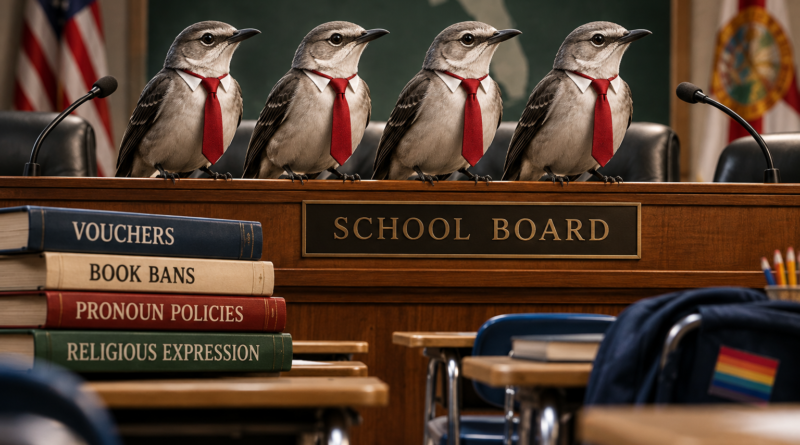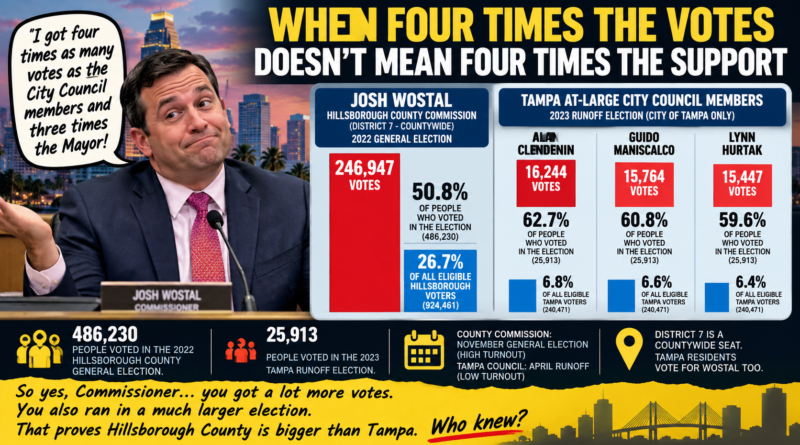

The Architecture of Abandonment: The Performance of Josh Wostal

This entry is in the series 2026 Elections

In the sterile halls of the Hillsborough County Center, he is known as “Hostile Wostal”—a man who treats the public treasury like a distressed asset ripe for liquidation. While he preens for social media as a fiscal hawk, his actual record is a masterclass in calculated abandonment, trading essential bus routes in South County for high-end sprawl subsidies that line the pockets of mega-developers like Lennar and Homes by WestBay. It isn’t “saving” when you strip the foundation of a community to pave the private driveways of the donor class; it is patrimonialism disguised as prudence.

Wostal’s governance is a performance of cruelty, evidenced by his crusade to defund the Supervisor of Elections and dismiss 100,000 of our neighbors as mere “ghost voters.” This isn’t about the bottom line; it is about rigging the game by silencing the voices he can’t win over. From stranding essential workers on the roadside to attacking the ballot box, Wostal has shown us that he knows the price of everything but the value of nothing. It is time to decide if we want a county that serves its people, or a family business that serves only its patrons. Follow the paper trail and learn more about how we can build a Hillsborough that belongs to everyone.

Read more

Hierocles: Expanding the Circle

This entry is in the series Journey Through Stoicism
This entry is in the series The Stoics

Stoicism often begins as a philosophy of the self. What I control. How I respond. How I stay steady when life shifts in ways I didn’t expect. But the Stoics never intended it to stop there. At some point, the question changes from how I manage myself to how I show up for other people.

In this essay, I introduce the Stoic philosopher Hierocles and his idea of expanding circles of concern. It’s a simple image with challenging implications. Through his teaching and my own experience, I explore what it means to move beyond inward discipline and begin living with a broader sense of responsibility. Read more.

Read more

Why Josie Tomkow is Wrong for Tampa

This entry is in the series Florida Legislature
This entry is in the series 2026 Elections

For decades, the “Home Rule” philosophy was the bedrock of Florida governance—the common-sense idea that the people who live in South Tampa and Northwest Hillsborough are better equipped to run their communities than a bureaucrat in a distant capital. But after the 2026 Legislative session, that principle isn’t just under attack; it’s being systematically dismantled. At the center of this power grab is Representative Josie Tomkow, a Polk County resident now seeking to represent Senate District 14. While her campaign paints a picture of “common sense” leadership, her voting record tells a different story: one of a reliable “yes-man” for a Tallahassee establishment that views your local autonomy as an obstacle to be cleared.

From voting to strip your city council of the power to host local cultural festivals to supporting state-level takeovers of local zoning boards, Tomkow has consistently prioritized state authority over your backyard reality. Whether it’s placing barriers at the ballot box for USF students or diverting your tax dollars away from public classrooms, her record is a blueprint for centralization. Senate District 14 doesn’t need a proxy for the Governor’s office; it needs a champion for its own streets. We’re taking a deep dive into the specific “preemption” bills Tomkow supported and why her vision for Florida is a direct threat to the independence of the Tampa Bay area.

[Read the full analysis here: The Death of Home Rule and the Rise of the Polk County Proxy]

Read more

Negative Visualization

This entry is in the series Stoicism Practices
This entry is in the series Journey Through Stoicism

Most people deal with uncertainty in one of two ways. They either worry endlessly about everything that might go wrong… or they assume nothing will. Neither approach prepares us very well for real life.

The Stoics practiced something different. They called it premeditatio malorum — the premeditation of difficulties. Instead of imagining every possible disaster, they briefly considered the challenges that might realistically arise and thought about how they would respond.

This simple mental exercise doesn’t increase anxiety. It reduces it. By removing surprise, it helps us meet life’s difficulties with steadiness rather than panic.

Read more

McCarthy in the Mangroves: Florida’s High-Tech Return to the Red Scare

This entry is in the series Florida Legislature

A Flagpole, a Principal, and the New “Thought Police”
If you’ve been following the news in Hillsborough County, you’re likely familiar with the recent “scandal” at Lennard High School—or rather, the scandal that wasn’t. We watched in real-time as Representative Danny Alvarez took to social media to demand a principal’s head over a student walkout that, upon even the slightest investigation, proved to be a non-event handled with textbook safety protocols. It was a classic “Red Scare” tactic: loud, factually hollow, and designed to intimidate. But while the principal’s career was thankfully spared, the mindset behind the attack has just been codified into a terrifying piece of legislation.

HB 945 is currently moving through the Florida legislature, and it should have every citizen—regardless of party—checking their digital locks. The bill seeks to create a new counterintelligence unit with the power to monitor our “patterns of life” and target anyone whose “views or opinions” are deemed “inimical” to the state. In a “Free State” that increasingly feels like a digital panopticon, we are being asked to trust our private data to an administration that can’t even get the facts straight about a local high school gathering.

When “inimical” effectively translates to “unfavorable to the Governor,” we have moved past the era of public safety and into the era of the Thought Police. Backed by a growing, personal “State Guard” militia, this isn’t just a policy shift; it’s a constitutional five-alarm fire. I’ve written a full breakdown of why this return to McCarthyism is a danger to the very fabric of our Republic.
Click here to read “McCarthy in the Mangroves” and see why Florida’s newest law is a direct assault on the First Amendment.

Read more

Choosing Enough

This entry is in the series Journey Through Stoicism
This entry is in the series The Stoic Virtues

We live in a world that is very good at convincing us that more is always better. More food, more comfort, more information, more outrage, more things. Our phones are built to keep our attention just a little longer. Our culture treats abundance as harmless and excess as normal. But when everything is available all the time, the real question is no longer what we can have. It is what we should choose to take in, and what it is quietly costing us.

Temperance offers an unfashionable answer. Not denial. Not purity. Enough. It asks us to notice our appetites, not just for food, but for attention, certainty, comfort, and stimulation. It invites us to consider whether what we consume is actually nourishing us, or simply keeping us busy and restless. In an age engineered to keep us reaching, choosing enough becomes a quiet act of freedom, one that clears space for presence, joy, and a life that feels more truly our own.

Read more

Civic Duty as Lived Responsibility

This entry is in the series Journey Through Stoicism

Where will someone sleep in your city tonight? Civic duty rarely announces itself. It does not arrive as a moment of clarity or a flood of inspiration. More often, it looks like routine. Mats laid out across a facility space. Meals delivered and set out. Volunteers arriving in shifts through the night so others can sleep indoors when the temperature drops.

We talk about civic duty as an idea, but it is better understood as a practice. It begins when concern becomes action. Not because the work feels noble, but because shared life demands it. When a community faces need, and some people have the capacity to respond, responsibility follows. Not as heroism. As participation.

This essay reflects on civic duty as lived responsibility. Drawing on Stoic philosophy, Wesleyan theology, and a wider moral consensus across traditions, it asks what it really means to show up for others when the work is repetitive, incomplete, and often unseen.

Read more

Justice as Responsibility: A Companion Examination

This entry is in the series Journey Through Stoicism
This entry is in the series The Stoic Virtues

Justice is one of the most frequently used moral words in public life, and one of the least examined. It appears in politics, religion, social movements, and law. Because it is so familiar, we often assume we mean the same thing when we use it. We usually do not.

Serious moral traditions have resisted reducing justice to feeling or slogan. Stoic philosophy, Christian ethics, and modern research all return to a similar conclusion: Justice is not primarily about emotion or ideology. It is about responsibility. Responsibility to others, to the common good, and to living in a way that keeps belief and behavior aligned.

Seen this way, justice is not a moment or a performance. It is discipline. A steady practice carried out over time. It asks for clarity without cruelty, conviction without self-righteousness, and persistence without spectacle. Justice endures not because it is loud, but because it is rooted.

Read more

Justice as a Way of Life

This entry is in the series The Stoic Virtues
This entry is in the series Journey Through Stoicism

Justice is a word we hear all the time, but people often understand it differently. It shows up in courtrooms, sermons, protest signs, and political speeches. Before it became a slogan, justice was seen as a way to live. Not just a stance or an opinion, but a mode of living.

For me, justice starts with faith. The prophet Micah says it simply: Do justice. Love mercy. Walk humbly with God. This command is not abstract. Justice is not something to admire from afar. It is something you do, often quietly, sometimes without certainty, and sometimes at a real cost.

I have seen justice take shape in public gatherings and protest marches, but I have also seen it in smaller, steadier acts. Helping someone get a meal. Standing up for a person who cannot speak for themselves. Showing up again when the work seems slow and unfinished. Justice does not always announce itself. Most often, it looks like ordinary people refusing to look away.

Read more