
Seneca Would Feel Right at Home Today
Some frustration doesn’t hit all at once. Instead, it grows slowly over days, weeks, or even years. You see decisions being made that don’t make sense, and hear confident words that don’t seem tethered to reality. You see people in positions of power act in ways that feel careless at best and corrosive at worst. Eventually, it’s not just disagreement, but a quiet exhaustion.
I’ve felt that way recently. It doesn’t come all at once; it comes in layers. Headlines make you shake your head. Conversations stall. Everything feels unsettled, and I keep coming back to one question: what am I supposed to do with this?
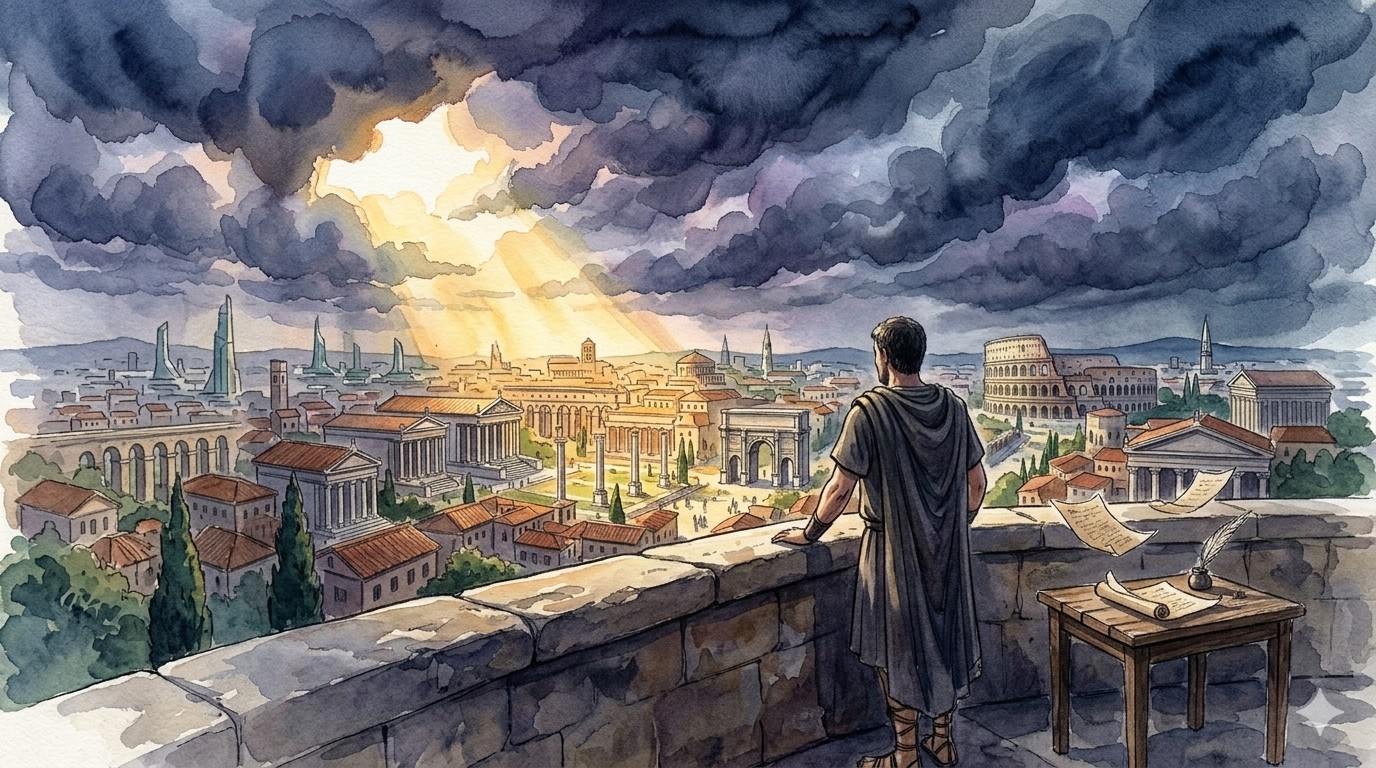 Seneca lived in a world that would feel familiar in its own way. Rome was powerful, wealthy, and unstable beneath the surface. Its leadership could be erratic. Its politics were tangled with ambition, fear, and self-interest. Seneca himself served in the inner circle of that world, advising Nero, a man whose grip on reality and restraint grew thinner over time. If anyone knew what it felt like to live under leadership that made you uneasy, it was him. He would feel “at home” today.
But Seneca didn’t write from a safe distance. He wrote while still living in that world.
That matters.
This matters because Seneca’s philosophy was not theoretical. It was forged amid contradiction: believing in virtue while surrounded by excess, seeking wisdom in a court that rewarded the opposite. He lived with the persistent gap between what should be and what is, confronting it rather than ignoring it.
He didn’t pretend that the gap didn’t exist. He learned how to live with it.
There’s a line of his that keeps coming back to me. “We suffer more often in imagination than in reality.”
At first, it sounds like a dismissal. Like he’s saying, things aren’t that bad. But that’s not what he means. He knew things could be bad. He lived through exile, political danger, and the constant uncertainty of imperial favor. What he’s pointing to is something else. The way the mind takes what is already difficult and multiplies it. The way we rehearse arguments, predict outcomes, and carry burdens that haven’t fully arrived.
Too often, I recognize that in myself. I notice it in myself when the news affects my whole day, when I imagine stressful futures, or when I feel tense even if nothing is actually wrong.
Seneca wouldn’t tell me to ignore what’s going on. He wasn’t naive. He understood power, corruption, and instability better than most. But he would ask a tougher question.
What part of this is actually mine to carry?
Not in a vague way, but in a practical sense. What can I influence? Where can I take action? And where am I just taking on burdens that aren’t really mine?
It’s the same idea we talked about in The Dichotomy of Control. It’s not just a slogan, but a line you have to keep drawing for yourself, because it doesn’t stay clear by itself.
It’s tempting, especially now, to feel responsible for everything. You try to keep up with every change and hold the whole situation in your mind. It feels like you’re staying informed, but after a while, it just turns into constant worry that doesn’t help you act.
Seneca had a different approach. He focused on the small circle where action is real. Your character. Your choices. Your response. Not because the larger world doesn’t matter, but because that is where your leverage actually is.
Lately, I’ve been reminded of that in quieter ways. Not in the headlines, but in the ordinary parts of the day. A conversation that goes better when I slow down and listen. A moment where I choose not to snap back, even if I feel like it. I keep a promise I made. These things won’t change a country, but they do shape a life.
Maybe that’s the real point. Seneca didn’t try to fix Rome. He tried to stay steady while living in it.
That kind of steadiness isn’t just sitting back or not caring. It means refusing to let outside chaos control your mind. It’s about acting where you can and stepping back where you can’t, without becoming numb or bitter. I’m reminded of something that’s become my motto of late. It’s by singer-songwriter Jana Stanfield, who wrote, “I can’t do all the good the world needs, but the world needs all the good I can do.”
That’s harder than it sounds.
A part of us wants things to be resolved. We want life to make sense, leaders to act with integrity, systems to work, and outcomes to be fair. When that doesn’t happen, the frustration doesn’t just stay on the outside. It turns inward, becoming restlessness, anger, or even quiet despair. That is part of the current control strategy. To “flood the zone,” to the point of making us all weary and ready to throw up our hands and surrender.
Seneca doesn’t promise that those conditions will change. In fact, he expects they often won’t. Instead, he offers a different kind of stability. Not in the world, but within yourself.
Seneca wrote, “True happiness is to enjoy the present without anxious dependence on the future.” He isn’t saying to ignore the future, but to avoid losing the present by worrying about what might happen.
I remember that when everything feels noisy and out of control. When life moves in ways I wouldn’t choose, it’s easy to keep watching and reacting. But that focus takes you away from the life happening right in front of you. And that life matters.
A morning walk. A talk at the table. Small acts of care that don’t make the news but keep things together. The chance to do the right thing when no one is watching. These aren’t distractions from bigger issues. They’re where your influence truly matters.
Seneca understood that a person can live through turbulent times without becoming chaotic. Not perfectly, and not without mistakes, but by trying. He also admitted something important: knowing this isn’t the same as living it. That might be the most honest part of his philosophy.
He wrote about anger while still struggling with it. He warned against excess even though he was wealthy. He advised restraint while surrounded by power. He kept facing these problems, not standing apart from them.
We do the same. That’s what this reflection is about. It’s not about giving answers, but finding a way to return to your center and steady yourself when life feels overwhelming.
The world may remain unstable. The headlines may not improve. The systems we rely on may continue to strain. None of that is guaranteed to resolve. But there is still this question, waiting underneath it all.
How will I meet this day? Not the whole future. Not the entire system. Just today.
