When Four Times the Votes Doesn’t Mean Four Times the Support

This entry is in the series 2026 Elections
This entry is in the series Daily Douche-Bag

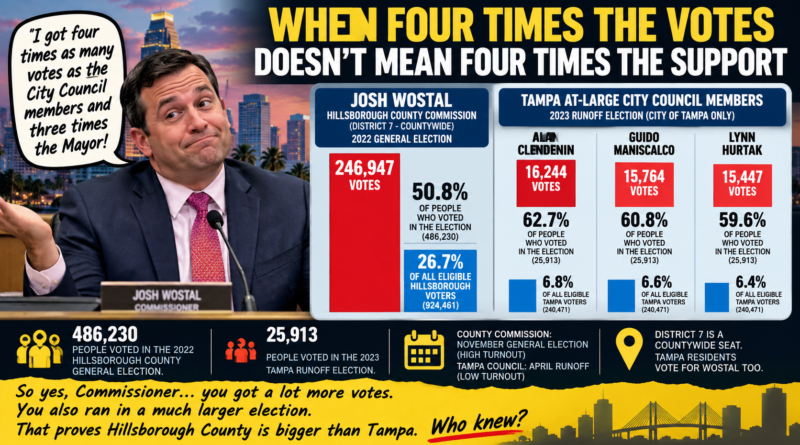
Josh Wostal has a unique way of measuring political influence. When people said Hillsborough County doesn’t treat Tampa fairly, he noted that he got far more votes than Tampa’s mayor and at-large City Council members. That sounds impressive until you consider the size of the electorate and voter turnout.

Wostal ran in a countywide November election where 486,230 people voted. Tampa’s at-large council members won their seats in an April runoff with only 25,913 voters. If you compare each candidate to the people who voted in their election, Wostal’s supposed advantage goes away. In fact, some of the votes he mentions came from Tampa residents. So, Hillsborough County is bigger than Tampa. Who would have thought?

Read more

Jackie Toledo and the Curious Case of Local Control

This entry is in the series 2026 Elections

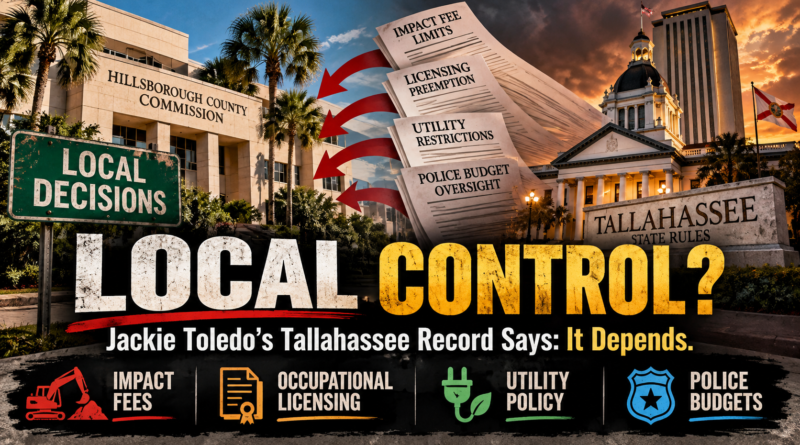
Jackie Toledo is now seeking a seat on the Hillsborough County Commission, where local officials decide on growth, infrastructure, public safety, and county policy. This makes her time in Tallahassee especially interesting, because she repeatedly supported laws that limited what counties and cities could decide for themselves.

Toledo supported state intervention in areas like impact fees, occupational licensing, utility policy, and even local police budgets; Toledo backed state intervention in matters normally handled close to home. In one case, Tallahassee could even review and overturn a local decision about a police budget.

There is a certain irony in spending years helping state government restrict local author

Read more

Cool Classrooms and Common Sense: Why Hillsborough Must Renew the Half-Penny Promise

This entry is in the series 2026 Elections
This entry is in the series Education
This entry is in the series Florida Amendments and Referenda-2026

Florida summer heat is not theoretical. It is a relentless physical reality. Anyone who expects children to concentrate on algebra or reading in an eighty-eight-degree classroom with a dead air conditioner and water dripping into plastic buckets has never spent an afternoon inside an aging Florida school building. You cannot build academic excellence when students and teachers are simply trying to survive the humidity.

Hillsborough Referendum 3 asks voters to renew the half-cent sales tax for another ten years to pay for air conditioning, roof repairs, and security at schools. Opponents talk about tax fatigue, but this is not a new tax. It keeps the same rate as in 2018. If it ends, your grocery bill will not go down, but school maintenance will lose $120 million a year.

The results speak for themselves. Since 2018, the Half-Penny Promise has funded over 750 projects, including air conditioning upgrades at 177 schools, all overseen by an independent Citizen Oversight Committee. Tourists pay about a quarter of the cost, and over $716 million has gone to local contractors and workers in Hillsborough County.

While the state Capitol stays busy manufacturing political culture wars and diverting public funds into private vouchers, local communities must take care of their own. Read the complete breakdown on why renewing this capital surtax is an investment in our kids, our local workforce, and our neighborhood schools.

Read more

Trading Four Votes for One: The Cynical Math Behind Hillsborough’s Commission Power Grab

This entry is in the series Florida Amendments and Referenda-2026
This entry is in the series 2026 Elections

If someone came to your door and offered to trade four hundred-dollar bills for a ten-dollar bill, you would quickly close the door and check your security cameras. That is exactly the kind of deal behind Hillsborough County Charter Referendum 2, a Tallahassee plan that would undo forty years of balanced local government.

For forty years, Hillsborough has used a mix of four district commissioners and three countywide at-large commissioners. This lets every voter choose four out of seven seats, giving people a say in the majority. Referendum 2 would end this system by expanding the board to nine and removing all at-large seats.

Think about what this means for your representation. You would go from voting for four commissioners to just one. You would not be able to vote for or against the other eight, even though they decide on taxes, infrastructure, and big development projects. Single-member districts encourage commissioners to trade favors for their own areas and ignore countywide needs like Port Tampa Bay and regional transit.

Tallahassee politicians love to lecture local communities about neighborhood control while quietly shrinking our democratic leverage from afar. Read the full commentary to see why trading away four seats for one is a bad trade for Hillsborough taxpayers, and why we must vote No on Charter Referendum 2.

Read more

The Ballot-Box Bureaucrat: Why Electing Hillsborough’s Superintendent Is Bad for Business and Worse for Classrooms

This entry is in the series 2026 Elections
This entry is in the series Education
This entry is in the series Florida Amendments and Referenda-2026

Imagine Tampa General Hospital announcing that it will now select its President and CEO through a countywide partisan primary. Picture candidates debating surgical protocols on debate stages, taking a full year off to solicit campaign checks from medical supply reps, and catering to partisan party bosses instead of patient care. No board of trustees would tolerate it, and no major health system would survive it. Yet that is the exact circus Tallahassee politicians want to bring to Hillsborough County Public Schools, the single largest employer in our community.

Proponents dress up the proposal in the language of parental rights and democratic empowerment. But under the current model, the superintendent answers to an elected, seven-member School Board every single day. If the superintendent mishandles district finances, botches bus routes, or mismanages schools, the board can act immediately. Under an elected system, that daily accountability vanishes. The School Board loses its supervisory power, leaving a single partisan politician in charge of a $4 billion budget and 220,000 students, answerable to voters only once every four years.

An even bigger problem is the smaller pool of candidates. Instead of searching the country for experienced school leaders, we would be limited to local registered voters. The best-performing states treat school administration as a professional job, while the only two states that still elect superintendents are not among the top performers.

Injecting culture-war primaries and campaign fundraising into our school system’s executive suite is a disaster waiting to happen. Read the full analysis on why turning school administration into a political prize hurts our students, undermines teachers, and destabilizes our local schools.

Read more

Brittany Lyssy’s School-Board Training Network Deserves a Closer Look

This entry is in the series Education
This entry is in the series 2026 Elections

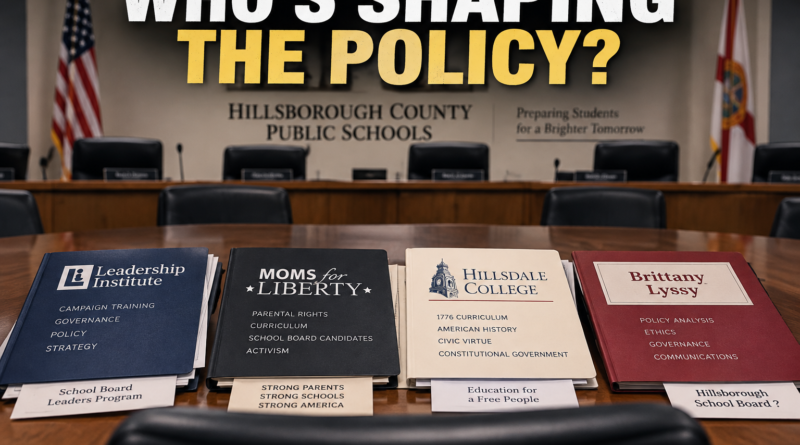
Brittany Lyssy cites her work with the Leadership Institute’s School Board Leaders Program as part of her education-policy experience. A closer look at that program shows a national conservative network built around recruiting, training, and supporting school-board candidates, with direct connections to Moms for Liberty and to policy resources from Hillsdale College and the Heritage Foundation.

One connection deserves particular attention. Bridget Ziegler, an early figure in Moms for Liberty, served in leadership of the same Leadership Institute school-board program where Lyssy worked on communications, policy analysis, ethics, and governance. Public records do not show that Lyssy belonged to Moms for Liberty or adopted every position promoted within that network, but the institutional ties are clear enough to warrant scrutiny.

The larger question is what parts of that philosophy Lyssy would bring to Hillsborough. The full article follows the connections among the Leadership Institute, Moms for Liberty, Hillsdale, Ziegler, and Lyssy’s own policy background, then asks what voters should examine before deciding how much those ties matter.

Read more

Josie Tomkow Discovers Homeowner Rights

This entry is in the series 2026 Elections

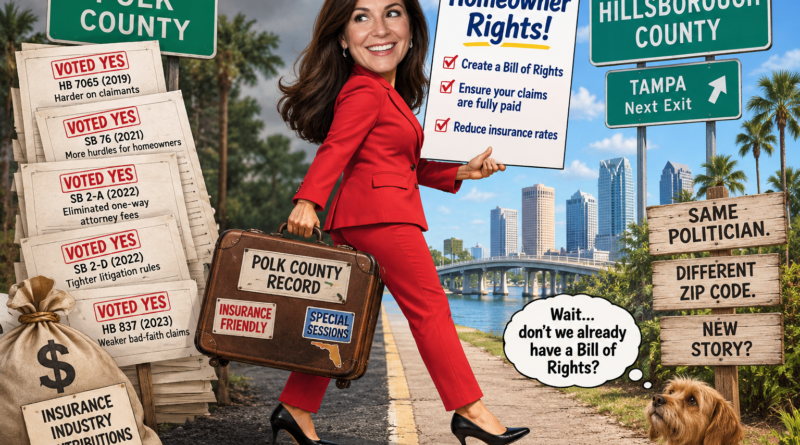
Josie Tomkow says she wants to create a Homeowner Claims Bill of Rights and make sure insurance claims are fully paid. This sounds reassuring, especially in a state where rising premiums and storm losses have made things tough for homeowners. There is just one awkward detail: Florida already has a Homeowner Claims Bill of Rights. Even more, Tomkow spent years voting for laws that made it harder and more expensive for policyholders to challenge insurers when claims were denied or underpaid.

Campaign records also show ongoing support for Tomkow from insurance companies, industry groups, civil-justice organizations, and a former Florida Insurance Commissioner who now works in insurance advisory.

So is this a real change of heart, or just a shift for campaign season? Her voting record, contribution history, and new promises make it worth taking a closer look.

Read more

Josie Tomkow, Insurance Reform, and a Trail Worth Following

This entry is in the series 2026 Elections

Florida homeowners have heard “insurance reform” so often that the phrase almost deserves its own ZIP code. But behind that label were years of very real changes to what happens when an insurance company denies or underpays a claim and a homeowner has to fight back.

Josie Tomkow voted yes, again and again, as Florida changed the rules around lawsuits, attorney fees, assignment-of-benefits claims, and insurer liability. Those laws may sound technical, but their effect can be painfully simple: even when policyholders have a valid dispute, taking an insurer to court can now carry more financial risk.

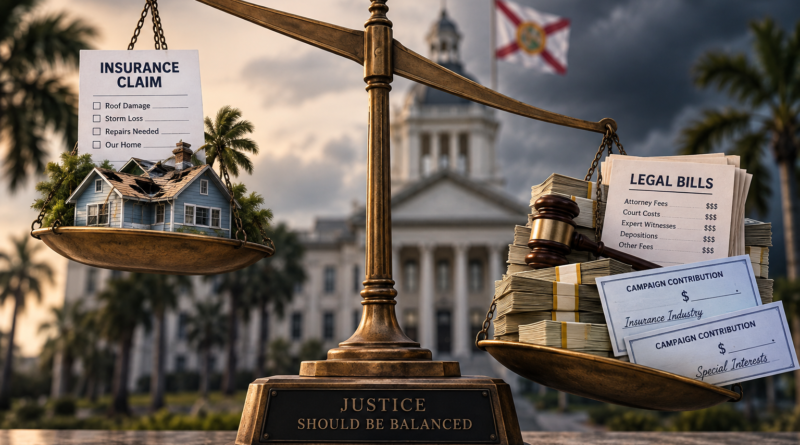
Then there is the campaign money. Tomkow’s contribution records show recurring support from insurers, insurance-industry organizations, civil-justice reform groups, and people tied directly to Florida’s insurance-policy world, including former Insurance Commissioner David Altmaier. This cycle alone, at least $2,500 has come from three interests closely connected to this issue.

No, campaign contributions do not come with thank-you notes for specific votes. But voters are entitled to look at the money, look at the voting record, and decide for themselves whether the two tell a story worth following.

Read more

Ken Gay’s Campaign For Hillsborough School Board Deserves a Much Closer Look

This entry is in the series 2026 Elections

Ken Gay brings nearly four decades of experience in Hillsborough County public schools to the District 6 School Board race. His long career gives voters plenty to respect. But a detailed candidate questionnaire offers a much fuller picture of the political and social views he would bring to the Board.

Gay identifies himself as a conservative Republican and has taken clear positions on school choice, transgender students, sex education, books, guns in schools, religion and the federal role in education. These are not assumptions about his politics. They come from answers Gay submitted himself.

His campaign finances add another layer. The campaign is largely self-funded, while a recently formed company called Faith in Policy has received a substantial share of Gay’s campaign spending. I took a closer look at Gay’s record, his own words and where his campaign money is coming from.

Read more

When “School Choice” Stops Meaning Public Education

This entry is in the series Education

Florida’s new Education Commissioner has said the state does not need to run schools at all. That raises a question that goes well beyond vouchers: what happens when “school choice” starts replacing the idea of public education itself?

Florida’s Constitution requires a system of free public schools. Yet an $8,000 voucher does not guarantee admission, does not guarantee a free education, and means something very different to a family that can add another $30,000 than it does to one that cannot. That is why the slogan “fund the student” leaves out so much.

At our Voices of Justice: Speak Up for Students program earlier this year, USF education policy professor Dr. Bill Black asked a simple question: “What is public in public education?” With Florida moving further toward publicly funded private education, that question deserves a much closer look.

Read more

Daniela Simic Has Been Preparing for This Job for Years

This entry is in the series 2026 Elections

Daniela Simic’s campaign is built around something school board races could use more of: deep experience with schools themselves. She has spent about 25 years in education, from the classroom to district leadership, with years of PTA and community work layered on top of it.

Her fundraising tells its own story. Simic and Brittany Lyssy have raised roughly the same amount from outside donors, but Simic reached that total through far more contribution transactions, a lower median donation, and broader support from individuals, educators, labor groups, and community organizations.

The race gives District 2 voters a clear factual comparison in background, donor base, and connection to Hillsborough’s schools. The full piece looks at Simic’s record, the people backing her, and the experience she brings to one of the largest school systems in the country.

Read more