
The Promise and the Pain of 250 Years
 Tomorrow, Americans will gather beneath fireworks, wave flags, sing patriotic songs, and celebrate the 250th anniversary of the Declaration of Independence.
I wish I could join that celebration with the same joy I felt fifty years ago, but I can’t.
The Bicentennial of 1976 is one of my happiest memories of growing up in Kings Mountain, North Carolina. I was 17, a high school junior, and a member of the marching band. For a town that proudly sits beside one of the earliest and most consequential American victories of the Revolutionary War, the nation’s 200th birthday was more than another holiday. It felt personal.
Each October, our town commemorates the Battle of Kings Mountain and the remarkable story of the Overmountain Men, frontier volunteers who crossed the Blue Ridge Mountains to intercept British Major Patrick Ferguson and helped change the course of the Revolution. In 1976, that annual celebration took on even greater significance. The reenactment drew larger crowds than ever. The parades seemed endless. The Vice President of the United States landed by helicopter at our high school to speak in the football stadium, and our band proudly performed for the occasion.
It was exhausting. It was exhilarating. And perhaps most importantly, it felt as though the entire country was celebrating together.
America was far from perfect in 1976. The Civil Rights Movement had won monumental victories, but equality remained unfinished work. LGBTQ Americans still lived under a cloud of fear and discrimination. Women continued fighting for opportunities that should never have required a fight. Religious minorities often found acceptance uneven at best.
But there was also a broad sense that we were, however imperfectly, moving toward the ideals our founders had declared two centuries earlier. The phrase “a more perfect Union” still sounded less like a slogan than a destination. Progress came slowly, unevenly, and often painfully, but it seemed to come, nonetheless.
Over the next fifty years, much of that promise appeared to be fulfilled. Americans gained greater freedom to worship according to conscience, to marry the person they loved, and to live more authentically than previous generations had imagined possible. Our understanding of equality broadened. Our appreciation for diversity deepened. While prejudice certainly never disappeared, open racism increasingly became something to condemn rather than celebrate.
We had not arrived. But we seemed to know which direction we were traveling.
Today, I am no longer certain that we are still moving in that direction.
I was raised to love this country. Until very recently, I felt a genuine swell of pride when the National Anthem was played or when “America the Beautiful” echoed through a sanctuary or stadium. Patriotism came naturally because I believed America’s story, despite its failures, was bent toward justice.
Today, my patriotism has become an act of grief because I no longer recognize the country’s direction.
I watch a President openly defy the law, Congress, and the courts while a compliant Supreme Court has granted him extraordinary immunity. No longer constrained by ethics, accountability, or even the appearance of shame, he and his family have become symbols of a level of self-enrichment and graft that would once have been unimaginable in the American presidency.
I watch legislatures weaken public education, concentrate power, and chip away at institutions designed to protect both liberty and accountability. I see fear replacing trust, cruelty masquerading as strength, and dissent increasingly portrayed not as an essential feature of democracy but as evidence of disloyalty.
Perhaps most painful of all, I see patriotism being redefined as loyalty to one man rather than fidelity to the Constitution and the principles that gave birth to this nation.
The Declaration of Independence was never a claim that America had achieved liberty and equality. It was a promise that each generation would be called to pursue them. Every great movement in our history, from abolition to women’s suffrage, from the Civil Rights Movement to the continuing struggle for equal dignity, has returned to those same remarkable words to remind us that our work was never finished. The founders gave us an aspiration. Every generation since has been asked whether it would move us closer to it or farther away.
This Fourth of July, I find myself wondering whether we are honoring that promise or abandoning it.
I know there are fellow Americans who see this moment very differently from me. Some believe our nation has finally been set back on the proper course. I cannot share that optimism. What saddens me most is not simply our political division. It is the realization that many people sincerely believe the erosion of constitutional norms, the concentration of power, and the abandonment of long-held democratic principles somehow represent patriotism.
That breaks my heart.
It is unlikely I will live to celebrate America’s 275th birthday, and I certainly will not be here for the tricentennial. I had hoped to leave this world believing our long national journey still pointed toward a more just and more inclusive democracy than the one I inherited as a child.
Instead, I find myself mourning what feels like a nation losing faith in its own highest ideals.
And yet…
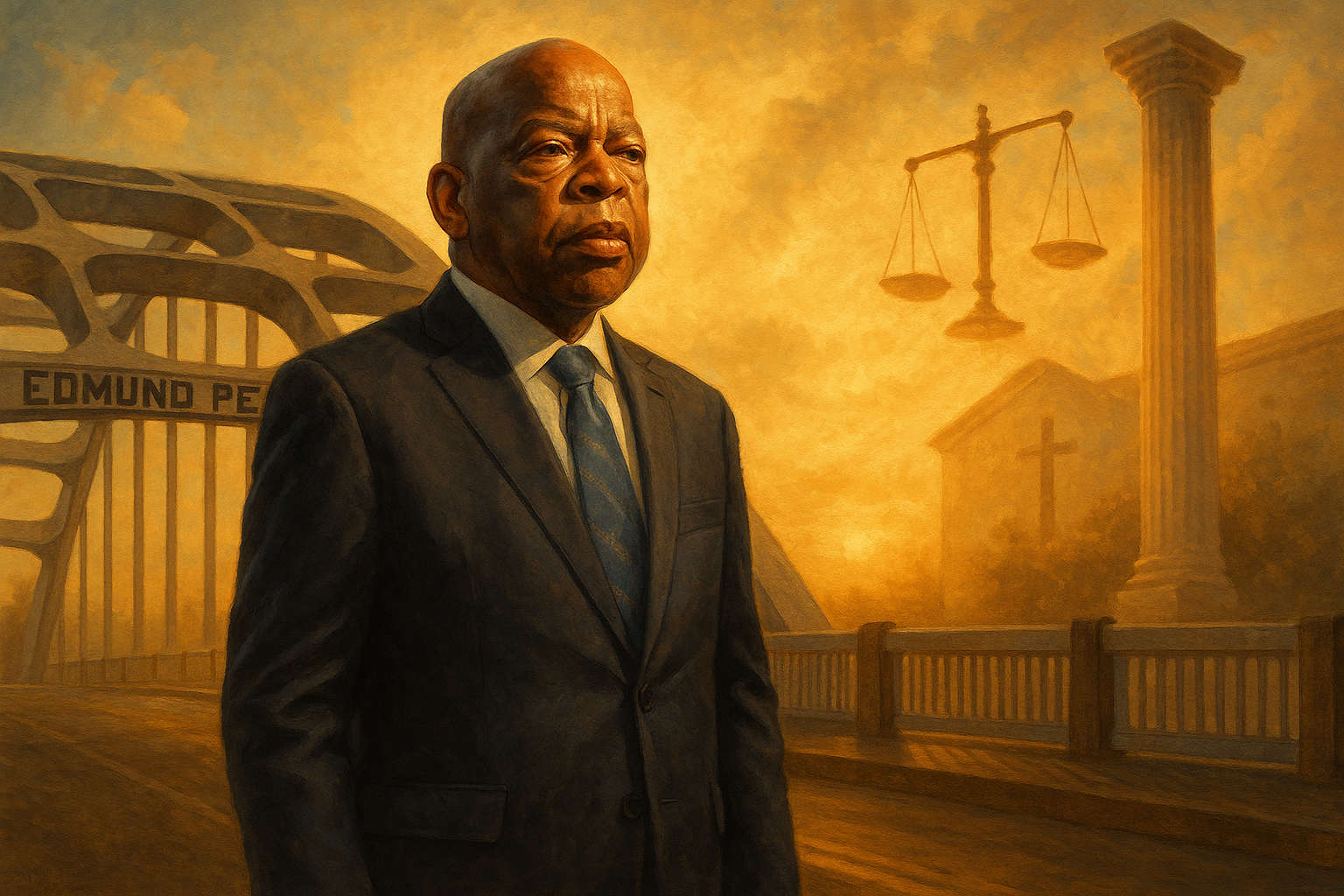
As I searched for words to close these reflections, I found myself returning to Congressman John Lewis. No one understood disappointment better than the man who crossed the Edmund Pettus Bridge knowing he would likely be beaten before he reached the other side. Yet near the end of his life, he offered this counsel:
“Do not get lost in a sea of despair. Do not become bitter or hostile. Be hopeful. Be optimistic. Never, ever be afraid to make some noise and get in good trouble, necessary trouble. We will find a way to make a way out of no way.”
I cannot honestly say I am optimistic today.
But perhaps hope is something different. Perhaps hope is not believing everything will somehow work out. Perhaps hope is simply refusing to surrender the promise made in Philadelphia two hundred and fifty years ago. It is refusing to let the Declaration become nothing more than an aging document admired for its prose but abandoned in its purpose.
If future generations once again gather with the excitement we felt in 1976, I hope it is because they chose to continue that unfinished work.
That would be an Independence Day worth celebrating.

Pingback:Deep Something | What Are We Going to Do Now?