
Mike Suarez Knows Insurance. That’s Why I Have Questions.
Mike Suarez makes a strong case for why Democrats should pick him for Florida House District 64. Florida faces an insurance crisis, and Suarez has spent over 30 years working in the industry. He now runs Suarez Insurance, Inc., and says his experience gives him the know-how to help fix the problem.
Fair enough. I would rather have legislators who understand the subjects they regulate. But experience also shows us where someone has spent a career, built relationships and earned a living. In Suarez’s case, his campaign finance reports are worth a closer look.
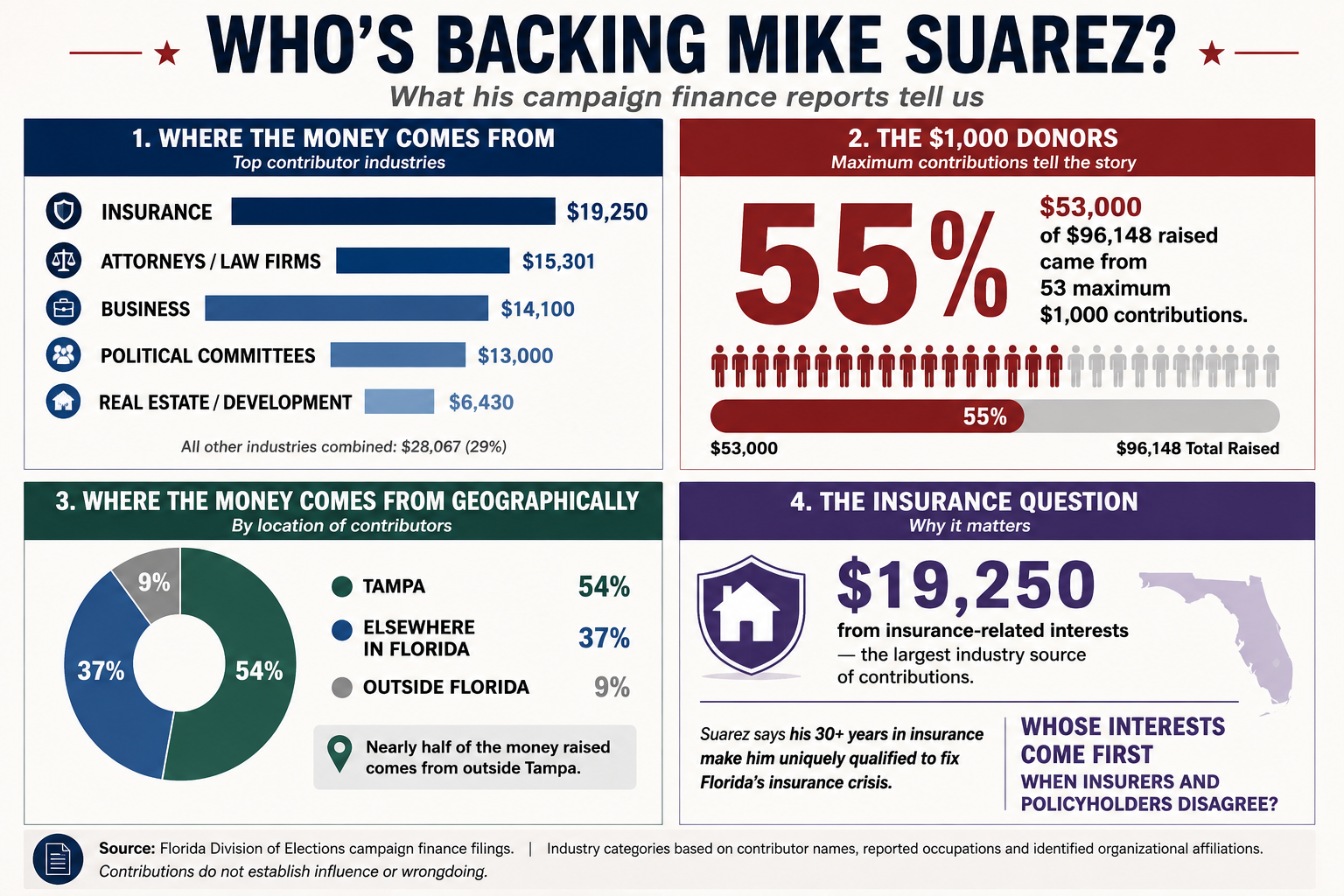
Suarez has raised about $96,148 from 255 reported contributions. Fifty-three were $1,000 contributions, accounting for $53,000, or about 55 percent of everything he raised. My analysis of his filings identified about $19,250 from insurance-related contributors, more than any other industry category. Attorneys and law firms accounted for roughly $15,300, business interests another $14,100, political committees $13,000, and real estate and development interests about $6,430.
Those figures require some care. Industry classifications involve judgment when contributor filings provide limited information. A campaign contribution also proves only that somebody gave money to a candidate. It does not prove what the donor expects in return.
Even so, political donations deserve attention because organizations usually spend money for a reason. PACs and trade groups mainly exist to push for their members’ interests. When they give to candidates, they’re choosing people they think will support their priorities.
Some of Suarez’s biggest donors include the Florida Insurance Council/Travelers Companies and Tower Hill Insurance Group. Associated Industries of Florida, which calls itself “The Voice of Florida Business,” has endorsed him in the Democratic primary. AIF praised his insurance background and said it looks forward to his support on business policies. Suarez replied that he looks forward to working with AIF.1 Both sides seem open about their connection.
So let’s get back to insurance.
When your livelihood has depended for decades on a particular industry, and people and organizations tied to that same industry contribute significantly to your campaign, voters have every right to ask whose interests will carry the most weight when the two sides disagree.
This question matters because the interests of insurance companies and policyholders do not always line up. An insurer needs to limit losses, control claims costs and remain profitable. A homeowner needs coverage that pays out when disaster hits and premiums they can afford. Sometimes good policy helps both sides, but sometimes lawmakers in Tallahassee have to pick one over the other.
Florida homeowners don’t need another seminar on why insurance is complicated. They feel the problem every time they get a renewal notice. Drivers know it when their car insurance bill is due. For anyone running to represent them in Tallahassee, the question is simple: What will you do to lower those bills?
Suarez argues that his insurance career makes him especially qualified to tackle Florida’s insurance crisis. Maybe it does. But having expertise and being independent are not the same thing.
If Suarez wants voters to treat three decades in insurance as a qualification for office, then his relationship with the insurance industry is also fair grounds for scrutiny. He cannot reasonably ask voters to count the experience while ignoring the ties that came with it.
So I want specifics. If legislation would lower premiums or boost consumer protections but add costs or rules for insurers, where would Mike Suarez stand? Which recent Florida insurance laws does he think missed the mark? What would he do differently? And what real drop in homeowners or auto insurance bills should voters expect from his policies?
Making homes stronger against hurricanes can cut losses and is good policy. Helping insurers stay financially stable can also be worthwhile. But neither one guarantees that homeowners will pay less when they get their next renewal notice.
Suarez isn’t new to politics. He spent eight years on Tampa City Council, including time as chair and as chair of HART. After term limits, he ran for mayor in 2019 and finished sixth in the first round. He tried to return to City Council in 2023 but lost. Now he’s running for the Florida House.2
There is nothing inherently wrong with wanting to keep serving in public office. Voters can judge for themselves what his record says about experience, ambition, and public service.
For me, the campaign finance report makes the decision more interesting. PACs, trade groups, and companies get involved in politics because public policy affects them. That’s their right. It’s our right to look at who funds candidates and ask what those donors want from Tallahassee.
Mike Suarez says his background in insurance makes him especially qualified to help solve Florida’s insurance crisis.
That means his insurance experience is part of his pitch to voters. His financial and professional ties to the industry should be part of the discussion as well.
The question isn’t whether Mike Suarez understands insurance. I’m quite sure he does.
The real question is whose interests his knowledge will serve when Florida’s insurance companies and policyholders want different things.
