The Books They Don’t Want Our Children to Read
Growing up, I didn’t have books that helped me understand who I was. People rarely talked openly about being gay,
Read more
The site for ranting and reporting by John Masters
This category is used when the post relates to actions by the Florida Legislature.

Growing up, I didn’t have books that helped me understand who I was. People rarely talked openly about being gay,
Read more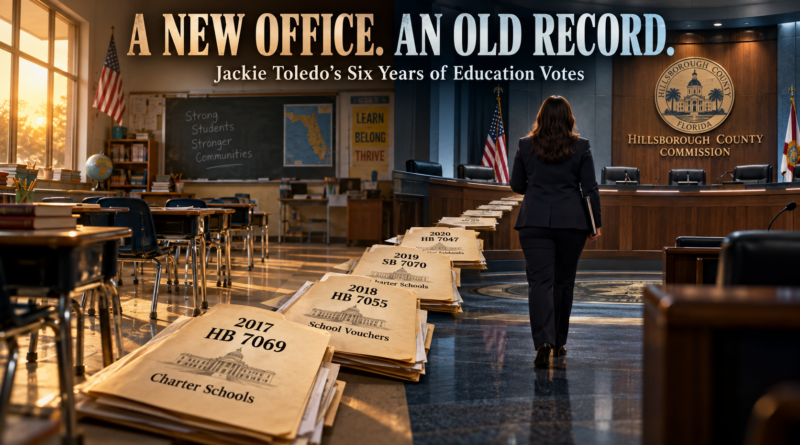
Jackie Toledo spent six years in the Florida House, where she repeatedly supported legislation expanding charter schools and private-school scholarship programs. Her voting record shows how Florida’s school-choice system grew during her time in Tallahassee.
The changes came almost every year. In 2017, Toledo supported legislation to expand charter schools and share certain local school construction funds with them. By 2021, she had also voted to create and expand the Family Empowerment Scholarship, broaden eligibility, and increase scholarship awards. Meanwhile, traditional public schools remained responsible for educating every enrolled child.
Now Toledo wants to serve on the Hillsborough County Commission. Her legislative record raises questions about her approach to public funding and local responsibility. The full article follows five years of education legislation and examines the choices she made along the way.
Read more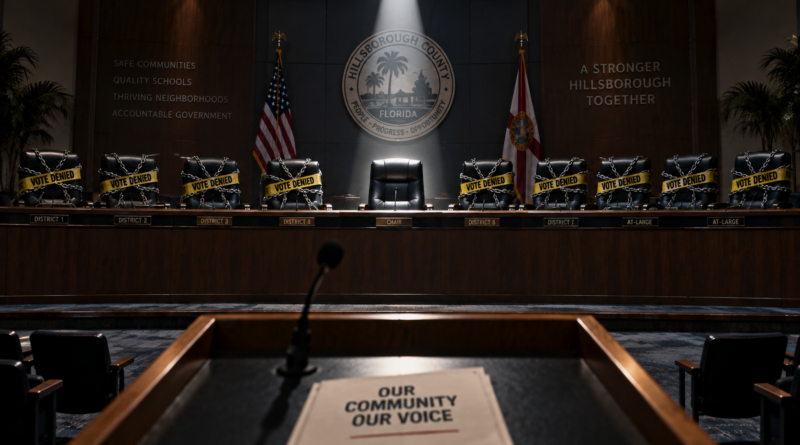
If someone came to your door and offered to trade four hundred-dollar bills for a ten-dollar bill, you would quickly close the door and check your security cameras. That is exactly the kind of deal behind Hillsborough County Charter Referendum 2, a Tallahassee plan that would undo forty years of balanced local government.
For forty years, Hillsborough has used a mix of four district commissioners and three countywide at-large commissioners. This lets every voter choose four out of seven seats, giving people a say in the majority. Referendum 2 would end this system by expanding the board to nine and removing all at-large seats.
Think about what this means for your representation. You would go from voting for four commissioners to just one. You would not be able to vote for or against the other eight, even though they decide on taxes, infrastructure, and big development projects. Single-member districts encourage commissioners to trade favors for their own areas and ignore countywide needs like Port Tampa Bay and regional transit.
Tallahassee politicians love to lecture local communities about neighborhood control while quietly shrinking our democratic leverage from afar. Read the full commentary to see why trading away four seats for one is a bad trade for Hillsborough taxpayers, and why we must vote No on Charter Referendum 2.
Read more
Imagine Tampa General Hospital announcing that it will now select its President and CEO through a countywide partisan primary. Picture candidates debating surgical protocols on debate stages, taking a full year off to solicit campaign checks from medical supply reps, and catering to partisan party bosses instead of patient care. No board of trustees would tolerate it, and no major health system would survive it. Yet that is the exact circus Tallahassee politicians want to bring to Hillsborough County Public Schools, the single largest employer in our community.
Proponents dress up the proposal in the language of parental rights and democratic empowerment. But under the current model, the superintendent answers to an elected, seven-member School Board every single day. If the superintendent mishandles district finances, botches bus routes, or mismanages schools, the board can act immediately. Under an elected system, that daily accountability vanishes. The School Board loses its supervisory power, leaving a single partisan politician in charge of a $4 billion budget and 220,000 students, answerable to voters only once every four years.
An even bigger problem is the smaller pool of candidates. Instead of searching the country for experienced school leaders, we would be limited to local registered voters. The best-performing states treat school administration as a professional job, while the only two states that still elect superintendents are not among the top performers.
Injecting culture-war primaries and campaign fundraising into our school system’s executive suite is a disaster waiting to happen. Read the full analysis on why turning school administration into a political prize hurts our students, undermines teachers, and destabilizes our local schools.
Read more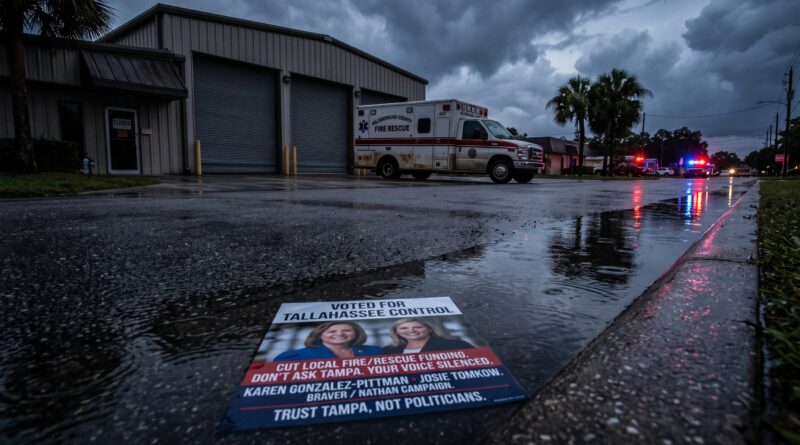
Every politician knows that promising a giant tax cut is an easy way to win an applause line. Florida Amendment 3 dangles that exact bait, promising homeowners an expanded homestead exemption and tighter assessment caps. It sounds like an effortless win until you calculate what actually pays for the fire rescue station down the street.
State analysts project this measure will strip over $8 billion from local budgets across Florida in a single year. That is not trimming bureaucratic fat; it is a fiscal sledgehammer aimed directly at 911 dispatchers, sheriff’s deputies, paramedics, and neighborhood road repairs. When both the Florida Sheriffs Association and statewide firefighter unions sound the alarm, voters need to look past the political marketing.
Because essential emergency services cannot simply be shut down, local communities will be forced to raise utility fees and regressive sales taxes to survive. That leaves working families, retirees on fixed incomes, and renters footing the bill for a tax break they will never see. Read the full analysis on why defunding your local first responders is too high a price to pay for a campaign slogan.
Read more
The television commercials for Florida Amendment 2 are almost entirely self-written. All you have to do is play the acoustic guitar, show the video of a dusty tractor, and then tell the heartwarming tale of a fourth-generation family farmer who is struggling. Although the story is touching, the sentimental presentation covers up a costly performance by the corporation.
Florida businesses currently have a standard exemption of $25,000 for tangible personal property, which covers a significant portion of the equipment needed by genuine small-scale growers. The main benefit of Amendment 2, however, goes to industrial agribusiness syndicates, huge commercial packing houses, and luxury agritourism event venues that operate fleets of machinery costing six figures.
When Tallahassee eliminates equipment taxes on commercial agricultural land, those multi-ton transport trucks do not stop chewing up county roads. The bill simply shifts. County commissions are left to either gut local services or force residential homeowners to make up the difference. Read the full breakdown of how Amendment 2 puts corporate welfare in overalls and leaves local taxpayers holding the tab.
Read more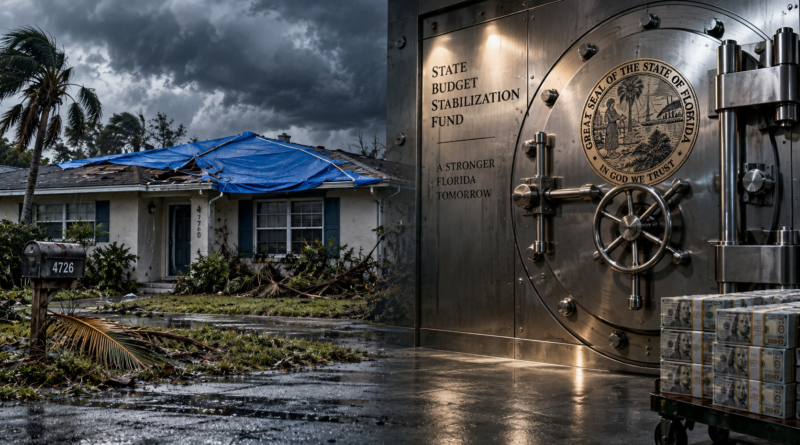
Tallahassee politicians often present Florida Amendment 1 as basic common sense. After all, who would argue with saving for a rainy day? But there’s a big difference between keeping an umbrella handy and locking away billions while your ceiling is falling in.
If you drive through Hillsborough County, you’ll see blue tarps still on roofs from storms years ago. Homeowners are struggling with high insurance costs, classrooms have broken air conditioners, and stormwater ditches need repairs. Yet Amendment 1 would require up to $750 million a year to be set aside in Tallahassee until the fund reaches 25 percent of general revenue.
Florida already has a fully funded emergency reserve at 10 percent. Forcing billions more into storage isn’t smart budgeting; it’s a way to cut local spending now so politicians can brag about a big balance later. Read the full essay to see why we should fix our roofs before Tallahassee builds another vault.
Read more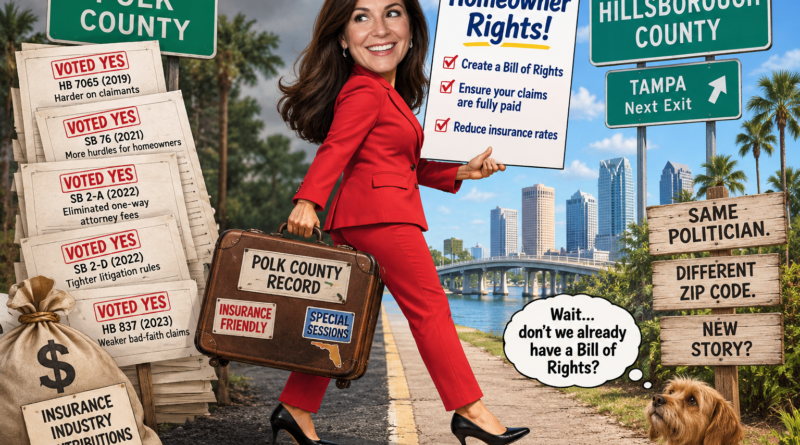
Josie Tomkow says she wants to create a Homeowner Claims Bill of Rights and make sure insurance claims are fully paid. This sounds reassuring, especially in a state where rising premiums and storm losses have made things tough for homeowners. There is just one awkward detail: Florida already has a Homeowner Claims Bill of Rights. Even more, Tomkow spent years voting for laws that made it harder and more expensive for policyholders to challenge insurers when claims were denied or underpaid.
Campaign records also show ongoing support for Tomkow from insurance companies, industry groups, civil-justice organizations, and a former Florida Insurance Commissioner who now works in insurance advisory.
So is this a real change of heart, or just a shift for campaign season? Her voting record, contribution history, and new promises make it worth taking a closer look.
Read more
Michael Owen sits where Florida’s property insurance laws are shaped: the House Insurance & Banking Subcommittee. His campaign finance reports also show substantial support from insurance companies, insurance political committees, agents’ groups, and lobbyists. The article examines that money alongside the choices he has made in office.
Owen has shown no shortage of legislative ambition when Hillsborough County government is involved. He sponsored HB 4027, which puts an elected school superintendent before Hillsborough voters, and HB 4029, which would substantially restructure the County Commission. Both measures passed the Legislature and require local voter approval.
That leaves a harder question. With homeowners still confronting steep insurance bills, what has Owen used his seat on Insurance & Banking to do for them? The campaign money does not answer that question by itself, but it makes his legislative record worth examining closely.
This article follows the money, looks at where Owen has chosen to spend his political capital, and asks what those priorities tell District 70 voters about whose concerns are getting attention in Tallahassee.
Read more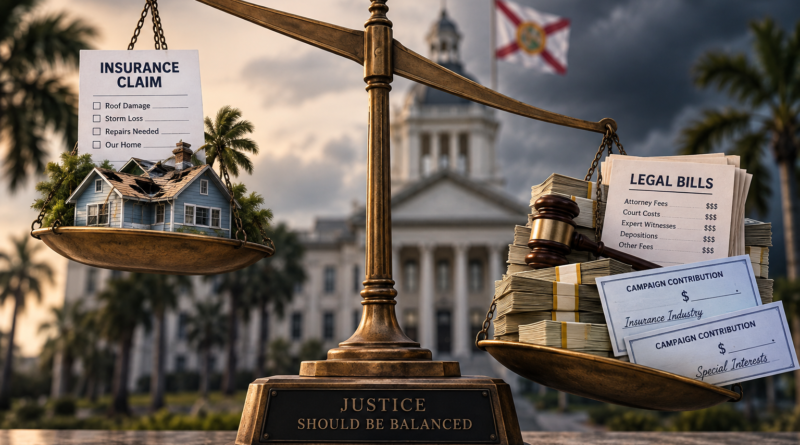
Florida homeowners have heard “insurance reform” so often that the phrase almost deserves its own ZIP code. But behind that label were years of very real changes to what happens when an insurance company denies or underpays a claim and a homeowner has to fight back.
Josie Tomkow voted yes, again and again, as Florida changed the rules around lawsuits, attorney fees, assignment-of-benefits claims, and insurer liability. Those laws may sound technical, but their effect can be painfully simple: even when policyholders have a valid dispute, taking an insurer to court can now carry more financial risk.
Then there is the campaign money. Tomkow’s contribution records show recurring support from insurers, insurance-industry organizations, civil-justice reform groups, and people tied directly to Florida’s insurance-policy world, including former Insurance Commissioner David Altmaier. This cycle alone, at least $2,500 has come from three interests closely connected to this issue.
No, campaign contributions do not come with thank-you notes for specific votes. But voters are entitled to look at the money, look at the voting record, and decide for themselves whether the two tell a story worth following.
Read more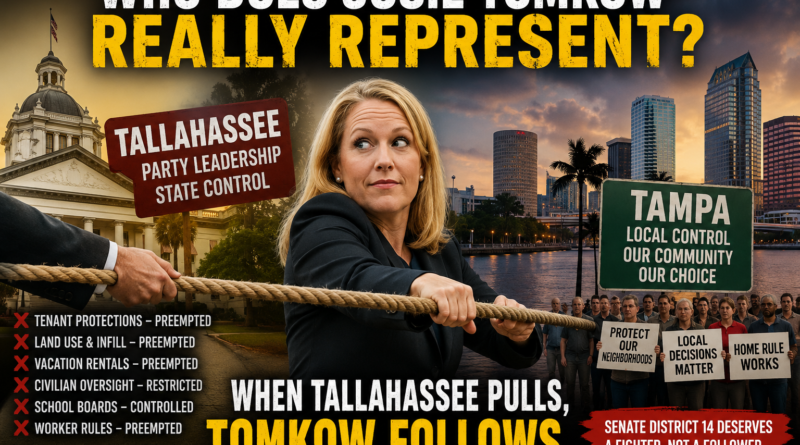
When Josie Tomkow had the chance to support local communities, she chose Tallahassee instead. This pattern appears throughout her House voting record: tenant protections, land use, infill development, vacation rentals, civilian oversight, worker rules, and school-board governance all go the same way.
This matters because Tomkow now wants to represent Senate District 14, which includes Tampa and Hillsborough County. But her record comes from somewhere else, and it raises an important question for voters here: when local needs clash with party leadership, whose side will she choose?
Her votes seem to answer. Even when another Hillsborough Republican voted no on a major preemption bill, Tomkow voted yes. So the question is not whether she can learn Tampa’s concerns. The question is whether she has already shown us who gets her vote when Tallahassee comes calling.
Read more