When the Culture War Comes for the School Board

This entry is in the series Education
This entry is in the series 2026 Elections

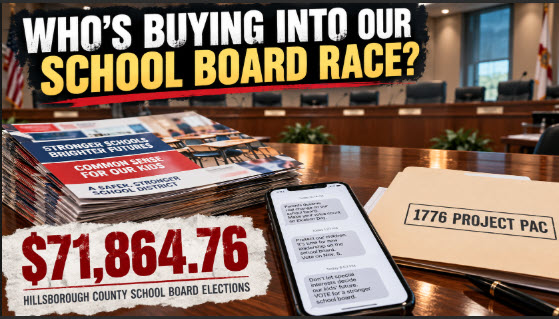
The 1776 Project PAC says it is deeply concerned about reading scores. Fair enough. It also wants school-board candidates to answer for CRT, DEI, social-emotional learning, gender policy, and whether they will replace “equity-based” curriculum. Apparently phonics now comes with a political questionnaire.

The group has endorsed exactly one Hillsborough County School Board candidate: Brittany Lyssy. It has also reported nearly $72,000 in Hillsborough school-board spending on texting, mail production, and postage. That is a lot of national political money for a race that is supposed to be nonpartisan.

So the obvious question is not whether the 1776 Project cares about schools. It clearly does. The question is what kind of school board it wants to build here, and what it expects from the only Hillsborough candidate it chose to support.

Read more

Stacy Hahn Helped Bring Tallahassee’s Culture War Into Hillsborough Schools

This entry is in the series 2026 Elections

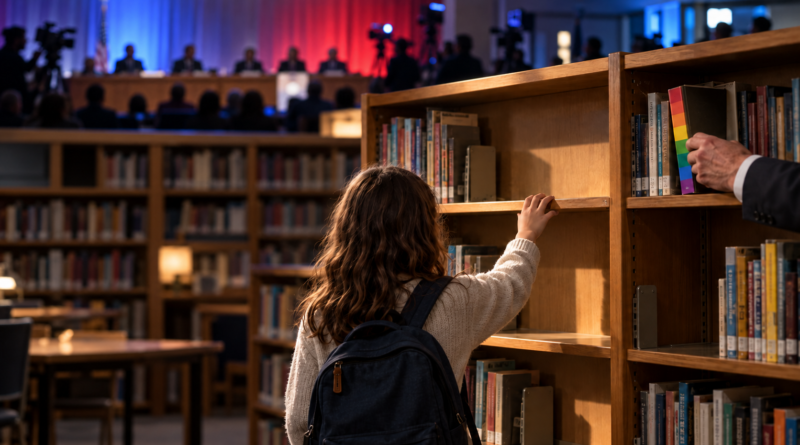
Stacy Hahn was not just caught up in Florida’s education culture war. She chose a side again and again. She stood with Gov. Ron DeSantis as he called book bans a “hoax,” voted to remove books even when review committees recommended keeping them, and was the only one to vote against a School Board proclamation for Pride Month.

Her record also shows the problem with the phrase “parental rights.” Parents could already limit what their own children checked out. Hahn supported something else: letting some parents decide what all families’ children could read. It seems parental rights only matter until a parent disagrees with Stacy Hahn.

This is personal for me. When I was growing up gay, I had no books to help me understand my feelings or to show me I was not alone. Somewhere in Hillsborough County, a child needs that same reassurance now. Censorship does not feel any softer to children just because it comes from someone with a doctorate and a pleasant smile.

Read more

The Books They Don’t Want Our Children to Read

This entry is in the series Hate Groups
This entry is in the series Deep Questions
This entry is in the series Florida Legislature
This entry is in the series 2026 Elections

Growing up, I didn’t have books that helped me understand who I was. People rarely talked openly about being gay,

Read more

Birds of a Feather

This entry is in the series 2026 Elections
This entry is in the series Education

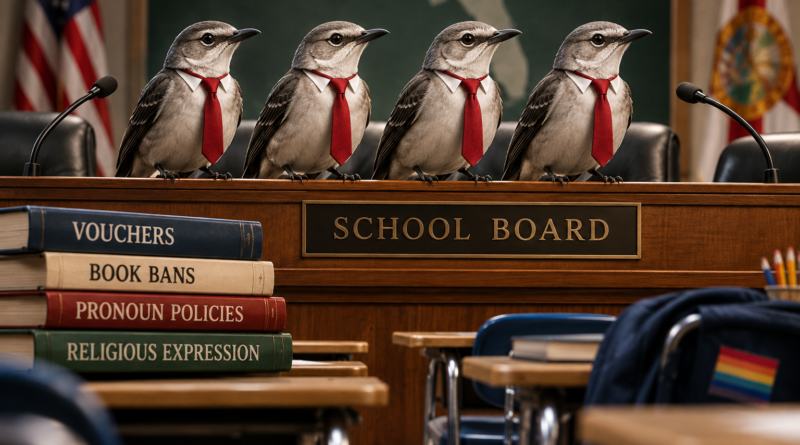
Ken Gay’s latest supporter graphic features Republican state representatives Danny Alvarez, Traci Koster and Michael Owen. Once you look at their education records, the endorsements require very little explanation. Alvarez and Koster backed Florida’s expansion of private-school scholarships and HB 1069, with its restrictions on sexual-orientation and gender-identity instruction and pronoun use. Owen has supported similar school-choice policies and legislation expanding religious expression in public schools.

The consequences of those LGBTQ-related policies are harder to shrug off as another Tallahassee culture-war hobby. Trevor Project research found that LGBTQ+ students attending schools with even one anti-LGBTQ+ policy reported higher rates of anxiety, depression and suicide attempts. Its 2023 research also found lower suicide-attempt rates among students with affirming school supports, including teachers who respected transgender and nonbinary students’ pronouns. Apparently, treating children with dignity has measurable benefits. Who knew?

So “birds of a feather” seems an apt description of the policy overlap. The same group supporting Gay has repeatedly backed moving education dollars toward private alternatives while supporting restrictions that fall particularly hard on LGBTQ+ students. The question behind the endorsements is worth examining: what does that agenda mean inside a public-school system charged with educating every child who walks through its doors?

Read more

Jackie Toledo’s Romance With “School Choice” – Right Temperament for County Commission?

This entry is in the series 2026 Elections

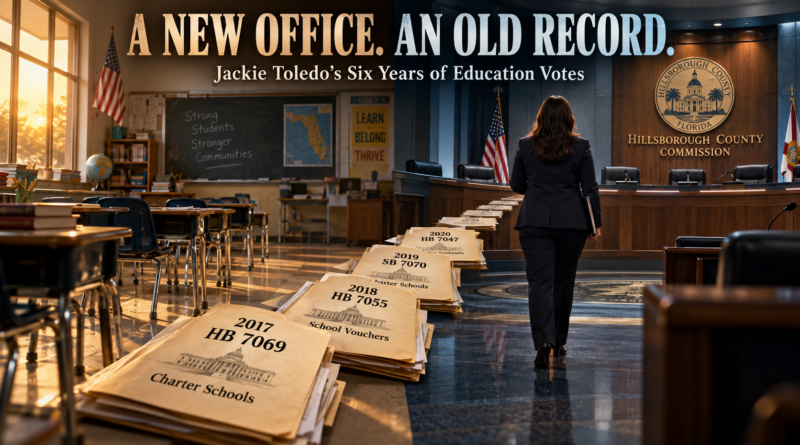
Jackie Toledo spent six years in the Florida House, where she repeatedly supported legislation expanding charter schools and private-school scholarship programs. Her voting record shows how Florida’s school-choice system grew during her time in Tallahassee.

The changes came almost every year. In 2017, Toledo supported legislation to expand charter schools and share certain local school construction funds with them. By 2021, she had also voted to create and expand the Family Empowerment Scholarship, broaden eligibility, and increase scholarship awards. Meanwhile, traditional public schools remained responsible for educating every enrolled child.

Now Toledo wants to serve on the Hillsborough County Commission. Her legislative record raises questions about her approach to public funding and local responsibility. The full article follows five years of education legislation and examines the choices she made along the way.

Read more

The Ballot-Box Bureaucrat: Why Electing Hillsborough’s Superintendent Is Bad for Business and Worse for Classrooms

This entry is in the series Education
This entry is in the series Florida Amendments and Referenda-2026
This entry is in the series 2026 Elections

Imagine Tampa General Hospital announcing that it will now select its President and CEO through a countywide partisan primary. Picture candidates debating surgical protocols on debate stages, taking a full year off to solicit campaign checks from medical supply reps, and catering to partisan party bosses instead of patient care. No board of trustees would tolerate it, and no major health system would survive it. Yet that is the exact circus Tallahassee politicians want to bring to Hillsborough County Public Schools, the single largest employer in our community.

Proponents dress up the proposal in the language of parental rights and democratic empowerment. But under the current model, the superintendent answers to an elected, seven-member School Board every single day. If the superintendent mishandles district finances, botches bus routes, or mismanages schools, the board can act immediately. Under an elected system, that daily accountability vanishes. The School Board loses its supervisory power, leaving a single partisan politician in charge of a $4 billion budget and 220,000 students, answerable to voters only once every four years.

An even bigger problem is the smaller pool of candidates. Instead of searching the country for experienced school leaders, we would be limited to local registered voters. The best-performing states treat school administration as a professional job, while the only two states that still elect superintendents are not among the top performers.

Injecting culture-war primaries and campaign fundraising into our school system’s executive suite is a disaster waiting to happen. Read the full analysis on why turning school administration into a political prize hurts our students, undermines teachers, and destabilizes our local schools.

Read more

Brittany Lyssy’s School-Board Training Network Deserves a Closer Look

This entry is in the series 2026 Elections
This entry is in the series Education

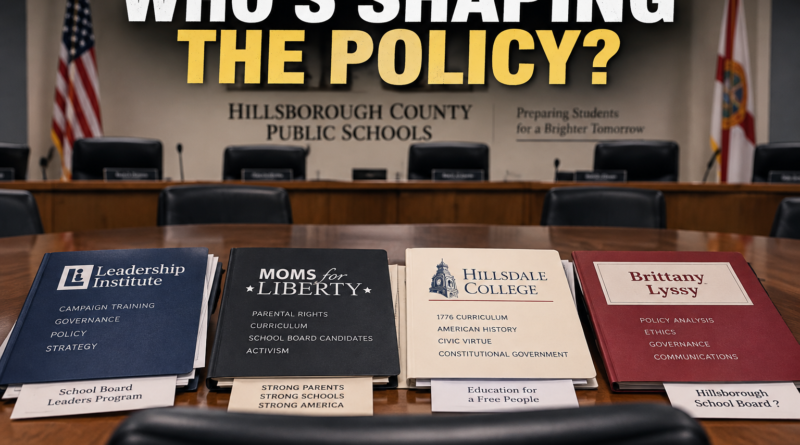
Brittany Lyssy cites her work with the Leadership Institute’s School Board Leaders Program as part of her education-policy experience. A closer look at that program shows a national conservative network built around recruiting, training, and supporting school-board candidates, with direct connections to Moms for Liberty and to policy resources from Hillsdale College and the Heritage Foundation.

One connection deserves particular attention. Bridget Ziegler, an early figure in Moms for Liberty, served in leadership of the same Leadership Institute school-board program where Lyssy worked on communications, policy analysis, ethics, and governance. Public records do not show that Lyssy belonged to Moms for Liberty or adopted every position promoted within that network, but the institutional ties are clear enough to warrant scrutiny.

The larger question is what parts of that philosophy Lyssy would bring to Hillsborough. The full article follows the connections among the Leadership Institute, Moms for Liberty, Hillsdale, Ziegler, and Lyssy’s own policy background, then asks what voters should examine before deciding how much those ties matter.

Read more

Let’s Run A Real Education Experiment

This entry is in the series Education

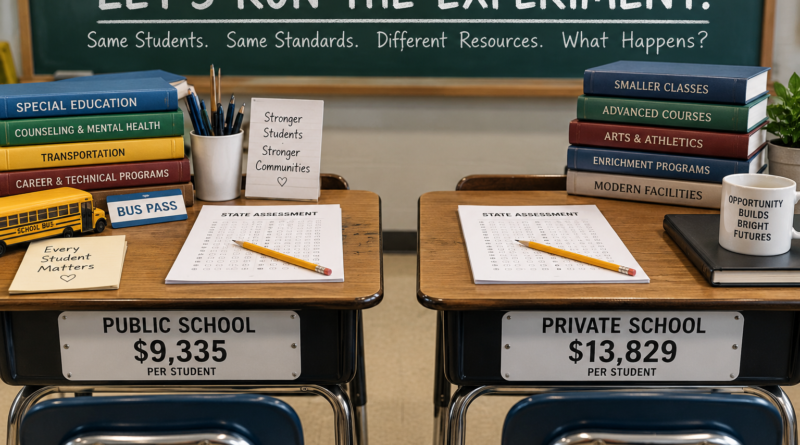
Florida spends about $9,335 per public-school student through its main funding formula. Average private-school tuition is about $13,800. So before we decide private schools produce better results, there is a question worth testing: what would happen if public schools had comparable resources?

The comparison gets more complicated because public and private schools often operate under different rules. Public schools serve students with widely different needs, provide transportation and specialized services, and operate under statewide testing and accountability requirements. Private schools receiving voucher money have different admissions, staffing, testing, and service obligations.

Research does not provide a simple answer that one system always produces better outcomes. Some private-school and voucher programs show gains, others show little difference, and some have produced worse academic results. Once researchers account for differences in family income, parental education, previous achievement, and other factors, much of the apparent private-school advantage can shrink.

So the essay proposes a thought experiment: fund public schools at something close to average private-school tuition while keeping their public obligations intact, or run the test in reverse by asking voucher schools to educate students for the voucher amount under comparable standards. Maybe the real difference is not public versus private education. Maybe it is what happens when one kind of school is simply better funded.

Read more

Some Things Should Not Be Run for Profit

This entry is in the series Education

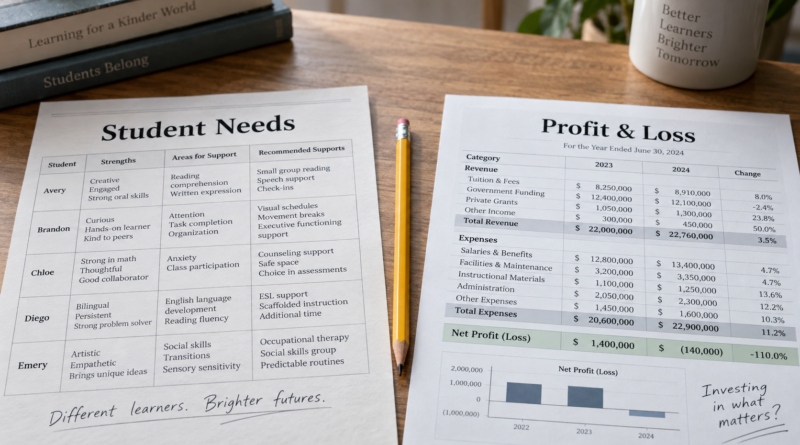
What if the biggest mistake in Florida’s education debate is assuming schools should work like ordinary businesses?

Markets reward efficiency, control costs, and give consumers choices. Public education has a different job. It has to serve every child, including the student who needs far more support, the student who needs advanced opportunities, and the student whose family could never afford to buy those services on its own.

That is why I think the debate over vouchers and school choice has to go deeper than whether competition can improve some outcomes. The real question is whether K-12 education should be organized around market incentives at all.

In this essay, I look at what happens when we confuse efficiency with public duty, and why some things may work better when the goal is not profit, but making sure everyone is served.

Read more

Ken Gay’s Campaign For Hillsborough School Board Deserves a Much Closer Look

This entry is in the series 2026 Elections

Ken Gay brings nearly four decades of experience in Hillsborough County public schools to the District 6 School Board race. His long career gives voters plenty to respect. But a detailed candidate questionnaire offers a much fuller picture of the political and social views he would bring to the Board.

Gay identifies himself as a conservative Republican and has taken clear positions on school choice, transgender students, sex education, books, guns in schools, religion and the federal role in education. These are not assumptions about his politics. They come from answers Gay submitted himself.

His campaign finances add another layer. The campaign is largely self-funded, while a recently formed company called Faith in Policy has received a substantial share of Gay’s campaign spending. I took a closer look at Gay’s record, his own words and where his campaign money is coming from.

Read more

When “School Choice” Stops Meaning Public Education

This entry is in the series Education

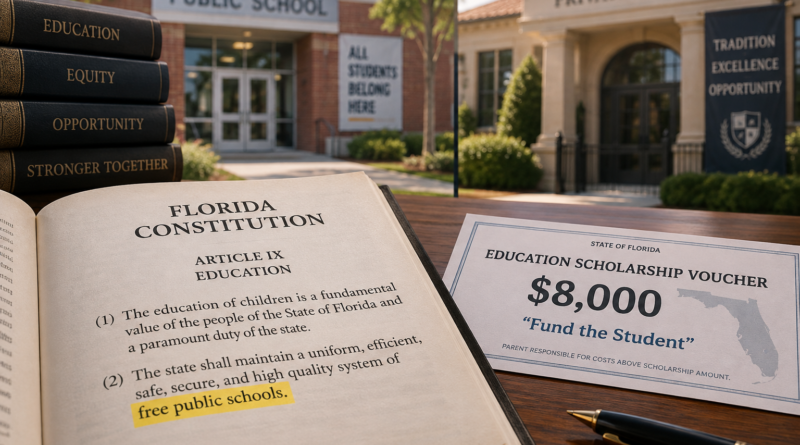
Florida’s new Education Commissioner has said the state does not need to run schools at all. That raises a question that goes well beyond vouchers: what happens when “school choice” starts replacing the idea of public education itself?

Florida’s Constitution requires a system of free public schools. Yet an $8,000 voucher does not guarantee admission, does not guarantee a free education, and means something very different to a family that can add another $30,000 than it does to one that cannot. That is why the slogan “fund the student” leaves out so much.

At our Voices of Justice: Speak Up for Students program earlier this year, USF education policy professor Dr. Bill Black asked a simple question: “What is public in public education?” With Florida moving further toward publicly funded private education, that question deserves a much closer look.

Read more