
Real Waste, Fake Waste, and Things Republicans Just Don’t Like

This entry is in the series Hillsborough DOGE Report Analysis

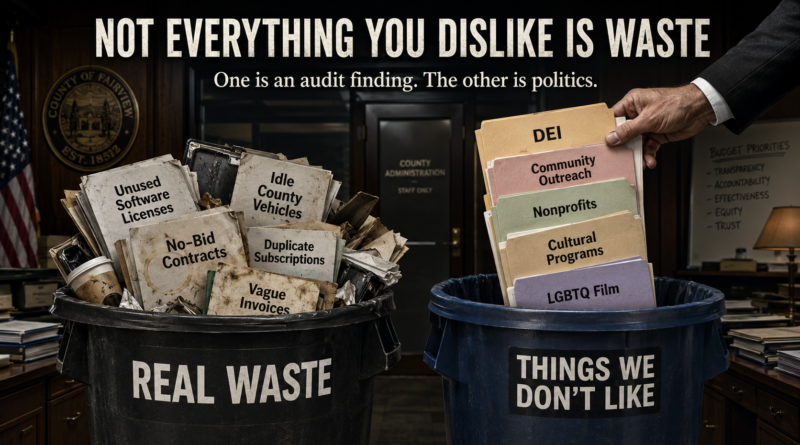
Not every proposed cut is the same. Unused software licenses, underused vehicles, vague contracts, and weak bidding rules are real places to look for waste.

But the Hillsborough County DOGE report also targets nonprofits, equity work, community outreach, and cultural programs. In this essay, I separate genuine control problems from programs that appear to have been labeled “waste” because committee members do not like their purpose.

Political opposition is fair. Calling it financial analysis is not.

Read more

Cutting a Program Is Not the Same as Making Government Efficient

This entry is in the series Hillsborough DOGE Report Analysis

The Hillsborough County DOGE committee calls the county health care plan a source of major savings. But ending care for more than 22,000 low-income residents is not the same as making government more efficient.

This essay looks at what the program actually does, why voters approved the tax that funds it, and what happens when needed care disappears from one budget line only to reappear in emergency rooms, hospitals, charities, and family finances.

Cutting a program may make a spreadsheet look better. The harder question is whether the community pays more when the service is gone.

Read more

They Did Not Find $678 Million in Waste

This entry is in the series Hillsborough DOGE Report Analysis

The Hillsborough County DOGE committee says it found roughly $678 million in potential savings. That sounds impressive, until you look at what the number actually includes: entire public programs, contract limits, fund balances, possible management changes, and spending choices committee members simply do not support.

In my latest essay, I take a closer look at the report and the difference between finding real waste and labeling any disliked program as waste. The committee may have raised some fair questions about fleet use, software licenses, contracts, and oversight. But cutting a service is not the same as making government more efficient, and a large number is not proof.

Read more

The Price of Political Playacting: Michael Owen’s Assault on Hillsborough Schools

This entry is in the series 2026 Elections

Hillsborough County Public Schools, the seventh-largest district in the nation, is facing a top-down assault disguised as “local accountability.” State Representative Michael Owen’s House Bill 4027 calls for a referendum to eliminate our professionally appointed superintendent in favor of a partisan elected office. The schools are already governed by an elected board of education. This change is not about transparency; it is a calculated effort to force a toxic culture-war agenda into our local classrooms and strip our school system of seasoned, professional leadership.

The structural fallout of this power grab is devastatingly clear. Instead of an experienced educational administrator focused on student performance, our district risks being handed over to a political partisan. Under an elected model, policy decisions on curriculum, budgeting, and student safety will inevitably bow to the need for campaign survival, turning every fourth year into a multi-million-dollar reelection spectacle. This essay shows how Owen’s legislative overreach, paired with his habit of distorting local facts for political points, threatens the shared institutions our children rely on.

Read more

Is Karen Gonzalez-Pittman Representing South Tampa or Tallahassee?

This entry is in the series 2026 Elections

Karen Gonzalez-Pittman represents South Tampa, but her voting record raises a fair question: is she representing this community, or carrying Tallahassee’s agenda back home? Again and again, she has voted for bills that take decision-making power away from local governments, local school boards, and local voters.

From housing and tenant protections to infill redevelopment, school policy, civilian oversight, and local employment standards, Gonzalez-Pittman has sided with state preemption over home rule. For South Tampa, where traffic, flooding, housing pressure, schools, and neighborhood character are intensely local concerns, that record deserves much closer scrutiny.

Read more

The Architecture of Abandonment: The Performance of Josh Wostal

This entry is in the series 2026 Elections

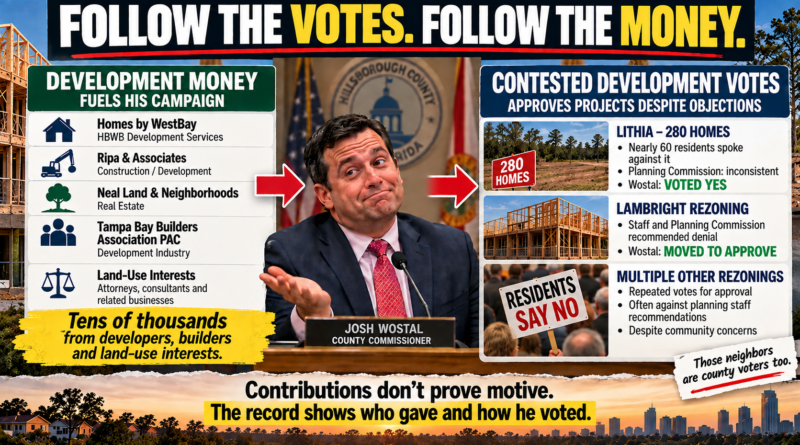
In the sterile halls of the Hillsborough County Center, he is known as “Hostile Wostal”—a man who treats the public treasury like a distressed asset ripe for liquidation. While he preens for social media as a fiscal hawk, his actual record is a masterclass in calculated abandonment, trading essential bus routes in South County for high-end sprawl subsidies that line the pockets of mega-developers like Lennar and Homes by WestBay. It isn’t “saving” when you strip the foundation of a community to pave the private driveways of the donor class; it is patrimonialism disguised as prudence.

Wostal’s governance is a performance of cruelty, evidenced by his crusade to defund the Supervisor of Elections and dismiss 100,000 of our neighbors as mere “ghost voters.” This isn’t about the bottom line; it is about rigging the game by silencing the voices he can’t win over. From stranding essential workers on the roadside to attacking the ballot box, Wostal has shown us that he knows the price of everything but the value of nothing. It is time to decide if we want a county that serves its people, or a family business that serves only its patrons. Follow the paper trail and learn more about how we can build a Hillsborough that belongs to everyone.

Read more

Why Josie Tomkow is Wrong for Tampa

This entry is in the series Florida Legislature
This entry is in the series 2026 Elections

For decades, the “Home Rule” philosophy was the bedrock of Florida governance—the common-sense idea that the people who live in South Tampa and Northwest Hillsborough are better equipped to run their communities than a bureaucrat in a distant capital. But after the 2026 Legislative session, that principle isn’t just under attack; it’s being systematically dismantled. At the center of this power grab is Representative Josie Tomkow, a Polk County resident now seeking to represent Senate District 14. While her campaign paints a picture of “common sense” leadership, her voting record tells a different story: one of a reliable “yes-man” for a Tallahassee establishment that views your local autonomy as an obstacle to be cleared.

From voting to strip your city council of the power to host local cultural festivals to supporting state-level takeovers of local zoning boards, Tomkow has consistently prioritized state authority over your backyard reality. Whether it’s placing barriers at the ballot box for USF students or diverting your tax dollars away from public classrooms, her record is a blueprint for centralization. Senate District 14 doesn’t need a proxy for the Governor’s office; it needs a champion for its own streets. We’re taking a deep dive into the specific “preemption” bills Tomkow supported and why her vision for Florida is a direct threat to the independence of the Tampa Bay area.

[Read the full analysis here: The Death of Home Rule and the Rise of the Polk County Proxy]

Read more

McCarthy in the Mangroves: Florida’s High-Tech Return to the Red Scare

This entry is in the series Florida Legislature

A Flagpole, a Principal, and the New “Thought Police”
If you’ve been following the news in Hillsborough County, you’re likely familiar with the recent “scandal” at Lennard High School—or rather, the scandal that wasn’t. We watched in real-time as Representative Danny Alvarez took to social media to demand a principal’s head over a student walkout that, upon even the slightest investigation, proved to be a non-event handled with textbook safety protocols. It was a classic “Red Scare” tactic: loud, factually hollow, and designed to intimidate. But while the principal’s career was thankfully spared, the mindset behind the attack has just been codified into a terrifying piece of legislation.

HB 945 is currently moving through the Florida legislature, and it should have every citizen—regardless of party—checking their digital locks. The bill seeks to create a new counterintelligence unit with the power to monitor our “patterns of life” and target anyone whose “views or opinions” are deemed “inimical” to the state. In a “Free State” that increasingly feels like a digital panopticon, we are being asked to trust our private data to an administration that can’t even get the facts straight about a local high school gathering.

When “inimical” effectively translates to “unfavorable to the Governor,” we have moved past the era of public safety and into the era of the Thought Police. Backed by a growing, personal “State Guard” militia, this isn’t just a policy shift; it’s a constitutional five-alarm fire. I’ve written a full breakdown of why this return to McCarthyism is a danger to the very fabric of our Republic.
Click here to read “McCarthy in the Mangroves” and see why Florida’s newest law is a direct assault on the First Amendment.

Read more

A Speech Built on Sand. Fact-Checking the President’s Address

Last night’s prime-time presidential address was sold as a report to the nation. What it delivered was more like a campaign rally with a White House backdrop.

We were told inflation has been “stopped,” prices are “coming down fast,” the border is “fully secure,” wars have been ended, and the economy is suddenly the hottest in the world. The problem is that many of these claims aren’t true, and others are so exaggerated that they lose all contact with reality. Public data on inflation, jobs, migration, and global conflicts tell a far more complicated story than the one presented on screen.

The speech also leaned heavily into partisan attacks, repeatedly blaming Democrats and President Biden while offering little effort to speak to the country as a whole. Even new announcements, such as a promised cash payment to service members, were floated without any explanation of their legality or funding. Symbolism replaced substance. Confidence stood in for evidence.

Read more

Bi-Vocational Martyrdom and the Pronoun Police: Crying Wolf in a Library

This entry is in the series Daily Douche-Bag

Tony Perkins is mad again. This time, it’s because his “bi-vocational” pastor buddy got fired from a public library job for refusing to call a coworker by their chosen pronouns. Perkins calls it persecution. I call it what happens when someone mistakes rudeness for righteousness. This essay cuts through the drama, mocks the martyr complex, and reminds Pastor Luke that if you want respect, you might try giving some. Being a public employee means treating the public like people — all of them.

Read more