Would This Resume Get the Job?

This entry is in the series 2026 Elections

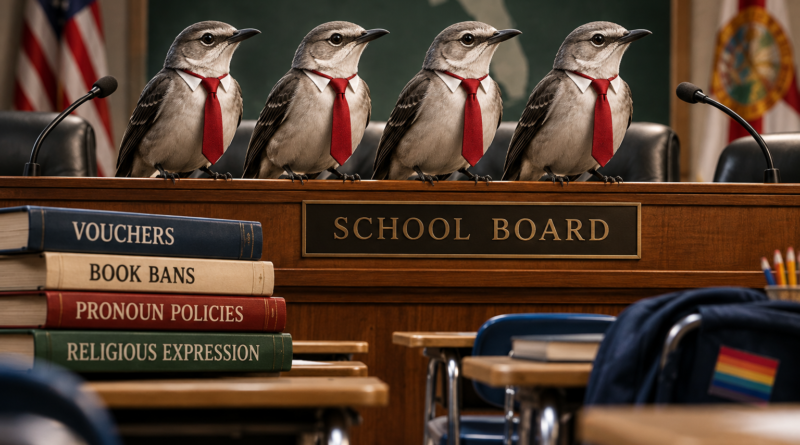
Would this resume get the job? That’s the question every voter should ask before electing someone to help govern the seventh-largest school district in the nation. Hillsborough County Public Schools oversees more than 218,000 students, employs over 23,000 people, and manages a budget exceeding $4 billion. If this were a private company, would this résumé earn a seat in the boardroom?

This article examines Brittany Lyssy’s publicly presented qualifications alongside her campaign finance reports, which show that, excluding a personal loan to her campaign, nearly four out of every ten identifiable donor dollars came from outside Hillsborough County. It’s not a partisan argument. It’s a hiring question. Before entrusting someone with one of the most consequential governing positions in our community, voters deserve to ask whether the experience matches the responsibility.

Read more

Seven Checks. One Address. Nothing to See Here… Probably.

This entry is in the series 2026 Elections

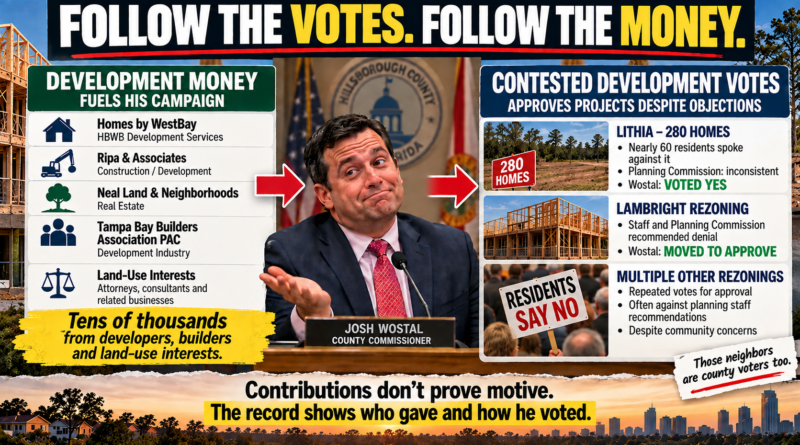
What if the most interesting story isn’t who gave to one candidate—but who keeps showing up in multiple County Commission races? That’s exactly what caught my attention while reviewing Donna Cameron Cepeda’s latest campaign finance report. One connected business network accounted for more than one-quarter of her campaign’s monetary contributions, and the same network also appears in Josh Wostal’s filings. There’s nothing illegal about that. In fact, businesses have every right to support the candidates they believe will best serve the community.

But campaign finance reports exist for a reason. They allow voters to see who is investing in our elections and to ask informed questions before casting a ballot. This article doesn’t accuse anyone of wrongdoing. Instead, it examines one business network’s unusually strong financial interest in Hillsborough County Commission races, and asks the question every voter should ask: Why are these races important enough to attract that level of investment?

Read more

What a Real Hillsborough County Efficiency Review Would Look Like

This entry is in the series Hillsborough DOGE Report Analysis

The Hillsborough County DOGE report raised important questions. However, a true efficiency review must go beyond highlighting large figures. It should test transactions, compare costs, assess workloads, evaluate results, and consider the impact of service reductions.

This final essay outlines the essential elements of a comprehensive review and emphasizes that public trust relies on evidence, not headlines. The objective should be a clear, substantiated case for how each dollar will be saved, rather than the largest possible savings claim.

Read more

When “Waste” Becomes a Political Word Instead of a Financial One

This entry is in the series Hillsborough DOGE Report Analysis

“Waste” should describe money spent badly. Too often, it becomes a political label applied before anyone proves that a program failed, cost too much, or duplicated another service.

This essay looks at how that label can be used to weaken support for public programs before the facts are settled. Real waste should be cut. Political dislike should be debated honestly. Those are not the same thing.

Read more

The DOGE Method: Lots of Documents, Limited Testing, Very Big Numbers

This entry is in the series Hillsborough DOGE Report Analysis

The Hillsborough County DOGE committee reviewed a large volume of records and announced more than $678 million in possible savings. But its own report also admits that the work involved limited due diligence, no transaction-level testing, and no independent verification.

That does not make the report useless. It does mean the public should treat it as a list of leads, questions, and proposed cuts, not as proof that hundreds of millions of dollars were wasted. A lot of documents can produce a big number. They do not automatically produce an audit.

Read more

Real Waste, Fake Waste, and Things Republicans Just Don’t Like

This entry is in the series Hillsborough DOGE Report Analysis

Not every proposed cut is the same. Unused software licenses, underused vehicles, vague contracts, and weak bidding rules are real places to look for waste.

But the Hillsborough County DOGE report also targets nonprofits, equity work, community outreach, and cultural programs. In this essay, I separate genuine control problems from programs that appear to have been labeled “waste” because committee members do not like their purpose.

Political opposition is fair. Calling it financial analysis is not.

Read more

Cutting a Program Is Not the Same as Making Government Efficient

This entry is in the series Hillsborough DOGE Report Analysis

The Hillsborough County DOGE committee calls the county health care plan a source of major savings. But ending care for more than 22,000 low-income residents is not the same as making government more efficient.

This essay looks at what the program actually does, why voters approved the tax that funds it, and what happens when needed care disappears from one budget line only to reappear in emergency rooms, hospitals, charities, and family finances.

Cutting a program may make a spreadsheet look better. The harder question is whether the community pays more when the service is gone.

Read more

Who Chose the Watchdogs?

This entry is in the series Hillsborough DOGE Report Analysis

Before accepting the Hillsborough County DOGE committee’s findings as a neutral review of county spending, it is worth asking who selected the people doing the reviewing.

The five-member panel included several people with solid professional backgrounds, but only one had clear forensic accounting credentials. At least three had strong Republican Party ties, including committee chair Jake Hoffman, a former Republican candidate and Young Republican leader.

This essay looks at how the committee was formed, how its members were chosen, and why a politically tilted advisory panel should not be treated like an independent audit team.

Read more

They Did Not Find $678 Million in Waste

This entry is in the series Hillsborough DOGE Report Analysis

The Hillsborough County DOGE committee says it found roughly $678 million in potential savings. That sounds impressive, until you look at what the number actually includes: entire public programs, contract limits, fund balances, possible management changes, and spending choices committee members simply do not support.

In my latest essay, I take a closer look at the report and the difference between finding real waste and labeling any disliked program as waste. The committee may have raised some fair questions about fleet use, software licenses, contracts, and oversight. But cutting a service is not the same as making government more efficient, and a large number is not proof.

Read more

The Empty Chairs of Tallahassee’s Brave Warriors

This entry is in the series 2026 Elections

The historic Tiger Bay Club of Tampa is known for hosting fierce, politically mixed audiences, the exact kind of room where business-friendly traditional Republicans used to enjoy a home-court advantage. Yet, at a recent Florida State Senate candidate forum following the club’s monthly luncheon, the Republican side of the dais looked like an abandoned movie set. Not a single Republican running for a State Senate seat representing Hillsborough County bothered to show up. Incumbents Nick DiCeglie and Jim Boyd, along with former House Representative Josie Tomkow, staged a coordinated vanishing act, leaving empty chairs where accountability was supposed to sit.

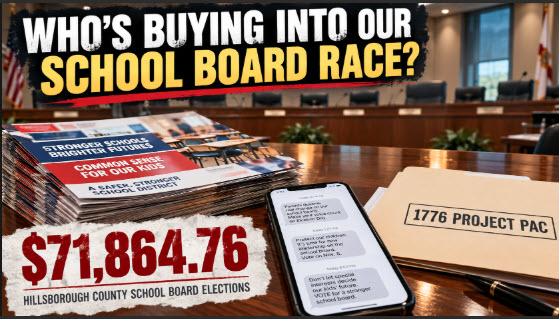
This missing-in-action routine isn’t just a scheduling oversight; it’s a strategic flight from a room full of constituents demanding answers. Over the last several years, this trio has marched in lockstep to strip local self-governance through state preemption while simultaneously passing disastrous property insurance “reforms” that sent premiums into the stratosphere. By refusing to face the music, and a polite crowd over a plate of chicken piccata, Hillsborough’s ghost candidates proved they would rather hide behind multimillion-dollar PAC mailers than explain why their legislative records read like a pocketbook nightmare for local taxpayers.

Read more

The Price of Political Playacting: Michael Owen’s Assault on Hillsborough Schools

This entry is in the series 2026 Elections

Hillsborough County Public Schools, the seventh-largest district in the nation, is facing a top-down assault disguised as “local accountability.” State Representative Michael Owen’s House Bill 4027 calls for a referendum to eliminate our professionally appointed superintendent in favor of a partisan elected office. The schools are already governed by an elected board of education. This change is not about transparency; it is a calculated effort to force a toxic culture-war agenda into our local classrooms and strip our school system of seasoned, professional leadership.

The structural fallout of this power grab is devastatingly clear. Instead of an experienced educational administrator focused on student performance, our district risks being handed over to a political partisan. Under an elected model, policy decisions on curriculum, budgeting, and student safety will inevitably bow to the need for campaign survival, turning every fourth year into a multi-million-dollar reelection spectacle. This essay shows how Owen’s legislative overreach, paired with his habit of distorting local facts for political points, threatens the shared institutions our children rely on.

Read more