
The People We Think We Know

This entry is in the series Lessons for Living Better
This entry is in the series Journey Through Stoicism

Have you ever been so certain about someone that you practically knew what they were going to say before they opened their mouth? I have. In fact, I once prepared myself for an uncomfortable confrontation with a woman at church, complete with a carefully considered response to the complaint I was sure was coming. There was just one problem. She had an entirely different conversation in mind.

It happened after a social justice program I’d organized at my church. One of our speakers, a Black lesbian community leader, had given an especially inspiring presentation. When a community member who’d attended, whom I’d assumed was quite conservative, approached me later and mentioned the speaker’s name, I braced myself. Instead, she announced, “You tell her she needs to run for governor.” Well, so much for my powers of observation. That woman has been something of a hero to me ever since.

The ancient Stoics understood something about our tendency to judge people before we have all the facts. Epictetus even used the example of watching someone bathe to explain the difference between observing behavior and deciding what it means. I’ll leave you to draw your own conclusions about the philosopher’s choice of examples. Modern psychology has since given names to some of these habits, including confirmation bias, which helps explain why we’re so good at finding evidence that supports what we already believe.

But this lesson has another side. Sometimes we judge people too favorably, especially when we know and like them. I’ve recently found myself questioning the decisions of an elected official I’ve come to respect and consider a friend. His choices have disappointed me, yet I also recognize that I owe him a conversation before deciding I understand his reasoning. That’s proving to be a harder exercise in Stoic wisdom than I expected.

In The People We Think We Know, the next essay in my Ten Lessons in Living Well series, I explore how our first impressions can mislead us in both directions, and what we might do to become a little fairer in our judgments. Along the way, there’s an unexpected political endorsement, a philosopher with an unusual interest in bathing habits, and a friendship that has me reconsidering what I thought I knew. Before you decide you’ve got someone figured out, give this one a read. You might discover you’ve been having a few imaginary arguments of your own.

Read more


You Can Be Right and Still Handle Something Badly

This entry is in the series Lessons for Living Better
This entry is in the series Journey Through Stoicism

What would you do if doing the right thing might cost you your job? Early in my career, I faced an ethical dilemma involving a lucrative contract and a client who wanted us to deliberately make legal evidence difficult to find. We walked away from the opportunity, and I’ve never regretted that decision. But one question has stayed with me. What would I have done if the company’s owner had disagreed?

That experience got me thinking about the choices we make when we’re convinced we’re right. Sometimes the stakes are high, involving our livelihood or our principles. More often, they show up in everyday conversations, little white lies, and disagreements where our desire to win gets the better of our judgment. The Stoics understood that knowing what’s right is only part of the challenge. How we act on that knowledge matters just as much.

In You Can Be Right and Still Handle Something Badly, I explore the sometimes uncomfortable distance between our convictions and our conduct. Drawing on Stoic wisdom, a lesson from my professional life, and a little honest self-examination, I consider what it means to act with integrity when circumstances test us. And I leave readers with a question worth considering before their next difficult conversation. When you’re certain you’re right, will you also be proud of how you behaved?

Read more

Joy in an Unfinished World

This entry is in the series Journey Through Stoicism

What do we do when good people suffer, when injustice wins out, and when doing everything right still doesn’t give us the results we hoped for? And how do we make space for happiness when so much around us feels wrong?

Those questions were at the center of Rev. Sally Campbell-Evans’ sermon this past Sunday at Hyde Park United Methodist Church. She was continuing a series on Ecclesiastes that Rev. Magrey deVega started the week before. Magrey had mentioned the Stoics, which caught my attention. Sally didn’t talk about Stoicism directly, but as I listened, I was struck by how closely her message matched ideas I’ve been studying and writing about for the past eighteen months.

One statement really stuck with me. “You are responsible for your faithfulness. Yes. But you are not responsible for controlling the outcomes.” That’s very close to what Epictetus taught almost two thousand years ago. We can choose how to act, what principles to follow, and how much effort to give. But we can’t guarantee the world will respond as we hope. I’ve learned that lesson through professional uncertainty, and I’ve encountered it just as often in my civic and social justice work.

But Sally took the discussion in a direction I found especially meaningful. She reminded us that seeing injustice means we have a responsibility to act, even if we can’t fix everything. And while we do that work, we still have lives worth enjoying. We have friends to spend time with, meals to share, everyday moments of happiness, and people whose presence makes hard days easier.

Then she shared a remarkable story from her time in Nicaragua during the Contra War. She was at a gathering of women when news came that one woman’s third son had been killed. The room filled with grief. After a while, another woman stood up and reminded everyone that life was still a gift worth celebrating. She invited them to dance, and they did. For the rest of the evening, those women danced together while grieving a terrible loss.

Read more

All the Seasons at Once

This entry is in the series Journey Through Stoicism

A year and a half ago, a simple text from my pastor, Rev. Magrey deVega, introduced me to two Latin words I’d never heard before: memento mori. Remember that you must die. That short exchange led me to explore Stoicism, mostly out of intellectual curiosity. I had no idea how important those ancient ideas would become when life started throwing surprises my way.

This past Sunday, Magrey preached on Ecclesiastes and once again mentioned the Stoics. It seems he still has more homework for me. His sermon explored an interesting idea about life’s changing seasons. We usually think of those seasons as coming one after another, but what if several show up at the same time?

In the last eighteen months, I’ve grieved while rebuilding my professional life, found moments of happiness amid uncertainty, and discovered how much steadiness can come from ordinary daily routines. Magrey’s interpretation of Ecclesiastes gave biblical words to what I’d been learning through Stoicism. It also reminded me that many religious and philosophical traditions reach similar insights about change, acceptance, and our limited time.

In All the Seasons at Once, I look back at how a simple curiosity became something deeply personal, and how Ecclesiastes added a new layer to that journey. It’s a reflection on finding hope in uncertain times, learning to value ordinary days, and realizing that grief and happiness can sometimes happen together.

Read more

Wisdom: Whittling Away at Uncertainty

This entry is in the series Journey Through Stoicism
This entry is in the series The Stoic Virtues

How do we know when we are wise?

I have been thinking about that question because wisdom may be the hardest Stoic virtue to define. Courage, justice, and temperance all give us something concrete to work with. Wisdom feels different. We rarely have all the information we want, yet life still requires us to decide, act, adjust, and sometimes admit we were wrong.

In Whittling Away at Uncertainty, I look at some decisions I would make differently today, a new job I am about to begin, and what experience has taught me about research, judgment, and knowing when enough information is enough. Wisdom may not be about certainty. It could be learning how to make the best decision we can, then having the courage to begin.

Read more

The Decision Was Mine-The Outcome Was Not

This entry is in the series Journey Through Stoicism

Lately, life has been asking for more decisions than usual. Not small ones, but the kind that seem to carry a future inside them. Work. Money. Health insurance. A parent’s care. A funeral. An estate. What to keep. What to let go. What to protect. What to release. In this season, I have learned that decision-making is not only a matter of logic. It also carries emotional weight, especially when the outcome remains uncertain.

In this essay, I reflect on a difficult job-search decision that still brings occasional regret, and how Stoic philosophy helps me think about it more clearly. The Stoics remind us that we can control the care, judgment, and integrity we bring to a decision. We cannot control the outcome. That distinction does not eliminate uncertainty, but it does offer a kind of mercy. Sometimes the best we can do is choose honestly from the place where we stand, then release what was never fully ours to command.

Read more

The Tuition of Regret

This entry is in the series Journey Through Stoicism

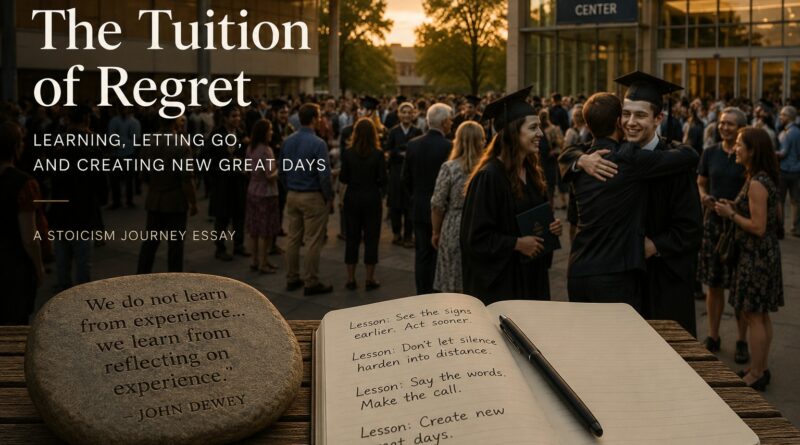
Most of us have regrets, whether we admit them or not. A word spoken too sharply. A kindness withheld. A friendship allowed to drift. A warning sign ignored until it was too late. We may like the idea of living with “no regrets,” but that has always struck me as too clean. If we have lived fully, loved deeply, failed honestly, or hurt someone along the way, regret eventually finds us.

In this essay, I explore regret through the lens of Stoicism, Daniel Pink’s work on The Power of Regret, and my own recent life. I have come to think of regret as life’s tuition. Nobody wants to pay it. Sometimes it is painfully expensive. But if we refuse to learn the lesson, we pay the tuition and never receive the education.

The Stoics did not ask us to deny regret or drown in it. They asked us to examine it, learn from it, make amends where we can, and then lay it down. Regret is not meant to become a permanent home. It is a classroom. The lesson may be to call the friend, offer the apology, act sooner, speak more gently, or create new great days while we still can.

Read more

When Justice Outruns Wisdom

This entry is in the series Journey Through Stoicism
This entry is in the series The Stoic Virtues

“I told her I was ready to give up. I wasn’t. I was frustrated.”

What began as a communication bottleneck in a church office became a lesson in leadership. When drafts moved without review and a public link went live incorrectly, urgency surged. The concern was legitimate. The tone was not. Justice rose quickly. Wisdom lagged behind. Where has urgency outrun wisdom in your week?

In this new essay, I contemplate what the Stoics understood about anger, discipline, and leadership—and why the same dynamic I saw in myself is evident at the highest levels of national leadership. Anger is a signal. It is not a strategy. Wisdom must organize justice, or institutions begin to fray.

Read: When Justice Outruns Wisdom.

Read more

Wisdom: The Organizing Virtue

This entry is in the series Journey Through Stoicism
This entry is in the series The Stoic Virtues

What happens when leadership confuses force with wisdom?

Learn a 3-step pause to outthink panic and regain control over decision-making. We are living in a moment when reactivity often masquerades as strength. Foreign policy escalates without proportion. Economic decisions shift with the winds of applause. Dissent is treated as disloyalty. But courage without wisdom becomes recklessness. Justice without wisdom becomes punishment. Temperance without wisdom becomes denial. Something essential is missing when judgment fails at scale.

In this new essay, I reflect on what Stoic wisdom actually looks like — not as abstraction, but as disciplined judgment under pressure. From sleepless nights of personal uncertainty to watching national decisions unfold, I explore why wisdom is the organizing virtue that keeps both a life and a nation from unraveling.

Read more in Wisdom: The Organizing Virtue.

Read more

Stoic Virtues: The Courage to Decide

This entry is in the series The Stoic Virtues
This entry is in the series Journey Through Stoicism

Most of us think courage looks like pushing forward, fighting, and refusing to give in. But sometimes courage takes a quieter form. Sometimes it shows up not as effort, but as clarity, not as resistance, but as resolve.

During my mother’s final hospital stay, she listened patiently as doctors talked about rehab and recovery. After they left, she said calmly, “I’m just done.” She wasn’t asking for permission or advice. She was stating a decision shaped by a lifetime of endurance. A woman raised in scarcity. A woman who carried family responsibility without complaint. A woman who knew the difference between fear, despair, and judgment.

In this essay, I reflect on what her final decision taught me about courage. Drawing on Stoic philosophy, scripture, and lived experience, I explore courage not as bravado, but as alignment. Not as clinging, but as choosing without illusion. If you’ve ever wondered what courage really looks like when life stops negotiating, I invite you to read more.

Read more

Virtues: Acceptance

This entry is in the series The Stoic Virtues
This entry is in the series Journey Through Stoicism

Acceptance is not resignation. It is the moment when the mind stops fighting reality and starts working with it. I learned that watching a man who rides a three-wheeled electric bike around Tampa with a smile that seems to rise from the inside out.

The Stoics taught that acceptance begins when we stop struggling against what we cannot change. I have been learning this the slow way, through grief, uncertainty, and the small moments that reveal what the heart is holding.

Read more