
Who Pays, and Who Benefits?
 Part Five of a Six-Part Series on Project 2025
There’s a question Americans should ask whenever politicians promise that their economic policies will make everyone more prosperous: Who gets the money?
For most families, being prosperous means covering the mortgage, buying groceries, paying insurance, and maybe having a little left for a dinner out. In Florida, where housing, insurance, and daily costs keep rising, that doesn’t sound like too much to ask.
The people behind Project 2025 see things differently. They want lower taxes for corporations and the wealthy, fewer business rules, and less federal protection for consumers and the environment. They say that letting businesses operate with fewer taxes and less oversight will lead to more investment, more jobs, and a stronger economy.
President Trump and the Republican-controlled Congress have already put much of this plan into action. Now, with new laws, voting records, and independent economic reports, we can see who gains financially and who ends up paying.
These results deserve a lot more attention than they’ve gotten.
Take the tax legislation President Trump signed on July 4, 2025. Republicans named it the One Big Beautiful Bill Act. Whatever its other qualities, the name certainly demonstrated an impressive willingness to grade one’s own homework.
The law continued big parts of Trump’s 2017 tax cuts, added new tax breaks, and cut federal spending on Medicaid, food assistance, and other programs. The Institute on Taxation and Economic Policy (ITEP) says over 70 percent of the 2026 tax cuts go to the richest 20 percent of Americans. The top 1 percent get an average tax cut of about $66,000 this year. The poorest fifth of Americans get less than 1 percent of the total tax benefits.
Let that sink in. The richest 1 percent will get about $117 billion in tax cuts this year, while the entire bottom 60 percent gets around $77 billion. Foreign investors who own shares in American companies are expected to get another $32 billion in tax breaks, which is more than twenty times what the poorest fifth of American taxpayers receive.
The Congressional Budget Office looked at how the law affects household resources like taxes, Medicaid, and food help. They found that lower-income households usually lose out, while middle- and upper-income households gain. Over nine years, the CBO expects about $900 billion less in benefits and other assistance, primarily through Medicaid and SNAP.
These choices have real effects on real people. Wealthy investors and high-earning business owners get big tax breaks. Low-income families lose help that pays for medical care and groceries. Older Americans who rely on Medicaid for nursing home care may have a harder time as federal funding drops. Rural hospitals, which often depend on Medicaid payments, also face more financial strain.
The administration says these changes will boost economic growth and help people rely less on government aid. Supporters also mention tax breaks for overtime, tips, and some older taxpayers. These do help some households, but they make up only a small part of the law’s total tax cuts.
But it’s clear who gets most of the benefits.
And if anyone thinks these huge tax cuts will finally control federal spending, the Congressional Budget Office has some unfortunate news. It estimated that the law would increase federal deficits by about $3.4 trillion over ten years. With interest on that extra debt, the total cost goes up to around $4.1 trillion.
Apparently, deficits become considerably less frightening when the money goes to people who already have plenty of it.
Specific officials are responsible for these decisions, including some who helped write Project 2025. Russell Vought, who wrote the chapter on the Executive Office of the President, now leads the Office of Management and Budget. That job puts him in charge of preparing the president’s budget and overseeing how federal agencies spend money. Treasury Secretary Scott Bessent has pushed the administration’s tax plans, and Peter Navarro, who wrote Project 2025’s argument for aggressive trade policies, serves as a senior White House trade adviser.
Their roles matter because Project 2025 was meant to shape government action. The people who wrote it suggested changes to federal policy, and now some of them are in positions to make those changes happen.
Congress also had to pass the tax and spending laws. Lawmakers can’t say they were just bystanders. On July 1, 2025, the Senate passed the bill 50–50, with Vice President JD Vance breaking the tie. Both Florida Republican senators, Rick Scott and Ashley Moody, voted yes. Every Senate Democrat and three Republicans voted no. Two days later, the House passed the final version, 218–214. Every House Democrat and two Republicans voted against it. Florida’s Republican House members supported the bill, while the state’s Democratic representatives opposed it.
But the impact goes beyond just taxes and benefit cuts.
President Trump’s tariffs have added new costs for American households. The administration says tariffs protect U.S. manufacturers, encourage companies to make goods here, and give America more leverage with other countries.
But tariffs are paid by American importers, and those costs often get passed on to consumers. Research from the Federal Reserve Bank of New York in September 2026 found that about 26 percent of the tariff increases showed up in higher consumer prices. That means families may pay more for imported clothes, electronics, household goods, and more. Businesses that need imported parts and materials also face higher costs, which they might absorb or pass along to customers.
Small businesses usually have fewer options than large corporations to negotiate prices or find new suppliers. For example, a Florida contractor dealing with higher material costs may not be able to absorb those increases, especially when customers are already having trouble paying for repairs or construction. And even though Trump often says foreign countries pay America’s tariffs, the federal government actually collects those taxes from American businesses. Apparently, international trade works differently when explained at a political rally.
The bigger financial picture tells us even more.
In October 2026, ITEP looked at the combined effects of the administration’s tax changes, higher prices, and the expiration of enhanced Affordable Care Act health insurance subsidies. It found that every income group except the richest 1 percent will pay more in net taxes and costs in 2026. For middle-income households, those extra costs are about 2.7 percent of their income. For the poorest fifth, it’s 5.7 percent. The study doesn’t even count the expected losses from cuts to Medicaid and food assistance.
For a Florida family already having trouble paying for rent, food, health insurance, and utilities, those percentages mean less money for other needs. At the same time, the wealthiest households get big tax breaks that can boost their savings and investment income.
The administration’s economic policies also impact corporations in ways other than taxes.
Project 2025 proposes major changes to federal environmental rules, especially those about fossil fuels and greenhouse gas emissions. In February 2026, EPA Administrator Lee Zeldin said the agency would repeal the 2009 greenhouse gas endangerment finding for motor vehicles and related emissions standards. The EPA says dropping these rules will lower regulatory costs and give manufacturers more flexibility. But environmental and public health groups warn that weaker pollution rules could raise health risks and add to long-term climate problems.
For automakers and other businesses, fewer regulations can mean lower costs to follow the rules. But for Florida homeowners, coastal communities, and taxpayers, the possible costs from more emissions and environmental damage are just as important. Floridians already deal with high property insurance, flooding, coastal development, and rising storm recovery costs. Climate change is part of these problems, along with building costs, development trends, and other issues.
When the government takes away environmental protections, businesses might save money right away, but communities could face more risks in the long run. The exact costs depend on which rules are changed and what happens next, but the people who benefit may never have to pay for the damage.
That’s an arrangement most Floridians would probably decline if someone explained it before asking them to pay.
And that brings us back to the main question: Who benefits, and who gets hurt?
Most of the benefits go to wealthy households, high-earning business owners, investors, and corporations that get tax breaks or fewer regulations. Some domestic manufacturers gain from tariff protection, and businesses that qualify for new deductions can lower their taxes.
Those at the greatest financial risk are lower-income families who rely on Medicaid or SNAP, workers whose small tax savings are canceled out by higher prices, people who lose affordable health insurance, and communities that pay more as public protections and services are cut.
The Congressional Budget Office’s findings show the effects of the 2025 budget law clearly. Congress passed a law that gives more to higher-income households and less to people with lower incomes. The estimates include changes in taxes and federal help, such as cuts to Medicaid and SNAP benefits.
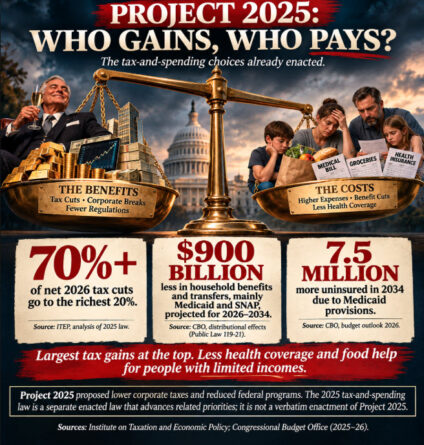 In Florida, these decisions affect families who are already having a hard time paying for housing, groceries, insurance, and medical bills. Wealthy households can save tens of thousands in taxes, while working families may see higher insurance costs or lose health coverage. Older residents might face new money problems if Medicaid help is harder to get. These changes hit neighbors who already live with tight budgets and rising costs.
The people who made these decisions should have their records reviewed. President Trump signed the law, and his administration created and pushed these policies. Florida Senators Rick Scott and Ashley Moody, along with every Republican member of Florida’s House, voted for the budget law. The link to Project 2025 should also be looked at closely. The people behind it called for lower taxes, less regulation, and big changes to federal spending. The administration has put some of these ideas into action.
When Democrats take control of Congress in January 2027, lawmakers will be able to look into the financial effects of these decisions, see what benefits big industries get, and question the officials who put these policies in place. Congress can also look at changing tax rules, bringing back assistance, and adding protections if the evidence supports it.
Americans can help hold leaders accountable. We can check how Congress members voted, ask questions at public meetings, and push federal agencies to show clear numbers about who gains from policy changes and who pays the price.
We should also consider how these choices affect our neighbors. When a family loses health coverage, a senior can’t afford care, or a small business faces higher costs, it impacts our whole community. The economic decisions made in Washington end up affecting our homes, jobs, hospitals, and neighborhoods. They shape the chances our children have and the financial security of older Americans who helped build this country.
The people who wrote Project 2025 shared their economic priorities openly. Now, the administration and Congress have shown us what happens when many of those ideas become law.
Americans have good reason to look at that record and ask leaders to explain whose interests their decisions support.
Sources
- Institute on Taxation and Economic Policy (ITEP). Tax Provisions in Trump’s Megabill: National and State-Level Estimates (2025).
https://itep.org/tax-provisions-in-trump-megabill-national-and-state-level-estimates/ - Congressional Budget Office (CBO). Distributional Effects of the 2025 Reconciliation Legislation.
https://www.cbo.gov/publication/61367 - Congressional Budget Office (CBO). Budgetary and Deficit Effects of the 2025 Reconciliation Legislation.
https://www.cbo.gov/publication/61570 - Associated Press. Reporting on Project 2025 Authors and Their Roles in the Trump Administration.
https://apnews.com/article/7d1c476694176876256e95cecbd49231 - United States Senate. Roll Call Vote 372, 119th Congress, First Session, July 1, 2025.
https://www.senate.gov/legislative/LIS/roll_call_votes/vote1191/vote_119_1_00372.htm - Federal Reserve Bank of New York. Staff Reports: Research on Tariff Increases and Consumer Prices.
https://www.newyorkfed.org/research/staff_reports/sr1201 - Institute on Taxation and Economic Policy (ITEP). Impact of Trump Policies on Taxes and Consumer Costs, 2026.
https://itep.org/impact-of-trump-policies-on-taxes-and-consumer-costs-2026/ - S. Environmental Protection Agency. President Trump and Administrator Zeldin Announce Major Deregulatory Action (2026).
https://www.epa.gov/newsreleases/president-trump-and-administrator-zeldin-deliver-single-largest-deregulatory-action-us
