
The Rights We Stand to Lose
 Part Three of a Six-Part Series on Project 2025
For more than fifty years, the people of Delray Beach, Florida, have celebrated St. Patrick’s Day with a parade. Every March, crowds gather along Atlantic Avenue for the music, floats, and festivities. It’s a beloved tradition that brings the community together, regardless of whether anyone’s ancestors came from Ireland.
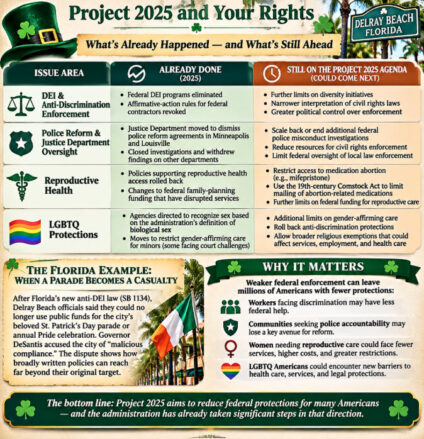
Then Florida’s Republican-led Legislature decided the state needed another law against diversity, equity, and inclusion (DEI).
Governor Ron DeSantis signed Senate Bill 1134 in April 2026, restricting local governments from funding certain programs associated with ethnicity, gender identity, and sexual orientation. The law takes effect in January 2027. Delray Beach officials reviewed it and concluded they could no longer organize or fund their St. Patrick’s Day parade or annual Pride celebration.
It seems celebrating Irish heritage is perfectly acceptable until someone notices that Irish heritage involves an ethnicity. DeSantis was furious, accusing the city of “malicious compliance” and insisting the law didn’t require canceling the parade. City officials disagreed, pointing to the law’s broad language and the legal consequences for violating it. The dispute remains unresolved, and private organizers may still hold the parade.
Perhaps someone should have considered how broadly the law was written before signing it. It’s a rather curious situation when the governor complains that local officials are taking his own legislation seriously.
This controversy provides a useful introduction to Part Three of our Project 2025 series because it illustrates how sweeping policy changes can impact people and activities that weren’t the original focus. Florida’s law isn’t directly from Project 2025, but both try to limit government programs tied to diversity and change how public institutions handle discrimination. I guess Ron wasn’t counting on “malicious compliance” of “the law with unintended consequences.”
The Heritage Foundation’s Project 2025 proposes major changes to federal civil rights enforcement. Its authors argue that programs intended to address discrimination have sometimes become discriminatory themselves. They want to eliminate federal DEI programs, narrow certain interpretations of civil rights law, and give political leaders greater control over enforcement decisions.
President Trump began acting on those priorities immediately after returning to office. In January 2025, he ordered federal agencies to eliminate DEI programs and revoked longstanding affirmative-action requirements for federal contractors. His administration described these changes as restoring merit and equal treatment.
 Everyone deserves fair treatment. The tougher question is what happens to people facing discrimination if the government stops looking for it.
Consider the Justice Department’s Civil Rights Division, established in 1957 to enforce federal laws protecting Americans from discrimination. Over the decades, its attorneys have investigated violations involving employment, housing, voting, education, and law enforcement. Their work has helped make constitutional protections meaningful for people who might otherwise lack the resources to challenge powerful institutions.
In May 2025, the Trump Justice Department moved to dismiss proposed police reform agreements in Minneapolis and Louisville. It also closed investigations and withdrew findings involving several other police departments. Earlier federal investigations had identified patterns of unconstitutional conduct, including excessive force and discriminatory policing.
The administration said the investigations used flawed methods and that federal oversight put extra burdens on local police. These concerns should be looked at. But pulling back federal enforcement also affects the people who made the complaints in the first place.
Imagine a family whose loved one suffered excessive police force, or residents who believe officers routinely treat their neighborhood differently because of race. Federal oversight can provide an avenue for accountability when local systems fail. Without it, those communities may have fewer resources to challenge misconduct or compel lasting reforms.
Project 2025’s proposals go far beyond just policing. Its authors also recommend restricting access to medication abortion and reconsidering federal rules governing mifepristone, a drug used in medication abortions. They propose using the Comstock Act, a nineteenth-century law, to restrict the mailing of abortion-related medications.
The Trump administration has already reversed several policies intended to support reproductive health access, while some additional restrictions remain proposals or face legal challenges. Changes to federal family-planning funding have also disrupted services. For women living in rural communities or in low-income households, these decisions can have immediate consequences. A clinic losing funding may reduce appointments or services, leaving patients with fewer options for contraception, cancer screenings, and other essential care. Restrictions on medication abortion could force some women to travel farther, pay more, or delay treatment.
It’s likely the nineteenth century was much less appealing for the women who actually lived through it.
Project 2025 also seeks stronger protections for religious organizations that object to certain government requirements. Religious freedom is a fundamental American right, but expanding exemptions raises difficult questions when an institution receives public funding or serves people who don’t share its beliefs. Depending on how the rules change, employees could face limits on health benefits, and patients could encounter additional barriers to care.
LGBTQ Americans face similar uncertainty. In January 2025, Trump directed federal agencies to recognize sex according to his administration’s definition of biological sex. Other actions sought restrictions on gender-affirming medical care for minors, with some facing court challenges. These policies can affect access to government services, health care, and protections against discrimination.
The biggest worry is how all these changes add up when combined.
Civil rights laws depend on enforcement. Congress can prohibit discrimination, but those protections mean considerably less when agencies stop investigating complaints, withdraw from cases, or reduce the resources available to enforce the law.
A worker who experiences discrimination may struggle to obtain federal assistance. Families challenging unequal treatment in schools could face fewer enforcement options. Communities seeking police accountability may lose federal support, while patients and LGBTQ Americans encounter new barriers to services and protections.
Some of these effects have already been documented. Others are likely risks if more Project 2025 proposals become law or policy. Courts have blocked or limited some actions, and current civil rights laws are still in place. But shifting enforcement priorities can weaken real protections long before Congress changes any laws.
That is the warning Americans need to understand. Project 2025 openly proposes changing how the federal government protects individual rights. The administration has already carried out significant parts of that agenda. The people most affected will often be those who depend on federal enforcement because they lack the money, influence, or resources to defend their rights alone.
When the new Congress convenes in January 2027, its members will have the authority to examine these changes, investigate their consequences, and demand answers from the officials responsible. They can review funding decisions, question agency leaders, and consider legislation to protect rights they believe are at risk.
Americans can also ask their representatives to take these responsibilities seriously. Congressional oversight matters most when lawmakers are willing to investigate administration decisions, including those their own party supports. The people who wrote Project 2025 made their intentions public. Its proposals, along with the actions already taken, provide a substantial record for Congress and the public to examine.
The rights Americans have spent generations securing deserve that scrutiny. We should not be turning back the clock on marginalized communities in this country, but that’s exactly what the authors of Project 2025 want.
The people who wrote Project 2025 made their intentions public, and the administration has already carried out significant parts of their agenda. The rights Americans spent generations securing deserve serious protection. No president or political adviser should have unchecked power to weaken those protections, particularly when the people affected have the fewest resources to defend themselves.
The 2026 midterm elections have given the incoming Congress new authority to scrutinize the administration’s actions and demand accountability. But an election victory alone cannot settle the questions Project 2025 raises. Congress will have to decide how it uses its oversight and lawmaking powers, and Americans will have to pay attention to those decisions. The future of civil rights enforcement depends in part on what both are prepared to do next.
