The Books They Don’t Want Our Children to Read
Growing up, I didn’t have books that helped me understand who I was. People rarely talked openly about being gay,
Read more
The site for ranting and reporting by John Masters
This category is used for posts related to any elections.

Growing up, I didn’t have books that helped me understand who I was. People rarely talked openly about being gay,
Read more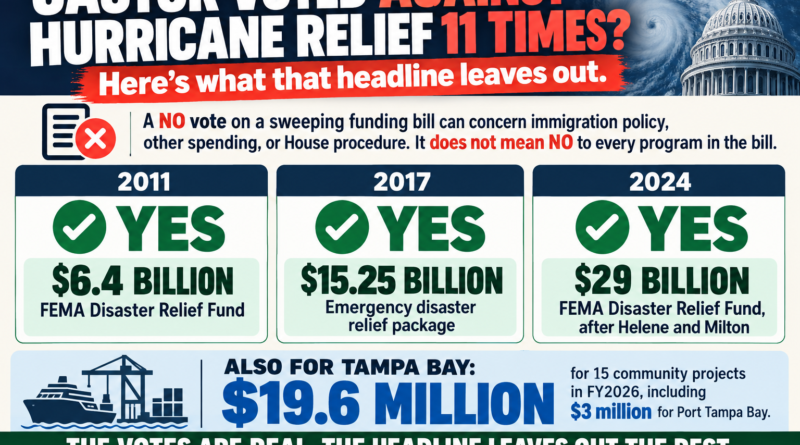
Kathy Castor voted against hurricane relief 11 times, supposedly blocking $151.43 billion in federal disaster assistance. That’s the accusation circulating in an article from West Orlando News, courtesy of the National Republican Congressional Committee. Eleven votes. More than $151 billion. You can almost hear the ominous music playing behind the next Republican campaign commercial.
There’s just one problem. When you examine the actual congressional records, the story begins to fall apart. The article counts votes against massive spending bills covering everything from FEMA to immigration enforcement, along with a procedural vote that had little to do with disaster relief itself. Apparently, voting against a bill containing dozens of provisions means you oppose every dollar in it. Congressional voting records are wonderfully useful things, particularly when you select only the votes that support your accusation.
Here’s what the article conveniently forgot to mention. Castor voted FOR $6.4 billion in FEMA disaster funding in 2011, FOR $15.25 billion in emergency disaster assistance in 2017, and FOR legislation providing $29 billion to FEMA following Hurricanes Helene and Milton in 2024. That last bill passed 366–34. Every single vote against it came from a Republican. Funny how that little detail escaped the article’s attention.
The NRCC is entitled to campaign against Kathy Castor. Voters are entitled to know what Congress actually did. We’ve examined the votes, the bills, and the facts the original article left out. Before accepting the claim that Castor repeatedly voted against hurricane relief, read the full article. The congressional record tells a much different story, and the facts are considerably less flattering to the people spreading this accusation.
Read more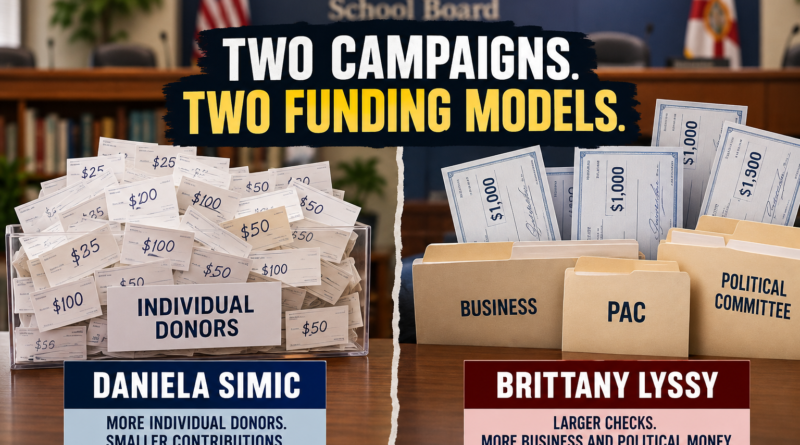
Campaign finance reports can be tedious, but the District 2 numbers tell a fairly simple story. Daniela Simic’s campaign is driven much more by individual donors and smaller contributions. Brittany Lyssy’s campaign relies far more heavily on large checks, businesses, and political committees. Her latest filings also include direct support from a Hillsborough County Republican organization in a race that is formally nonpartisan.
There is another layer. Lyssy also chairs a separate political committee bearing her name, while part of the education-policy experience she cites comes from the conservative Leadership Institute’s school-board program. That same program has featured Bridget Ziegler in a leadership and training role.
The full article strips away the financial-report clutter and examines who is funding these two campaigns, the political networks surrounding them, and the very different professional backgrounds the candidates would bring to the Hillsborough County School Board.
Read more
Can you be a Stoic and still be politically active? I think the answer is not only yes, but that Stoicism gives us a better way to do it. The ancient Stoics did not confuse acceptance with surrender. They accepted what could not be changed, while challenging injustice when action was still possible.
That question feels especially urgent now. We are living in a time when division itself has become a political tool. Culture war fights can dominate attention while people are still struggling with housing, health care, violence, war, and the basic question of whether government can still solve real problems. Anger may be useful in campaigns. It is rarely enough to build a decent society.
Stoicism asks something harder of us. Stay engaged without becoming consumed. Think clearly when others are trying to provoke you. Act with courage when something is wrong. Keep justice at the center. And remember that the people on the other side of a political argument are still part of the same community.
Politics, at its best, is what we choose to do together. This essay asks what Stoicism can teach us about showing up for that shared life, especially when the temptation is to give up, tune out, or shout louder.
Read more
Florida summer heat is not theoretical. It is a relentless physical reality. Anyone who expects children to concentrate on algebra or reading in an eighty-eight-degree classroom with a dead air conditioner and water dripping into plastic buckets has never spent an afternoon inside an aging Florida school building. You cannot build academic excellence when students and teachers are simply trying to survive the humidity.
Hillsborough Referendum 3 asks voters to renew the half-cent sales tax for another ten years to pay for air conditioning, roof repairs, and security at schools. Opponents talk about tax fatigue, but this is not a new tax. It keeps the same rate as in 2018. If it ends, your grocery bill will not go down, but school maintenance will lose $120 million a year.
The results speak for themselves. Since 2018, the Half-Penny Promise has funded over 750 projects, including air conditioning upgrades at 177 schools, all overseen by an independent Citizen Oversight Committee. Tourists pay about a quarter of the cost, and over $716 million has gone to local contractors and workers in Hillsborough County.
While the state Capitol stays busy manufacturing political culture wars and diverting public funds into private vouchers, local communities must take care of their own. Read the complete breakdown on why renewing this capital surtax is an investment in our kids, our local workforce, and our neighborhood schools.
Read more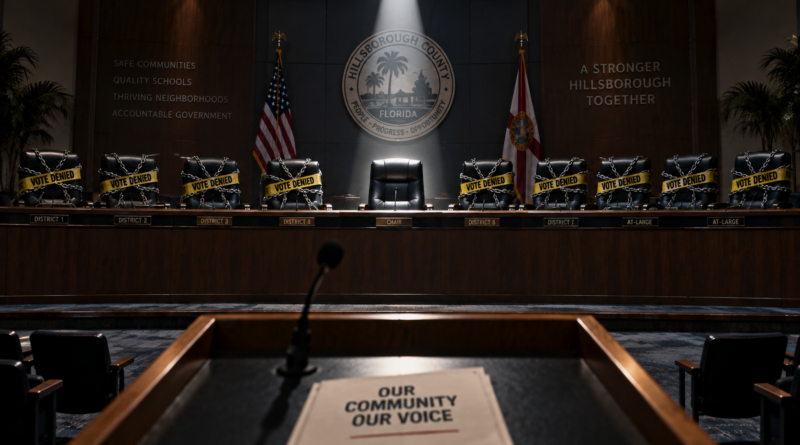
If someone came to your door and offered to trade four hundred-dollar bills for a ten-dollar bill, you would quickly close the door and check your security cameras. That is exactly the kind of deal behind Hillsborough County Charter Referendum 2, a Tallahassee plan that would undo forty years of balanced local government.
For forty years, Hillsborough has used a mix of four district commissioners and three countywide at-large commissioners. This lets every voter choose four out of seven seats, giving people a say in the majority. Referendum 2 would end this system by expanding the board to nine and removing all at-large seats.
Think about what this means for your representation. You would go from voting for four commissioners to just one. You would not be able to vote for or against the other eight, even though they decide on taxes, infrastructure, and big development projects. Single-member districts encourage commissioners to trade favors for their own areas and ignore countywide needs like Port Tampa Bay and regional transit.
Tallahassee politicians love to lecture local communities about neighborhood control while quietly shrinking our democratic leverage from afar. Read the full commentary to see why trading away four seats for one is a bad trade for Hillsborough taxpayers, and why we must vote No on Charter Referendum 2.
Read more
Tallahassee politicians often present Florida Amendment 1 as basic common sense. After all, who would argue with saving for a rainy day? But there’s a big difference between keeping an umbrella handy and locking away billions while your ceiling is falling in.
If you drive through Hillsborough County, you’ll see blue tarps still on roofs from storms years ago. Homeowners are struggling with high insurance costs, classrooms have broken air conditioners, and stormwater ditches need repairs. Yet Amendment 1 would require up to $750 million a year to be set aside in Tallahassee until the fund reaches 25 percent of general revenue.
Florida already has a fully funded emergency reserve at 10 percent. Forcing billions more into storage isn’t smart budgeting; it’s a way to cut local spending now so politicians can brag about a big balance later. Read the full essay to see why we should fix our roofs before Tallahassee builds another vault.
Read more
Michael Owen sits where Florida’s property insurance laws are shaped: the House Insurance & Banking Subcommittee. His campaign finance reports also show substantial support from insurance companies, insurance political committees, agents’ groups, and lobbyists. The article examines that money alongside the choices he has made in office.
Owen has shown no shortage of legislative ambition when Hillsborough County government is involved. He sponsored HB 4027, which puts an elected school superintendent before Hillsborough voters, and HB 4029, which would substantially restructure the County Commission. Both measures passed the Legislature and require local voter approval.
That leaves a harder question. With homeowners still confronting steep insurance bills, what has Owen used his seat on Insurance & Banking to do for them? The campaign money does not answer that question by itself, but it makes his legislative record worth examining closely.
This article follows the money, looks at where Owen has chosen to spend his political capital, and asks what those priorities tell District 70 voters about whose concerns are getting attention in Tallahassee.
Read more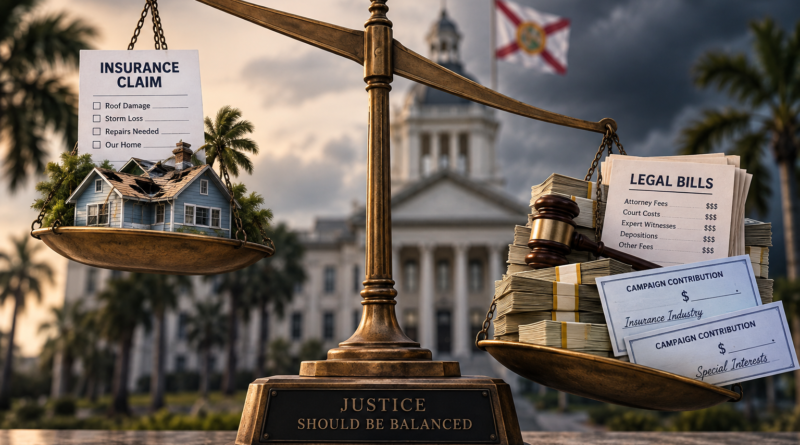
Florida homeowners have heard “insurance reform” so often that the phrase almost deserves its own ZIP code. But behind that label were years of very real changes to what happens when an insurance company denies or underpays a claim and a homeowner has to fight back.
Josie Tomkow voted yes, again and again, as Florida changed the rules around lawsuits, attorney fees, assignment-of-benefits claims, and insurer liability. Those laws may sound technical, but their effect can be painfully simple: even when policyholders have a valid dispute, taking an insurer to court can now carry more financial risk.
Then there is the campaign money. Tomkow’s contribution records show recurring support from insurers, insurance-industry organizations, civil-justice reform groups, and people tied directly to Florida’s insurance-policy world, including former Insurance Commissioner David Altmaier. This cycle alone, at least $2,500 has come from three interests closely connected to this issue.
No, campaign contributions do not come with thank-you notes for specific votes. But voters are entitled to look at the money, look at the voting record, and decide for themselves whether the two tell a story worth following.
Read more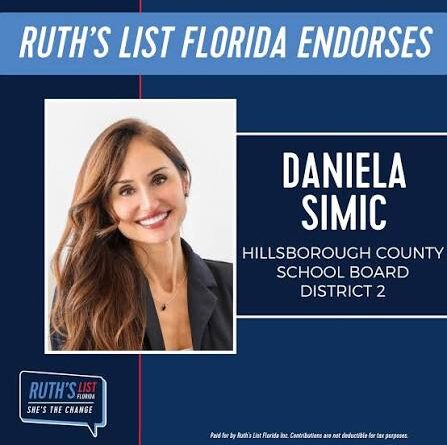
Daniela Simic’s campaign is built around something school board races could use more of: deep experience with schools themselves. She has spent about 25 years in education, from the classroom to district leadership, with years of PTA and community work layered on top of it.
Her fundraising tells its own story. Simic and Brittany Lyssy have raised roughly the same amount from outside donors, but Simic reached that total through far more contribution transactions, a lower median donation, and broader support from individuals, educators, labor groups, and community organizations.
The race gives District 2 voters a clear factual comparison in background, donor base, and connection to Hillsborough’s schools. The full piece looks at Simic’s record, the people backing her, and the experience she brings to one of the largest school systems in the country.
Read more
Stacy Hahn doesn’t sound much like Josh Postal. She’s thoughtful, qualified, and generally pleasant. But votes count the same whether they come with a scowl or a smile, and Hahn’s eight years on the Hillsborough County School Board show a record that’s much more conservative than her polished image suggests.
Hahn opposed letting voters decide on more funding for teacher pay, voted against defending that referendum when Postal and the County Commission tried to block it, rejected a Pride Month proclamation, and publicly aligned herself with Ron DeSantis’s political group. There are some exceptions in her record, but when it comes to taxes, LGBTQ recognition, sexual-health education, and DeSantis-era politics, the pattern is clear.
Now Hahn is running for the County Commission with a campaign mostly funded by construction, development, real estate, and government-relations groups—including businesses that have worked with Hillsborough County. These contributions don’t prove improper influence, but voters have a right to look at who is supporting a candidate and what choices that candidate might make in office. Dr. Hahn may be a more pleasant version of Josh Postal, but the real question is whether Hillsborough County needs another version at all.
Read more