Two Candidates, Two Very Different Ways of Paying In House District 64

This entry is in the series 2026 Elections

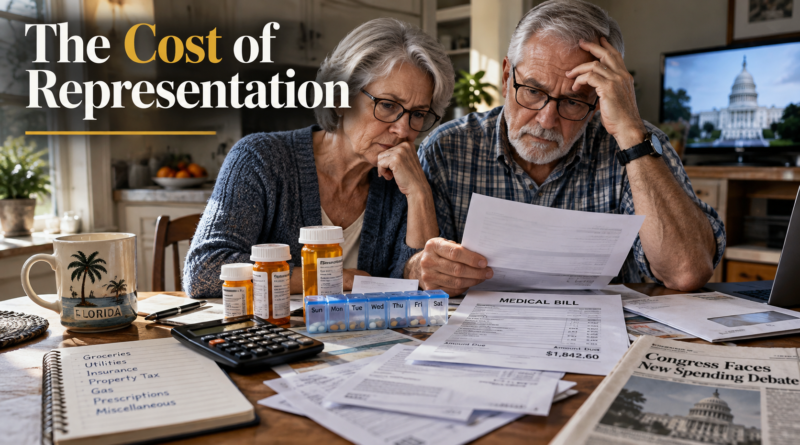
How much does it cost to send someone to Tallahassee? And more importantly, who’s picking up the tab? Campaign finance reports may not be exciting, but the numbers in Florida House District 64 reveal a clear story. One candidate has raised most of his money from individual donors, while the other has received most of his support from political committees and Republican Party groups. The difference is striking.

Democrat Luis Salazar has raised over $64,000 from individuals, with hundreds of small donations. Republican Dan Weldon has raised about $12,000 from individual donors. At the same time, Republican Party organizations have given Weldon about $106,500 in cash and campaign services, such as staff, polling, research, and consulting. That’s about 62% of his total reported campaign resources. It seems Tallahassee provides more than just legislative advice.

It’s no surprise that political parties back their candidates. But how much support they give, compared to money from regular people, is worth a closer look. We’ve reviewed both candidates’ campaign finance reports, including where their money comes from and who pays for professional help. The results raise an important question for voters: Who is paying to put your next state representative in office?

Read more

Following the Money Behind Josie Tomkow

This entry is in the series 2026 Elections

Campaign finance is so complicated that most voters give up before they get to the interesting part. That may be part of the point. Josie Tomkow has a regular campaign account and two political committees, with millions of dollars coming from business groups, health care interests, developers, insurers, political committees, and party organizations—often with names that don’t reveal who is really behind them.

Insurance stands out. About $92,500 came from companies, organizations, and people involved in property, auto, and casualty insurance. That’s notable on its own, but it’s even more interesting since Tomkow is now running as a candidate who wants to reform insurance, even though her voting record shows support for laws that reduced legal protections for policyholders. Her version of insurance reform has, at times, looked suspiciously like an aid package for the insurance industry.

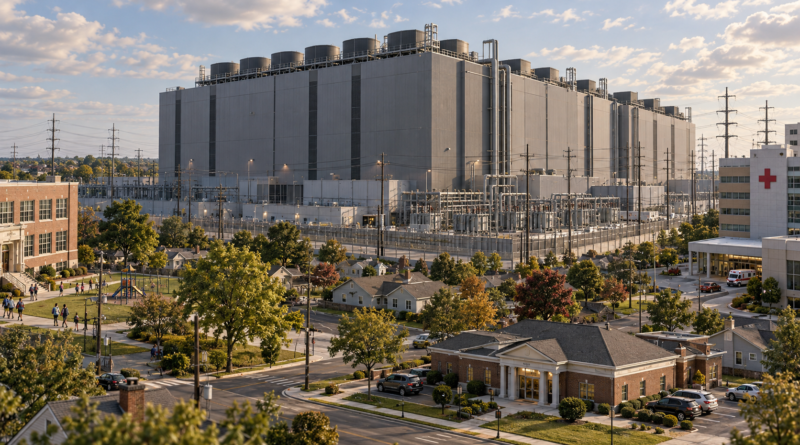
There’s also at least $94,500 from donors directly connected to data centers, cloud computing, energy, or the infrastructure behind them. Add in big business and development money, plus $50,000 from Publix, and the donor list gets even more interesting. Maybe Publix just expects Tomkow to buy a lot of groceries. The rest of us might want to keep an eye on where the money goes.

Read more

Who Is Building Stacy Hahn’s Campaign?

This entry is in the series 2026 Elections

Campaign finance reports rarely contain a smoking gun. Mostly, they contain checks—and Stacy Hahn’s reports include many from industries most affected by County Commission decisions. At least $63,850, or about 38% of her total contributions, came from construction, development, real estate, engineering, and architecture interests.

There is also the Tampa Bay Rays’ new ownership group. After Commissioner Donna Cameron Cepeda questioned public funding for a new stadium, more than $40,000 was donated by Rays owners and related companies to Hahn, her Republican primary opponent. It seems all those builders and developers decided on their own that Hillsborough County really needed Hahn on the Commission. Sometimes, civic enthusiasm spreads quickly.

Legal contributions do not prove corruption. But campaign money is not charity, either. With roads crowded, schools full, and neighborhoods often asked to make way for new projects, voters should ask a simple question: Can Hillsborough County afford more development-at-any-cost government, and who is paying for it?

Read more

Gus Bilirakis: Who Benefits from His Votes?

This entry is in the series 2026 Elections

After nearly 20 years in Congress, Gus Bilirakis has had plenty of opportunities to demonstrate whose interests he represents. Now, with Florida’s newly drawn Congressional District 12 stretching across parts of Hillsborough and Pasco counties, it’s worth looking at his record. For residents worried about health care, household expenses, and the rising cost of living, some of his votes raise uncomfortable questions.

Bilirakis supported legislation that the Congressional Budget Office projects will leave millions more Americans uninsured and reduce federal food assistance. He opposed bipartisan infrastructure funding and pandemic relief that provided direct help to families and communities. Apparently, there’s plenty of room in Washington to cut taxes, but far less enthusiasm for helping people pay their medical bills.

Then there’s the campaign money. Nearly 56% of Bilirakis’s direct campaign contributions come from political committees, including PACs associated with pharmaceutical manufacturers, health insurers, utilities, and telecommunications companies. Many of those industries have business before the congressional committee on which he serves. Campaign contributions don’t prove influence, of course. But after two decades in Washington, voters have every reason to ask a simple question: Who is Gus Bilirakis working for?

Read more

Follow the Votes. Follow the Money.

This entry is in the series 2026 Elections

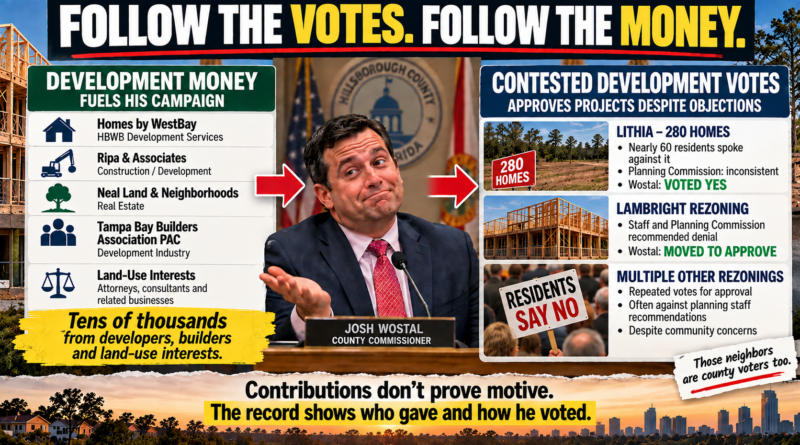
Josh Wostal likes to remind people that he represents voters across Hillsborough County. Some of those voters have shown up at County Commission meetings, asking commissioners to slow development in their neighborhoods. In several cases, Wostal voted the other way, even when county planning officials recommended denial or found the proposed development inconsistent with the comprehensive plan.

Then there is the money. Builders, developers, construction firms and land-use interests have contributed substantial sums to Wostal’s political operation. In at least two cases, contributors or business networks tied to his campaign also had development matters come before the commission. None of that proves why Wostal cast a particular vote. It does give voters a reason to look closely at who funds his political operation and what happens when development interests come before him.

And those residents standing at the podium asking him to listen? They are countywide voters too.

Read more

Two Campaigns, Two Very Different Funding Models

This entry is in the series Education
This entry is in the series 2026 Elections

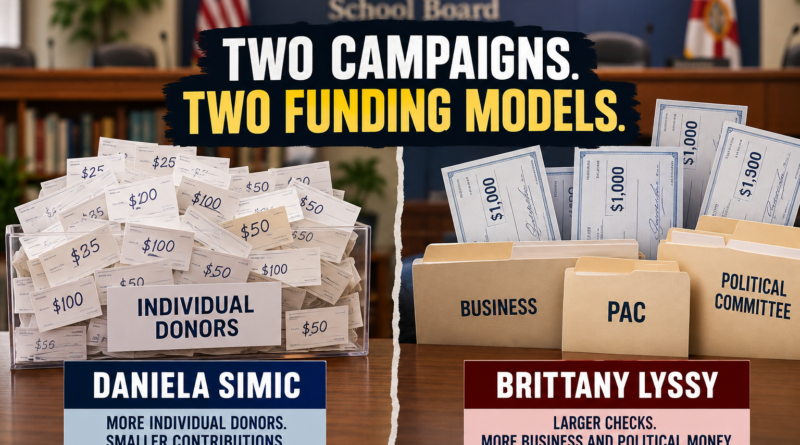
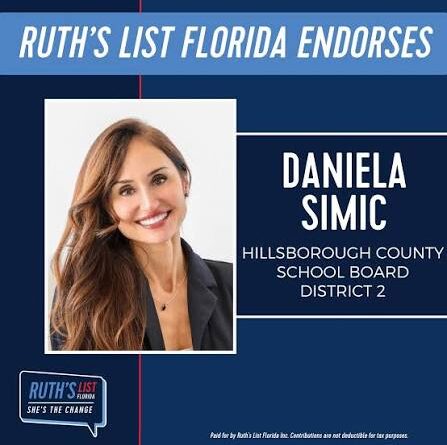
Campaign finance reports can be tedious, but the District 2 numbers tell a fairly simple story. Daniela Simic’s campaign is driven much more by individual donors and smaller contributions. Brittany Lyssy’s campaign relies far more heavily on large checks, businesses, and political committees. Her latest filings also include direct support from a Hillsborough County Republican organization in a race that is formally nonpartisan.

There is another layer. Lyssy also chairs a separate political committee bearing her name, while part of the education-policy experience she cites comes from the conservative Leadership Institute’s school-board program. That same program has featured Bridget Ziegler in a leadership and training role.

The full article strips away the financial-report clutter and examines who is funding these two campaigns, the political networks surrounding them, and the very different professional backgrounds the candidates would bring to the Hillsborough County School Board.

Read more

Whose Voice in the Committee Room? Michael Owen, Insurance Cash, and the Squeeze on District 70

This entry is in the series 2026 Elections

Michael Owen sits where Florida’s property insurance laws are shaped: the House Insurance & Banking Subcommittee. His campaign finance reports also show substantial support from insurance companies, insurance political committees, agents’ groups, and lobbyists. The article examines that money alongside the choices he has made in office.

Owen has shown no shortage of legislative ambition when Hillsborough County government is involved. He sponsored HB 4027, which puts an elected school superintendent before Hillsborough voters, and HB 4029, which would substantially restructure the County Commission. Both measures passed the Legislature and require local voter approval.

That leaves a harder question. With homeowners still confronting steep insurance bills, what has Owen used his seat on Insurance & Banking to do for them? The campaign money does not answer that question by itself, but it makes his legislative record worth examining closely.

This article follows the money, looks at where Owen has chosen to spend his political capital, and asks what those priorities tell District 70 voters about whose concerns are getting attention in Tallahassee.

Read more

Josie Tomkow, Insurance Reform, and a Trail Worth Following

This entry is in the series 2026 Elections

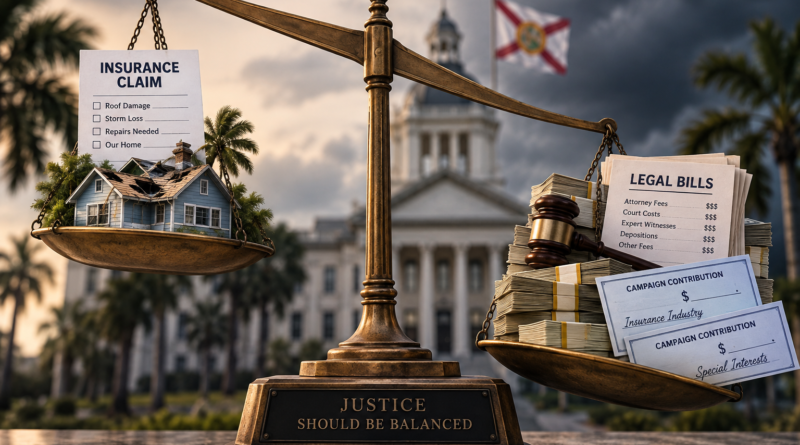
Florida homeowners have heard “insurance reform” so often that the phrase almost deserves its own ZIP code. But behind that label were years of very real changes to what happens when an insurance company denies or underpays a claim and a homeowner has to fight back.

Josie Tomkow voted yes, again and again, as Florida changed the rules around lawsuits, attorney fees, assignment-of-benefits claims, and insurer liability. Those laws may sound technical, but their effect can be painfully simple: even when policyholders have a valid dispute, taking an insurer to court can now carry more financial risk.

Then there is the campaign money. Tomkow’s contribution records show recurring support from insurers, insurance-industry organizations, civil-justice reform groups, and people tied directly to Florida’s insurance-policy world, including former Insurance Commissioner David Altmaier. This cycle alone, at least $2,500 has come from three interests closely connected to this issue.

No, campaign contributions do not come with thank-you notes for specific votes. But voters are entitled to look at the money, look at the voting record, and decide for themselves whether the two tell a story worth following.

Read more

Daniela Simic Has Been Preparing for This Job for Years

This entry is in the series 2026 Elections

Daniela Simic’s campaign is built around something school board races could use more of: deep experience with schools themselves. She has spent about 25 years in education, from the classroom to district leadership, with years of PTA and community work layered on top of it.

Her fundraising tells its own story. Simic and Brittany Lyssy have raised roughly the same amount from outside donors, but Simic reached that total through far more contribution transactions, a lower median donation, and broader support from individuals, educators, labor groups, and community organizations.

The race gives District 2 voters a clear factual comparison in background, donor base, and connection to Hillsborough’s schools. The full piece looks at Simic’s record, the people backing her, and the experience she brings to one of the largest school systems in the country.

Read more

A Polite Version of Josh Wostal Is Still Too Much

This entry is in the series 2026 Elections

Stacy Hahn doesn’t sound much like Josh Postal. She’s thoughtful, qualified, and generally pleasant. But votes count the same whether they come with a scowl or a smile, and Hahn’s eight years on the Hillsborough County School Board show a record that’s much more conservative than her polished image suggests.

Hahn opposed letting voters decide on more funding for teacher pay, voted against defending that referendum when Postal and the County Commission tried to block it, rejected a Pride Month proclamation, and publicly aligned herself with Ron DeSantis’s political group. There are some exceptions in her record, but when it comes to taxes, LGBTQ recognition, sexual-health education, and DeSantis-era politics, the pattern is clear.

Now Hahn is running for the County Commission with a campaign mostly funded by construction, development, real estate, and government-relations groups—including businesses that have worked with Hillsborough County. These contributions don’t prove improper influence, but voters have a right to look at who is supporting a candidate and what choices that candidate might make in office. Dr. Hahn may be a more pleasant version of Josh Postal, but the real question is whether Hillsborough County needs another version at all.

Read more