
Two Candidates, Two Very Different Ways of Paying In House District 64
 Ever wonder what a difference in campaign financing means? What does it tell you about what the community thinks of a candidate? I think about stuff like that because I believe data tells a story.
If you’ve ever tried to read a campaign finance report, you know it’s not the most exciting material. Unless you enjoy sifting through lists of names, addresses, dates, and dollar amounts, it can be a slog. Honestly, I’d prefer a trip to the dentist.
But there’s a reason to bother. Once you get past the accounting, those reports can tell us quite a bit about who’s paying to put someone in public office.
Let’s look at the Florida House District 64 race between Democrat Luis Salazar and Republican Dan Weldon. Both have raised money and gotten support from political groups. But when you see where their money comes from, the differences stand out.
 Let’s start with the people writing the checks.
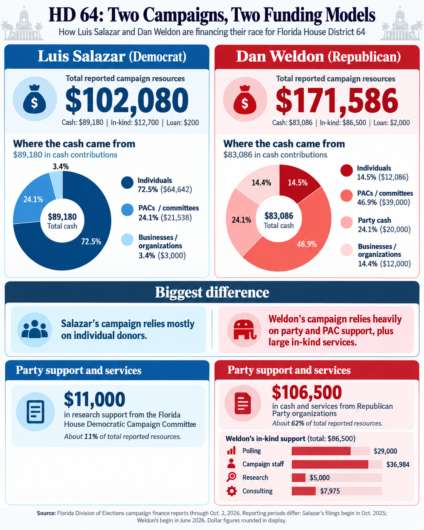
Salazar has raised about $89,180 in cash. Around $64,642, or 72.5%, came from individual donors. His report lists many $5, $10, $25, and $50 gifts. Some people give a small amount each month. No one gets rich from $10 donations, but enough of them can fund a campaign.
Weldon has raised about $83,086 in cash, but just $12,086, or 14.5%, came from individual donors.
That’s a big difference. Salazar has received more than five times as much from individuals as Weldon. In Hillsborough County alone, Salazar has about $43,356 from individual donors, while Weldon has $9,760.
To be fair, a bigger share of Weldon’s individual donations comes from local people. But since individual donations are such a small part of his total, that comparison only goes so far. So where does the rest come from?
Well, Tallahassee has been generous.
Of Weldon’s $83,086 in cash contributions, about $59,000 came from political committees and party organizations. That includes a $20,000 contribution from the Florida House Republican Campaign Committee.
His report also includes a remarkable number of $1,000 contributions from political committees. Several of these committees share the address 527 East Park Avenue in Tallahassee. Apparently, it’s a busy place. And the cash contributions are only part of the story.
Weldon has also received in-kind contributions. That’s a fancy way of saying someone pays for campaign goods or services instead of giving the candidate a check. The campaign must still report the value of those services.
In Weldon’s case, the Florida House Republican Campaign Committee provided nearly $79,000 in services, including $29,000 for polling, almost $37,000 for campaign staff, $5,000 for research, and nearly $8,000 for professional consulting.
That’s a lot of professional help, and it all adds up. The Republican Party of Florida also provided another $7,541 in services.
When you add it all up, Republican Party organizations have supplied about $106,500, or 62% of Weldon’s total reported campaign resources. That’s significant support for a State House race.
Salazar also has help from political organizations.
His supporters include labor unions, Equality Florida Action PAC, Everytown for Gun Safety Action Fund, and three Florida Realtors political committees. The Florida House Democratic Campaign Committee also provided $11,000 in research services, which is about 11% of his $102,080 in total reported resources.
It’s no surprise that political parties support their candidates. That’s part of their job. But how much support they give is worth looking at, especially when we’re choosing who will represent us in Tallahassee.
Timing also matters. Salazar started reporting contributions in October 2025, while Weldon’s first report was in June 2026. Salazar has had more time to build his donor base.
Even so, the financial reports show how these campaigns work. Salazar has raised most of his money from individuals, with hundreds making small donations. Weldon has gotten most of his support from party organizations and political committees, plus many professional campaign services.
Of course, none of this tells us how either candidate will vote if elected, and a political donation doesn’t mean anyone expects something in return.
But it does raise an important question for voters: Who is paying to send these candidates to Tallahassee?
I look for who their community supports most. That’s the story here, and it’s clearly Luis Salazar.
Sources
- Florida Department of State, Division of Elections, Campaign Finance Database.
- Luis Salazar, 2025–2026 Campaign Contribution Reports.
- Dan Weldon, 2026 Campaign Contribution Reports.
- Florida House Republican Campaign Committee, 2025–2026 Campaign Finance Reports.
Note: All dollar amounts, donor classifications, and geographic comparisons were calculated from the candidate contribution records published by the Florida Division of Elections.
