
What Happens to the American Promise?
 Part Four of a Six-Part Series on Project 2025
Think about spending your life working, paying taxes, raising a family, and helping your community. Now you’re retired, living on a fixed income, and relying on Social Security and Medicare for some security in your later years. Maybe your spouse needs nursing home care, and Medicaid helps cover costs your family couldn’t afford alone.
At the same time, your grandchildren go to public schools that have trouble hiring teachers, keeping up their buildings, and offering services for kids with special needs.
These are ordinary American families, and the government programs they rely on are about to change in big ways.
Welcome to Part Four of our Project 2025 series. Here, we’ll look at what happens when the federal government cuts back support for education, health care, and programs that help Americans meet basic needs.
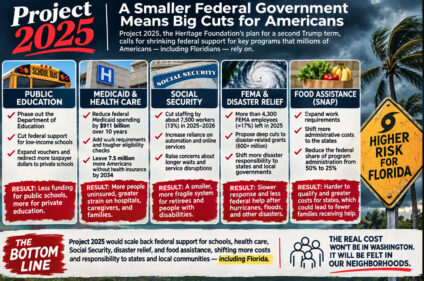
We’re already seeing some of the effects, and even bigger changes are still to come. In July 2025, President Trump signed the sweeping federal budget law his administration called the One Big Beautiful Bill Act. The Congressional Budget Office estimated that its Medicaid provisions would reduce federal spending by approximately $911 billion over ten years and leave 7.5 million more Americans without health insurance by 2034.
That’s a huge amount of health care to take away from something advertised as beautiful. Perhaps the beauty depends on whether you’re pretending to balance a federal budget or trying to pay a hospital bill.
Medicaid provides medical coverage for low-income Americans, children, and people with disabilities. It also pays for much of the nation’s long-term nursing home care, including care for older Americans who have exhausted their savings. The new law adds work requirements for some Medicaid recipients, increases eligibility checks, and makes other changes to cut federal spending. Some parts won’t fully kick in for years, but the expected impact is significant.
And we’ve seen what can happen when states impose these requirements. Arkansas introduced Medicaid work requirements in 2018. Within months, more than 18,000 people had lost coverage, often because they struggled with reporting rules rather than refusing to work. A federal court later blocked the program.
 Apparently, the cure for poverty is supposed to be paperwork. Those unable to complete it can presumably improve their circumstances while uninsured.
Florida already has serious problems with health care access. The state remains among those that haven’t expanded Medicaid under the Affordable Care Act. Additional federal restrictions could place further pressure on uninsured residents, hospitals, and families caring for older relatives. When an uninsured neighbor needs emergency care, the cost doesn’t magically disappear. Hospitals and communities still have to handle it.
Social Security presents another concern, especially for older Americans and people with disabilities.
Between January 2025 and January 2026, Social Security Administration staffing fell by approximately 7,500 employees, or 13 percent, according to the Center on Budget and Policy Priorities. The Government Accountability Office has warned that the agency needs a plan to retain employees with the skills required to deliver timely service.
The administration says phone and field office wait times got better in 2026. But independent groups still see problems with staffing, claims processing, and service. Fewer staff doesn’t always mean worse service, but it does make it harder to handle mistakes or surprises. If you’re waiting for disability benefits, fixing a payment mistake, or having trouble with an online system, good service is important. People who’ve paid into Social Security for years deserve a system that picks up the phone and solves their problems.
That’s not asking for much.
And here in Florida, we have another reason to worry about Washington’s plans: the Federal Emergency Management Agency, better known as FEMA. More than 4,300 FEMA employees left during fiscal year 2025, and the Government Accountability Office found that the agency made staffing cuts without first determining how they would affect disaster response. The administration also proposed further cuts to disaster-related grants. Project 2025 calls for shifting more responsibility for disaster preparedness and recovery to state and local governments. That ought to concern anyone who has ever watched a hurricane approach Florida. FEMA helps coordinate disaster response, supports recovery efforts, and provides assistance when communities face losses beyond their means. Weakening that capacity could mean slower recovery, less help for displaced families, and greater financial burdens on state and local taxpayers.
We’ve been fortunate to avoid another statewide catastrophe during the past two hurricane seasons, but that hardly means Florida has escaped serious storms. Hurricane Isaias brought flooding to the Panhandle in October, heavy rainfall caused widespread flooding across parts of the peninsula in early November, and record-setting rains recently inundated communities along the Atlantic coast. Anyone who has lived in Florida long enough knows that a quiet season offers no guarantee about the next one. Yet Washington is reducing FEMA’s workforce while proposing changes that would leave states with more responsibility. Apparently, the plan is to hope the weather cooperates. I prefer a federal disaster agency ready to help when it doesn’t.
Then there’s food assistance.
For families having a hard time, losing food help can mean picking between groceries, rent, and medicine. Older Americans on fixed incomes might face the same tough choices.
And despite the familiar political speeches about people refusing to work, millions of Americans receiving Medicaid or living in SNAP households are employed. Many others are children, retirees, or people with disabilities. The idea that government assistance is a lavish lifestyle choice would probably surprise someone trying to stretch a few hundred dollars across an entire month.
Now consider what Project 2025 proposes for public education, particularly here in Florida.
The Heritage Foundation calls for eliminating the federal Department of Education, changing how federal special education funding is administered, and eventually returning more responsibility for helping low-income schools to the states. It also favors vouchers and education savings accounts that allow taxpayer money to support private education.
Florida has already embraced that last idea enthusiastically. Following the Legislature’s 2023 expansion of private school vouchers, more than 500,000 Florida students now use taxpayer-funded scholarships. The state spends more than $4 billion annually on these programs, including assistance available to families who could already afford private tuition.
In Miami-Dade County, the contrast is striking. During the 2026–27 school year, approximately $766 million in state education funding goes toward private school vouchers, compared with $737 million for public and charter schools. Local property taxes also support public schools, so these figures don’t represent total school funding, but they demonstrate how dramatically state priorities have shifted.
Public schools still have to serve every child who comes, including those with disabilities, language barriers, or families who can’t provide private transportation. When students leave, schools lose money, but their buildings, buses, and other costs stay the same. So, the plan is to keep running the neighborhood school while also paying another school to teach some of its former students. Financial innovation is a wonderful thing when someone else has to make the numbers work.
Now there’s a possible double impact.
In March 2025, Trump ordered his education secretary to facilitate closing the Department of Education to the extent permitted by law. The department subsequently cut its workforce by roughly half, raising concerns about its ability to manage funding and enforce protections for students. If Congress ultimately approves Project 2025’s larger education proposals, Florida public schools could face additional pressure from reduced federal support while state dollars continue flowing toward private education.
Kids who need the most help could end up facing the biggest challenges.
That’s what ties all these policies together.
 Project 2025 calls for changing the federal government’s role in education, health care, and public assistance. The administration and Congress have already enacted substantial parts of that approach, with further proposals awaiting action. The financial effects extend beyond the people receiving benefits. Children struggling in underfunded schools become adults entering our workforce. Patients without insurance still need medical treatment, and nursing homes depend on adequate funding to care for our parents and grandparents. Communities share the costs when basic needs go unmet.
This is the warning Americans need to hear. Cutting federal spending might make the budget look better, but it often means extra costs for states, families, hospitals, and local communities. Those effects deserve just as much attention as the money saved. When Democrats take control of Congress in January 2027, they’ll have opportunities to investigate these changes, examine their effects, and reconsider federal funding priorities. The president retains his veto power, so meaningful changes will require legislative work and sustained public scrutiny.
Everyday Americans can help by going to school board meetings, looking into voucher spending, asking state lawmakers questions, and demanding that Congress members explain how funding cuts affect their constituents. We can support food banks, public schools, and groups that help families get health care, while also insisting that government does its job.
And perhaps we should pay a little more attention to our neighbors. The child who struggles to read, the family who can’t afford medical care, and the older couple facing nursing home bills are all part of our community. Their situations shape the kind of society we build and the future we leave behind. The American promise has always meant believing that every child should get a chance to learn, that illness shouldn’t ruin a family’s future, and that people facing hard times deserve a fair shot at getting back on their feet.
Keeping those promises costs money. So does breaking them.
Sources
- Heritage Foundation. Mandate for Leadership: The Conservative Promise (Project 2025, 2023).
https://static.project2025.org/2025_MandateForLeadership_FULL.pdf - Congressional Budget Office. Estimated Budgetary Effects of H.R. 1, the One Big Beautiful Bill Act (2025).
https://www.cbo.gov/ - Kaiser Family Foundation (KFF). Medicaid and the 2025 Reconciliation Law: Coverage and Spending Impacts.
https://www.kff.org/ - Center on Budget and Policy Priorities. Analysis of Social Security Administration Staffing Reductions (2026).
https://www.cbpp.org/ - U.S. Government Accountability Office. Federal Workforce Changes and Social Security Administration Workforce Challenges (2026).
https://www.gao.gov/ - Social Security Administration. Agency Performance and Customer Service Updates (2026).
https://www.ssa.gov/ - U.S. Department of Agriculture, Food and Nutrition Service. Supplemental Nutrition Assistance Program: Administrative Costs and Changes Under the 2025 Reconciliation Law.
https://www.fns.usda.gov/snap - National Bureau of Economic Research. Medicaid Work Requirements and Coverage Losses in Arkansas.
https://www.nber.org/ - Florida Policy Institute. Florida Education Funding and Private School Voucher Analysis (2025–2026).
https://www.floridapolicy.org/ - NBC News. Reporting on Miami-Dade Public School Funding and Florida Private School Vouchers (October–November 2026).
https://www.nbcnews.com/ - The White House. Improving Education Outcomes by Empowering Parents, States, and Communities (March 20, 2025).
https://www.whitehouse.gov/presidential-actions/2025/03/improving-education-outcomes-by-empowering-parents-states-and-communities/ - U.S. Department of Education, Office of Inspector General. Oversight of Department of Education Workforce Reductions and Restructuring (2025–2026).
https://oig.ed.gov/
