
We All Want to Save Democracy. From What, Exactly?
 The 2026 Election, Part Three
After looking at what voters wanted in the 2026 election and what Congress might actually do, I kept coming back to something that puzzled me. Americans from both political parties say democracy matters, and many think it’s in real trouble.
So why can’t we agree on what’s putting it at risk?
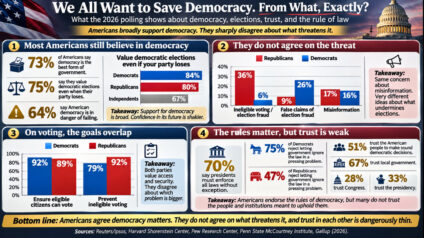
A June Reuters/Ipsos poll found that 73% of Americans think democracy is the best form of government. Even better, 75% said they value democratic elections, even if their preferred party loses. That included 84% of Democrats and 80% of Republicans.
It seems we agree that democracy is worth saving. We just can’t agree on who’s trying to destroy it. The same survey found that 64% believed American democracy was in danger of failing. That included 85% of Democrats and 50% of Republicans.
Those numbers caught my eye. So I looked into it more, and what I found helps explain why our political disagreements are so tough to solve.
 Two Parties, Two Different Fears
Researchers at Harvard’s Shorenstein Center surveyed more than 16,000 Americans before the November election and asked what concerned them most about the voting process. Among Republicans, 36% identified ineligible voters or election fraud as their greatest concern. Only 6% of Democrats chose that answer.
Democrats saw a different danger. Twenty-six percent worried most about false claims of election fraud, compared with 9% of Republicans. Both groups expressed nearly identical concern about misinformation, at 16% of Democrats and 17% of Republicans.
There’s some irony in that last finding. We agree misinformation is a problem, but we don’t agree on what’s actually false. That can make for some lively family dinners, though maybe fewer invitations next Thanksgiving.
But the differences have consequences.
What Does the Evidence Say?
Election security is important. Every eligible voter should get the chance to vote, and every legal vote should count. People who commit election fraud on purpose should face consequences. But the evidence matters.
In September, the Trump administration reported approximately 1,600 potential voter-fraud cases and 160 arrests following a nationwide investigation of noncitizen voting. The Justice Department separately reported charges against 70 people for unlawful voting or registration offenses.
Those numbers should be investigated, and legal action should be taken if needed. But they make up a tiny part of the more than 211 million active registered voters. An arrest doesn’t mean someone is guilty. The evidence hasn’t shown widespread noncitizen voting that could change national election results.
Here’s where the polling becomes especially interesting. Pew found that 89% of Republicans and 92% of Democrats considered ensuring that eligible citizens could vote important. Large majorities in both parties also supported preventing ineligible voting.
We agree on those basic goals. We just disagree about how serious the problems are and whether the solutions might cause new issues. Surely we can protect voting without treating every election like a crime scene.
The Constitution Applies to Everyone
Another area shows Americans agree more than our political arguments suggest. Penn State’s McCourtney Institute for Democracy found that 70% of Americans believed presidents have a duty to enforce all laws without exception. More than three-quarters agreed that presidents must obey laws and court rulings even when they believe those decisions are wrong.
That sounds encouraging. But the agreement weakened when researchers asked whether the government could disregard the law to address a pressing problem. Seventy-five percent of Democrats rejected that idea, compared with just 47% of Republicans.
It seems the urge to make exceptions grows when the rules get in the way of something we want done.
A Crisis of Trust
The problem extends beyond elections and presidential power. Gallup’s September survey found that only 28% of Americans trusted the legislative branch, while 33% trusted the executive branch. Confidence in the federal government’s ability to handle domestic problems was equally low.
Maybe the most troubling finding was that only 51% trusted the American people to make good decisions in a democracy. Think about that. Nearly half of us don’t have confidence in our fellow citizens’ ability to make democratic decisions.
There was one bright spot. Sixty-seven percent trusted their local governments. Maybe seeing elected officials at the grocery store reminds us they’re people too, even if we don’t always agree with them.
But democracy can’t work well when people lose trust in the institutions that run elections, enforce laws, and settle disputes.
What are we trying to save?
I started this series by asking what voters wanted from Congress. Then I looked at the obstacles to accountability and cooperation. Now I’m wondering if we’ve found a deeper problem.
Americans still share key democratic values. We want fair elections, a lawful government, and leaders who respect constitutional limits. But our political loyalties affect how we see threats and who we’re willing to hold accountable.
To rebuild trust, we’ll need honest elections, solid evidence, independent institutions, and a willingness to apply the same standards regardless of party. It will also require something increasingly scarce in American politics: being willing to accept an uncomfortable fact, even if it comes from someone we don’t like.
I worry about whether Congress can meet that challenge. But we’re the ones who elect Congress, and our willingness to look at the facts matters just as much as theirs.
We say we want to save democracy. Maybe we should start by agreeing that its rules apply to everyone.
Sources:
- Reuters/Ipsos. “Two in Three Americans Say U.S. Democracy Is in Danger of Failing.” June 2026.
https://www.ipsos.com/en-us/two-three-americans-say-us-democracy-danger-failing - Harvard Kennedy School, Shorenstein Center. “Voters Divided Over Top Concerns About 2026 Elections.” September 2026.
https://shorensteincenter.org/resource/voters-divided-over-top-concerns-about-2026-elections/ - Associated Press. Reporting on the Trump administration’s investigations into alleged noncitizen voting. September 2026.
https://apnews.com/article/9cebf968f72e6209a09a5d4adce2c155 - The Heritage Foundation. Election Fraud Database.
https://www.heritage.org/voterfraud - Pew Research Center. “Broad Public Confidence in Elections in the U.S., but Partisans Differ Over Concerns About Access, Security.” October 20, 2026. https://www.pewresearch.org/politics/2026/10/20/broad-public-confidence-in-elections-in-the-u-s-but-partisans-differ-over-concerns-about-access-security/
- Pew Research Center. “How Confident Are Americans in the Midterm Elections’ Fairness and Accuracy?” August 5, 2026.
https://www.pewresearch.org/short-reads/2026/08/05/how-confident-are-americans-in-the-midterm-elections-fairness-and-accuracy/ - Penn State University, McCourtney Institute for Democracy. “Americans Weigh In on Presidential and Citizen Responsibilities to the Rule of Law.” May 2026.
https://democracy.psu.edu/poll-report-archive/americans-weigh-in-on-presidential-and-citizen-responsibilities-to-the-rule-of-law/ - Gallup. “Trust in Federal Government Sinks to New Depths.” October 2026.
https://news.gallup.com/poll/715361/trust-federal-government-sinks-new-depths.aspx - Gallup. Research on Americans’ confidence in major U.S. institutions. 2026.
https://news.gallup.com/poll/1597/confidence-institutions.aspx - Gallup. Research on Americans’ trust in government and the democratic process. 2026.
https://news.gallup.com/topic/trust-in-government.aspx
