
I’d like to keep the Rays – I’d also like to see the whole bill
Let me start by saying I would like to keep the Tampa Bay Rays in the area. But, in my view, we got snookered on the Bucs stadium deal, and I’m concerned we may be heading down a familiar road. Perhaps I’ll share my impressions of that earlier adventure another time.
I have a degree in Business Administration from a pretty good business college. I should also disclose that accounting was NOT my best subject. What follows is my honest attempt to make sense of a complicated public deal, with help from some AI tools and a stack of documents.
A project this big is bound to be complicated. Here, we’re dealing with a stadium, a college campus, public land, private development, several layers of government, different funding sources, and a web of agreements.
Some of this complexity can’t be helped. Still, I wonder how much of it actually helps those pushing for the deal. As my grandfather might have said, it feels a bit like “hiding the weeny.”
One problem is that some key agreements are either coming later or aren’t easy to find in the public documents we have. That doesn’t mean they don’t exist, but it does mean the community is being asked to judge the deal without seeing everything.
I’m not happy about that.
Here’s what I’ve figured out so far.
What are we putting into this?
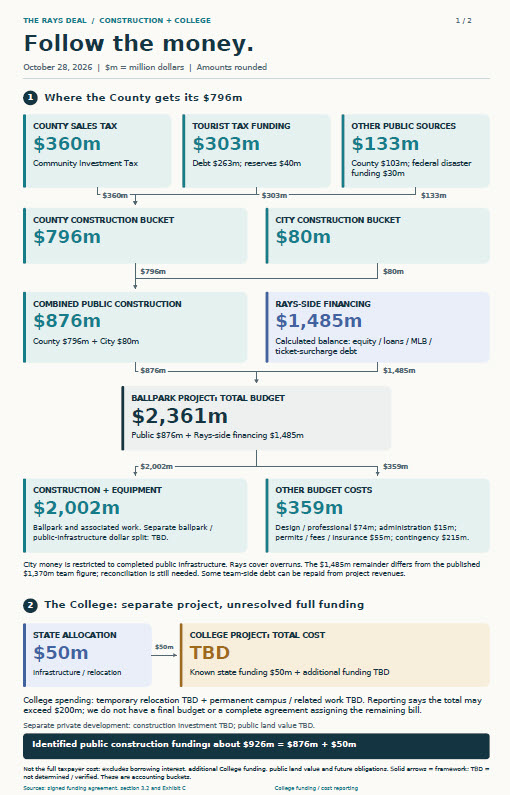
The stadium and associated construction project has a budget of approximately $2.36 billion. The City and County have committed approximately $876 million toward that construction, subject to the agreement’s conditions.
The County’s share is about $796 million. That includes $360 million in Community Investment Tax money, $303 million in tourist-tax borrowing and reserves, $103 million from other County resources and approximately $30 million in federal disaster-recovery funding.
The City’s share is $80 million, restricted to reimbursing completed public infrastructure improvements serving the project. The City may use borrowing to finance that commitment.
Tampa residents participate in both the City and County commitments. Residents elsewhere in Hillsborough participate in the County commitment. Visitors help pay some of the taxes involved, but these are still public resources.
“No new taxes” sounds reassuring. Existing tax dollars, however, still spend remarkably well.
The Rays have to cover the rest of the project costs and any construction overruns. They can use equity or borrow money, but it’s not like the owner is just writing a personal check.
The public’s construction commitment is just one part of the total cost. Borrowing means paying interest and fees. Public land and long-term development rights are valuable, and future maintenance, repairs, and services will also cost money, and I’ve not found estimates for that (where’s that weeny again?).
And what happens to the College?
Hillsborough College’s Dale Mabry campus is central to this project. Its property provides the location, while its students and programs must accommodate the disruption.
The state has allocated $50 million for campus infrastructure and relocation. Reporting indicates that relocation and rebuilding may cost more than $200 million. We have not located a final, fully funded budget assigning responsibility for the entire bill.
If you add the $50 million from the state to the stadium’s public construction funding, that’s about $926 million in public money, not counting borrowing costs and other unknowns. And there’s still another $150 million needed to finish the new campus, if it ever gets built.
The new campus could be a big upgrade, but students, faculty, and taxpayers still deserve clear answers about where everyone will go, what it will cost, and who’s paying.
Moving a college requires somewhat more planning than moving a couch.
What supposedly comes back?
The central promises include a County-owned stadium, a long-term commitment from the Rays, public infrastructure, a rebuilt campus, and surrounding development with housing, businesses, and entertainment.
Those benefits could matter, but their real value depends on what actually gets built, when it opens, and what ongoing costs the public will have.
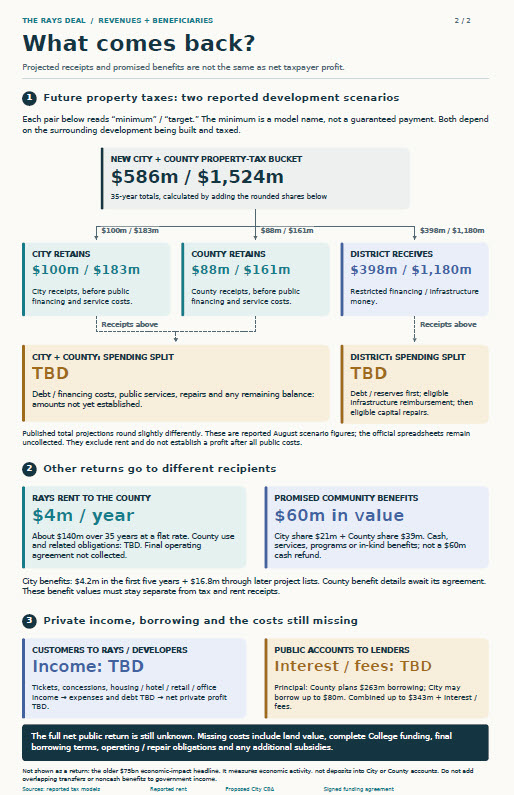
Reports say that over 35 years, the City could keep about $100 million to $183 million in extra property taxes. The County’s share is estimated at $88 million to $161 million. (That almost covers the cost of rebuilding a college.)
These numbers are based on different development assumptions. The so-called “minimum” scenario isn’t a guaranteed minimum payment.
A big part of the property-tax growth from the development would go to the stadium district to pay for infrastructure and capital costs. The City and County would only keep their agreed portions.
The County is also supposed to get $4 million a year in stadium rent, which adds up to $140 million over 35 years if the rate stays the same. But we still don’t have the final operating agreement to see what expenses and obligations come with that money. That’s a pretty important detail, but I couldn’t find it anywhere.
There’s also a minimum $60 million community-benefits promise, split between the County and City and provided by the Rays organization. This can be cash, programs, services, or in-kind contributions from the Rays. These are worth considering, but they should be counted separately from money going into government accounts.
There’s also the much-quoted $75 billion economic-impact estimate (and we all know how reliable those are). That number is about projected economic activity around the stadium and nearby development over 30 years. It doesn’t mean $75 billion will end up in public coffers.
The real question is how much money the governments actually keep, when it comes in, and what’s left after expenses.
So far, the documents we’ve found don’t show that the deal pays for itself.
Why I’m still a “no”
There are some important protections. Public contributions have a cap, payments have conditions, and the Rays have to cover any construction overruns. The public isn’t just handing over a blank check.
But some big parts of the financial picture are still missing or not available. That makes it hard to know the real cost, what we might get back, and the risks the community is taking on.
Meanwhile, the team has set tight deadlines for opening the new stadium. I get that construction needs a schedule, but I also know that anyone asking for public money wants to keep things moving quickly.
We’ve all heard a car salesman say the price and financing are only good “today,” and thought, “Great, now I don’t need to ask more questions.” Just sign here…
Another major uncertainty is Florida’s November 3 property-tax amendment vote.
The signed stadium agreement does address Amendment 3. It includes procedures if the amendment makes certain uses of public funding unlawful, including possible alternative arrangements and limits on obligations to replace unavailable funding.
But that still leaves a bigger question: What happens if local governments lose a lot of revenue and have to cover other essential services? Can we still afford this commitment?
I haven’t seen a full public accounting that answers that. So, with what I know right now, I’m a “no” on this deal.
If anyone on the City Council or County Commission can fill in the gaps, I’d be glad to talk. I’m open to changing my mind if the facts change.
Like I said before, I want the Rays to stay here. I’ve also thought for a long time that the dog-track property should be seriously considered for a stadium.
For this proposal, the people being asked to help pay for it deserve clear commitments, easy-to-understand numbers, and enough time to look them over.
Preferably before we’re told where to “just sign here.”
Sources
Information reviewed through October 28, 2026
- Signed Stadium Development and Funding Agreement
The principal source for public contributions, construction costs, tax sharing, funding conditions, and Amendment 3 provisions. See especially Sections 3.2, 3.6(e), 3.8 and 3.10, and Exhibits C and E.
https://chatgpt.com/library?file_id=libfile_564743997f088191a5dda55ffbd2f80a&account_id=personal - WUSF: “Final agreement reached on Rays stadium. Next up: votes by city and county” — August 21, 2026
Reporting on the financing framework, proposed annual rent, and 35-year initial commitment. This predates final approval; the signed agreement controls where terms differ.
https://www.wusf.org/sports/2026-08-21/final-agreement-reached-stadium-with-rays-tampa-hillsborough-county - WUSF: “Renderings show ‘reimagined’ Hillsborough College campus” — August 26, 2026
Reporting on the $50 million state allocation, replacement campus, and potential relocation costs exceeding $200 million.
https://www.wusf.org/education/2026-08-26/hillsborough-college-renderings-reimagined-campus-rays-stadium-district - Tampa Monitor: “Follow Up on a Follow Up: CDD Revenue Models” — August 29, 2026
Published tables describing the “minimum” and “target” development scenarios and projected property-tax shares. This is secondary analysis; the underlying official spreadsheets remain a collection target.
https://www.tampamonitor.com/news/follow-up-on-a-follow-up-cdd-revenue-models/ - Proposed City of Tampa–Rays Community Benefits Agreement, with completed benefits list
Documents the City’s $21 million share, initial $4.2 million commitment, valuation of cash and in-kind benefits, and enforcement provisions. This was the proposal collected before the October 29 meeting.
https://chatgpt.com/library?file_id=libfile_4ef2878f82708191a96cad1bca453da1&account_id=personal - Hillsborough County Tax Collector: “Property Tax Reform”
Official explanation of Amendment 3, its November 3 election date, and proposed implementation.
https://www.hillstaxfl.gov/property-tax-reform/ - WUSF: “Possible economic impact of Tampa Bay Rays stadium discussed Thursday” — April 14, 2026
Explains the AECOM study behind the $75 billion economic-impact estimate, including its dependence on surrounding development.
https://wusf.org/text/politics-issues/2026-04-14/possible-economic-impact-tampa-bay-rays-stadium-discussed-thursday - WUSF: “Tampa Bay Rays trim their stadium ask, but a $75M gap remains unresolved” — April 16, 2026
Documents the earlier negotiations, financing uncertainties, and pressure to reach an agreement by the team’s deadline.
https://www.wusf.org/sports/2026-04-16/tampa-bay-rays-trim-their-stadium-ask-but-a-75m-gap-remains-unresolved - AI was used to analyze documents and prepare this essay.
