
Seven Checks. One Address. Nothing to See Here… Probably.

This entry is in the series 2026 Elections

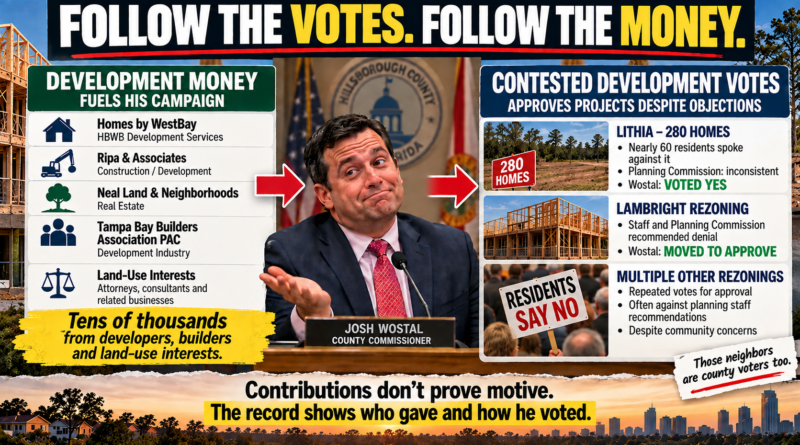
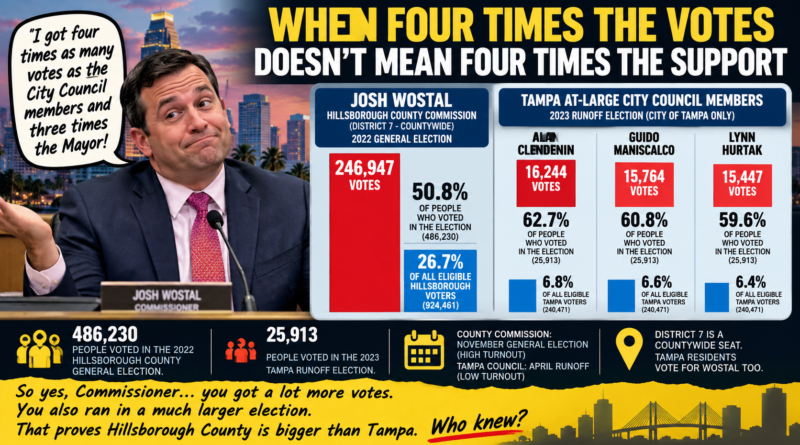
What if the most interesting story isn’t who gave to one candidate—but who keeps showing up in multiple County Commission races? That’s exactly what caught my attention while reviewing Donna Cameron Cepeda’s latest campaign finance report. One connected business network accounted for more than one-quarter of her campaign’s monetary contributions, and the same network also appears in Josh Wostal’s filings. There’s nothing illegal about that. In fact, businesses have every right to support the candidates they believe will best serve the community.

But campaign finance reports exist for a reason. They allow voters to see who is investing in our elections and to ask informed questions before casting a ballot. This article doesn’t accuse anyone of wrongdoing. Instead, it examines one business network’s unusually strong financial interest in Hillsborough County Commission races, and asks the question every voter should ask: Why are these races important enough to attract that level of investment?

Read more

What a Real Hillsborough County Efficiency Review Would Look Like

This entry is in the series Hillsborough DOGE Report Analysis

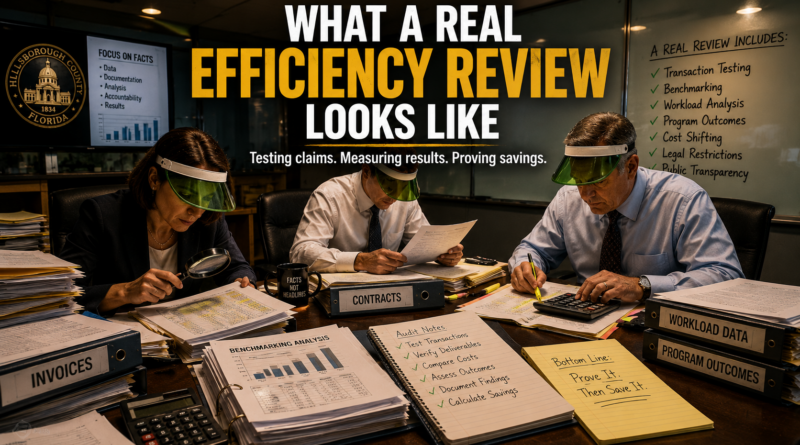
The Hillsborough County DOGE report raised important questions. However, a true efficiency review must go beyond highlighting large figures. It should test transactions, compare costs, assess workloads, evaluate results, and consider the impact of service reductions.

This final essay outlines the essential elements of a comprehensive review and emphasizes that public trust relies on evidence, not headlines. The objective should be a clear, substantiated case for how each dollar will be saved, rather than the largest possible savings claim.

Read more

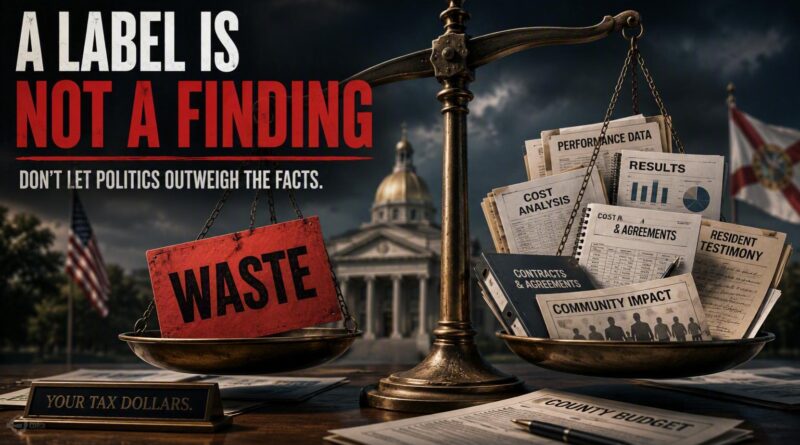
When “Waste” Becomes a Political Word Instead of a Financial One

This entry is in the series Hillsborough DOGE Report Analysis

“Waste” should describe money spent badly. Too often, it becomes a political label applied before anyone proves that a program failed, cost too much, or duplicated another service.

This essay looks at how that label can be used to weaken support for public programs before the facts are settled. Real waste should be cut. Political dislike should be debated honestly. Those are not the same thing.

Read more

The DOGE Method: Lots of Documents, Limited Testing, Very Big Numbers

This entry is in the series Hillsborough DOGE Report Analysis

The Hillsborough County DOGE committee reviewed a large volume of records and announced more than $678 million in possible savings. But its own report also admits that the work involved limited due diligence, no transaction-level testing, and no independent verification.

That does not make the report useless. It does mean the public should treat it as a list of leads, questions, and proposed cuts, not as proof that hundreds of millions of dollars were wasted. A lot of documents can produce a big number. They do not automatically produce an audit.

Read more

Real Waste, Fake Waste, and Things Republicans Just Don’t Like

This entry is in the series Hillsborough DOGE Report Analysis

Not every proposed cut is the same. Unused software licenses, underused vehicles, vague contracts, and weak bidding rules are real places to look for waste.

But the Hillsborough County DOGE report also targets nonprofits, equity work, community outreach, and cultural programs. In this essay, I separate genuine control problems from programs that appear to have been labeled “waste” because committee members do not like their purpose.

Political opposition is fair. Calling it financial analysis is not.

Read more

Cutting a Program Is Not the Same as Making Government Efficient

This entry is in the series Hillsborough DOGE Report Analysis

The Hillsborough County DOGE committee calls the county health care plan a source of major savings. But ending care for more than 22,000 low-income residents is not the same as making government more efficient.

This essay looks at what the program actually does, why voters approved the tax that funds it, and what happens when needed care disappears from one budget line only to reappear in emergency rooms, hospitals, charities, and family finances.

Cutting a program may make a spreadsheet look better. The harder question is whether the community pays more when the service is gone.

Read more

Who Chose the Watchdogs?

This entry is in the series Hillsborough DOGE Report Analysis

Before accepting the Hillsborough County DOGE committee’s findings as a neutral review of county spending, it is worth asking who selected the people doing the reviewing.

The five-member panel included several people with solid professional backgrounds, but only one had clear forensic accounting credentials. At least three had strong Republican Party ties, including committee chair Jake Hoffman, a former Republican candidate and Young Republican leader.

This essay looks at how the committee was formed, how its members were chosen, and why a politically tilted advisory panel should not be treated like an independent audit team.

Read more

They Did Not Find $678 Million in Waste

This entry is in the series Hillsborough DOGE Report Analysis

The Hillsborough County DOGE committee says it found roughly $678 million in potential savings. That sounds impressive, until you look at what the number actually includes: entire public programs, contract limits, fund balances, possible management changes, and spending choices committee members simply do not support.

In my latest essay, I take a closer look at the report and the difference between finding real waste and labeling any disliked program as waste. The committee may have raised some fair questions about fleet use, software licenses, contracts, and oversight. But cutting a service is not the same as making government more efficient, and a large number is not proof.

Read more

The Tale of Two Doctors

This entry is in the series 2026 Elections

In a political era where labels are often used as shields, few examples are as stark as the “Dr.” honorific Donna Cameron-Cepeda wears to project authority over Hillsborough County’s $12 billion budget. While she cites her background as a financial analyst for a global corporation, her actual policy record reveals a troubling pattern of “pulling up the ladder” behind her. Having once relied on the very social safety nets and affordable housing she now votes to dismantle, her leadership has become a case study in the disconnect between personal history and public consequence.

The upcoming election presents a rare, high-contrast choice as Dr. Neil Manimala, a board-certified physician, enters the race with a platform centered on “healing” the damage done by recent regressive shifts. While Cameron-Cepeda’s tenure has been defined by culture-war distractions and the defunding of vital community nonprofits, Manimala represents a return to verified, professional competence. With even members of her own party filing to challenge her, the message is clear: Hillsborough is ready for a leader who values evidence over ideology and people over performance.

To understand the full scope of this “Doctor vs. Doctor” showdown and why this race has become a focal point for the future of our county, read the full analysis.

Read more

The Architecture of Abandonment: The Performance of Josh Wostal

This entry is in the series 2026 Elections

In the sterile halls of the Hillsborough County Center, he is known as “Hostile Wostal”—a man who treats the public treasury like a distressed asset ripe for liquidation. While he preens for social media as a fiscal hawk, his actual record is a masterclass in calculated abandonment, trading essential bus routes in South County for high-end sprawl subsidies that line the pockets of mega-developers like Lennar and Homes by WestBay. It isn’t “saving” when you strip the foundation of a community to pave the private driveways of the donor class; it is patrimonialism disguised as prudence.

Wostal’s governance is a performance of cruelty, evidenced by his crusade to defund the Supervisor of Elections and dismiss 100,000 of our neighbors as mere “ghost voters.” This isn’t about the bottom line; it is about rigging the game by silencing the voices he can’t win over. From stranding essential workers on the roadside to attacking the ballot box, Wostal has shown us that he knows the price of everything but the value of nothing. It is time to decide if we want a county that serves its people, or a family business that serves only its patrons. Follow the paper trail and learn more about how we can build a Hillsborough that belongs to everyone.

Read more

2022 Election – Board of County Commissioners District 5

This entry is in the series 2022 Election

This one is an easy one. I have no reason to think that Cepeda’s candidacy is anything more than an attempt to grab attention and advance some MAGA Christian Nationalist agenda, which Commissioner Smith has demonstrated her understanding of the issues important for a county commission to address, and can build a coalition to get things done. Keep Hillsborough County safe from an unhinged MAGA agenda, and vote for Mariella Smith.

Read more