
They Did Not Find $678 Million in Waste
 This is the first in a series exploring the recent DOGE Report issued by an unelected committee established by Hillsborough County Government. (You can download the report at the end of this article.)
A few weeks ago, Hillsborough County’s citizen DOGE committee member Jake Hoffman challenged me to wait until the committee released its report.
“Just read it,” was the message.
Well, the report is out.
I read it.
Mr. Hoffman and I don’t see things the same way.
He sees hundreds of millions in government waste. I see a mix of questions, assumptions, political complaints, possible management fixes, and suggested service cuts, all added up to make a big headline.
The committee grouped $529.25 million it recommended eliminating with another $149.1 million it recommended reviewing or reducing. That sounds impressive, as if members went through invoices, checked transactions, talked to employees, reviewed contracts, and uncovered piles of taxpayer money being wasted.
That is not what happened.
The committee did not do a formal audit. It did not thoroughly review each program or test many transactions. It also did not show that the money was misspent, spent illegally, or even spent poorly.
Instead, the committee listed programs, contracts, fund balances, employee costs, and policy choices that members thought should be reviewed, changed, reduced, or cut.
That may be useful work. It may even lead to real savings. But that is not the same as actually finding $678 million in waste. That difference is important.
Suppose the county spends money on a program that committee members dislike. They may recommend ending it. They may argue that the county should spend the money elsewhere or return it to taxpayers. That is a policy position. But just because someone with a spreadsheet and a title says so, that does not make it “waste.”
The clearest example is the county’s Indigent Health Care Program. The committee counted almost $300 million from that program as possible savings. That is not about efficiency. It is a suggestion to end a health care program for low-income residents.
Maybe the program has extra reserves or weak controls. Some patients might qualify for other coverage. Maybe some parts should change. Those are fair questions. But unless the committee shows who would lose care, what other coverage is really available, what costs would shift to hospitals and emergency rooms, and whether the county would lose federal matching funds, it has not found waste. It has just found a public service it wants to end.
There is a difference between making a program run better and making it disappear.
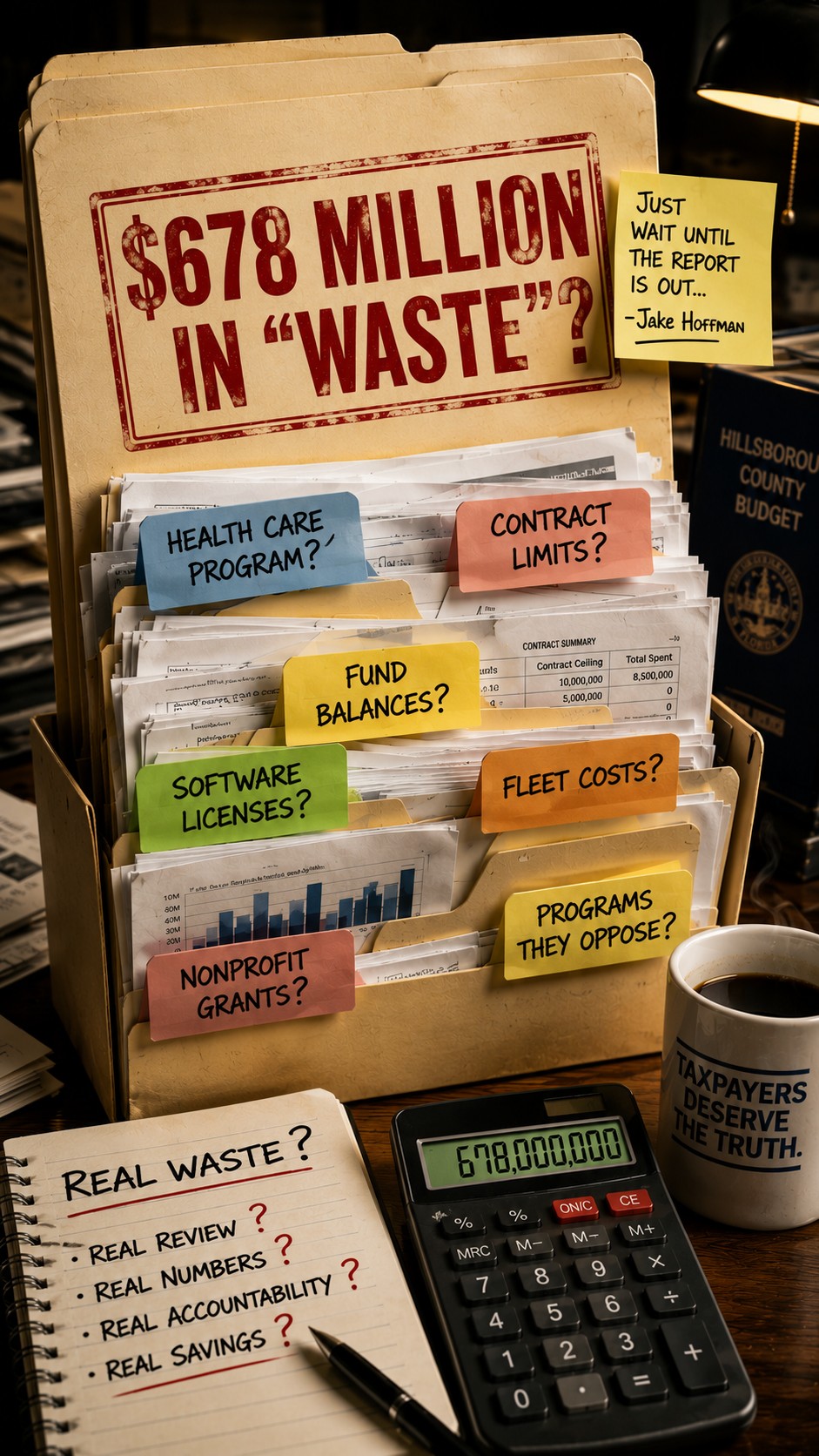 The report also raises concerns about vehicle allowances, fleet use, software licenses, noncompetitive contracts, nonprofit grants, film incentives, staffing levels, community liaisons, equity programs, and school-zone cameras. Some of those deserve a serious look.
Unused software licenses are wasteful. Underused vehicles can be wasteful. Badly written contracts can be wasteful. Paying too much because no one bothered to seek competitive bids can be a waste.
A real efficiency review should focus on what the county bought, what it got, what it paid, and if it could have gotten the same result for less. But the report often jumps from “this should be reviewed” to “this money can be saved” very quickly. A contract with a high spending limit does not mean the money was spent. A fund balance is not wasted money. An employee is not unnecessary just because a national ratio says so. A nonprofit grant is not waste just because the committee members dislike the organization. A film subsidy is not waste just because someone dislikes the film’s topic.
Government accounting is difficult enough without adding cultural commentary as a new math function. The report’s largest weakness is that it groups unlike things together.
The report adds possible savings from software licenses to the total cost of public programs. It mixes contract values with yearly expenses. One-time fund balances are combined with possible ongoing cuts. Management reforms are listed next to ideological complaints.
Then the total is announced as though every dollar had been proven unnecessary. That is not analysis. It is addition. And even the addition needs footnotes.
To be clear, Hillsborough County’s budget is big. No one should think every dollar is managed perfectly. There are probably old contracts, unused licenses, weak controls, unnecessary purchases, and programs that have continued without enough review.
Find those problems. Document them. Show the invoices, the duplication, the missed goals, and the cost comparisons. Show what can be cut without just moving the cost somewhere else.
Then, and only then, call it waste.
The DOGE committee has made a helpful starting list. It has pointed out areas that need more study and some practices that might need to change.
But it has not shown proof of $678 million in waste.
Jake told me to wait for the report. I have the report. I am still waiting for the evidence.
- Hillsborough County DOGE Committee report and recommendations.
- Hillsborough County Board policies governing nonprofit funding and political activity by county-funded organizations.
- Public reporting on the committee’s claimed savings and its recommendations concerning the Indigent Health Care Program.
