
The Ballot-Box Bureaucrat: Why Electing School Superintendents Is a Governance Nightmare
We have a strange habit in a few corners of this country of assuming that because something can be voted on, it should be voted on. It’s an old impulse, a kind of democratic over-indexing that confuses local control with actual competence.
Right now, a tiny fraction of public school systems nationwide, less than one percent, concentrated almost entirely in Florida and Alabama, still choose their school superintendents via a partisan ballot line. The people who defend this practice call it “democratic localism.” They wrap it in the flag of parental rights and voter autonomy.
But let’s be honest about what it delivers. It doesn’t deliver better test scores, higher graduation rates, or smoother operations. The data shows it has virtually zero impact on student achievement. What it actually delivers is a system-wide structural fracture.
To understand why, you have to look at how these two different models handle power and qualifications:
- The Talent Pool Collapse: To hire an appointed superintendent, a school board can launch a national search. They can recruit a seasoned educator with a doctorate in education administration from across the country. To be elected superintendent, a candidate must be a registered voter living in that specific county. You are choosing your chief executive from a microscopic local sample based on political ambition rather than professional excellence.
- The Accountability Illusion: In a standard corporate or civic model, the board hires the executive, sets the metrics, and fires them if they fail. It’s clean accountability. In an elected system, the superintendent is a political peer to the board. They both have their own mandates from the voters. When they inevitably clash, the system locks up. You get parallel legal counsels, public grandstanding, and a total hollowing out of administrative stability.
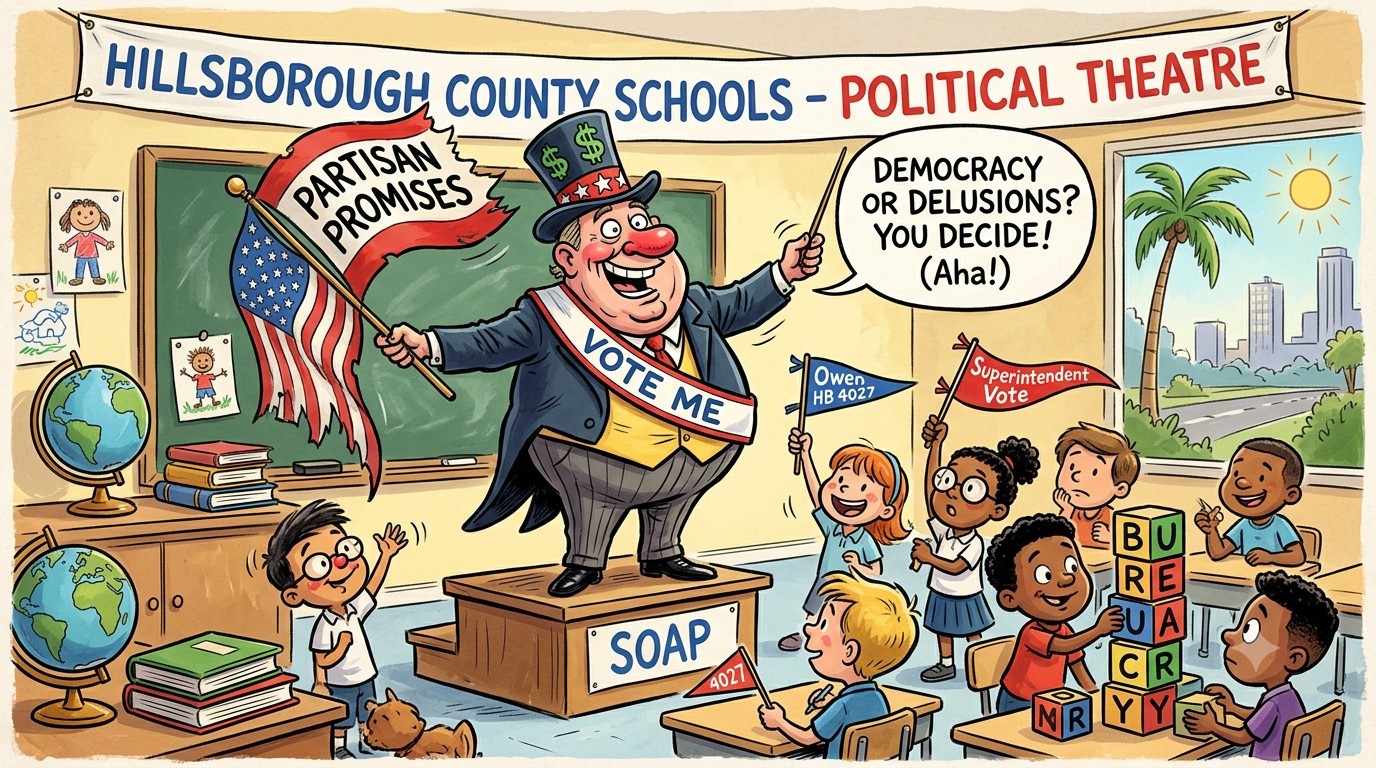 The hypocrisy of this push is laid bare by its loudest champions. Consider State Representative Michael Owen, the sponsor of HB 4027, the bill designed to push an elected partisan superintendent onto Hillsborough County. Representative Owen has established a clear record of voting yes on sweeping state preemption bills that strip local cities and counties of their home-rule authority. Yet, when it comes to the complex task of running a massive metropolitan school district, Owen suddenly rediscovers his “devotion” to local voter control.
This isn’t principled localism; it is a selective, cynical power play. When local boards don’t align with state-level political agendas, partisan politicians simply rewrite the rules of local governance to force a partisan knife fight.
If Representative Owen and his allies want to argue that a partisan popularity contest is the secret recipe for academic excellence, they are arguing against the entire map of American education. The data does not care about political theater. Standard-bearers of public education, states like New York, Connecticut, Massachusetts, and New Jersey, consistently hold the top four spots in national rankings for public school quality. None of them touch the elected superintendent model with a ten-foot pole. They treat school administration as a highly specialized profession.
Meanwhile, the only two states that cling to this structural anomaly tell a very different story. Alabama ranks 43rd in the nation for public school quality, weighed down by historically low proficiency metrics. Florida sits right in the middle of the pack at 24th. While Tallahassee loves to issue glossy press releases boasting about “Education Freedom” and parental power, the state’s actual public school performance is thoroughly average.
Partisan execution doesn’t move the needle; it just moves the goalposts.
Education isn’t a business, but managing a school system is an administrative vocation.
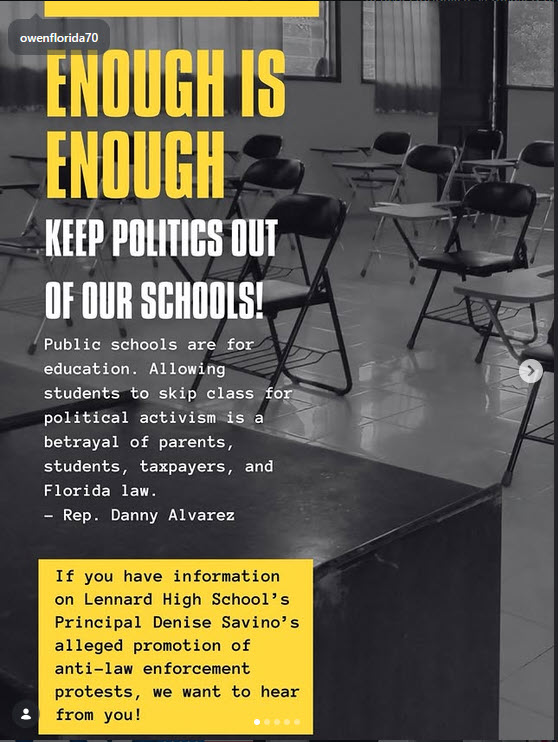
And this is rich…Owen has, on his Instagram account from about a year ago, a post saying, “ENOUGH IS ENOUGH-KEEP POLITICS OUT OF OUR SCHOOLS.” Hypocrisy, thy name is Michael Owen.

Pingback:Deep Something | The Ballot-Box Bureaucrat: Why Electing Hillsborough’s Superintendent Is Bad for Business and Worse for Classrooms