
What We Choose Together
I have been thinking about politics again, which is usually a dangerous thing to admit out loud. Politics can make otherwise reasonable people turn strange. It can flatten conversations, harden faces, and reduce real human beings to voting blocs and talking points. It can make people who are kind in every other corner of life suddenly sound as if compassion were a weakness and cruelty were a strategy.
And yet, I cannot escape the sense that disengaging from politics is itself a moral choice, not simply a neutral or quieter one. Our choices, whether to engage or avoid, are moral acts that shape our common life.
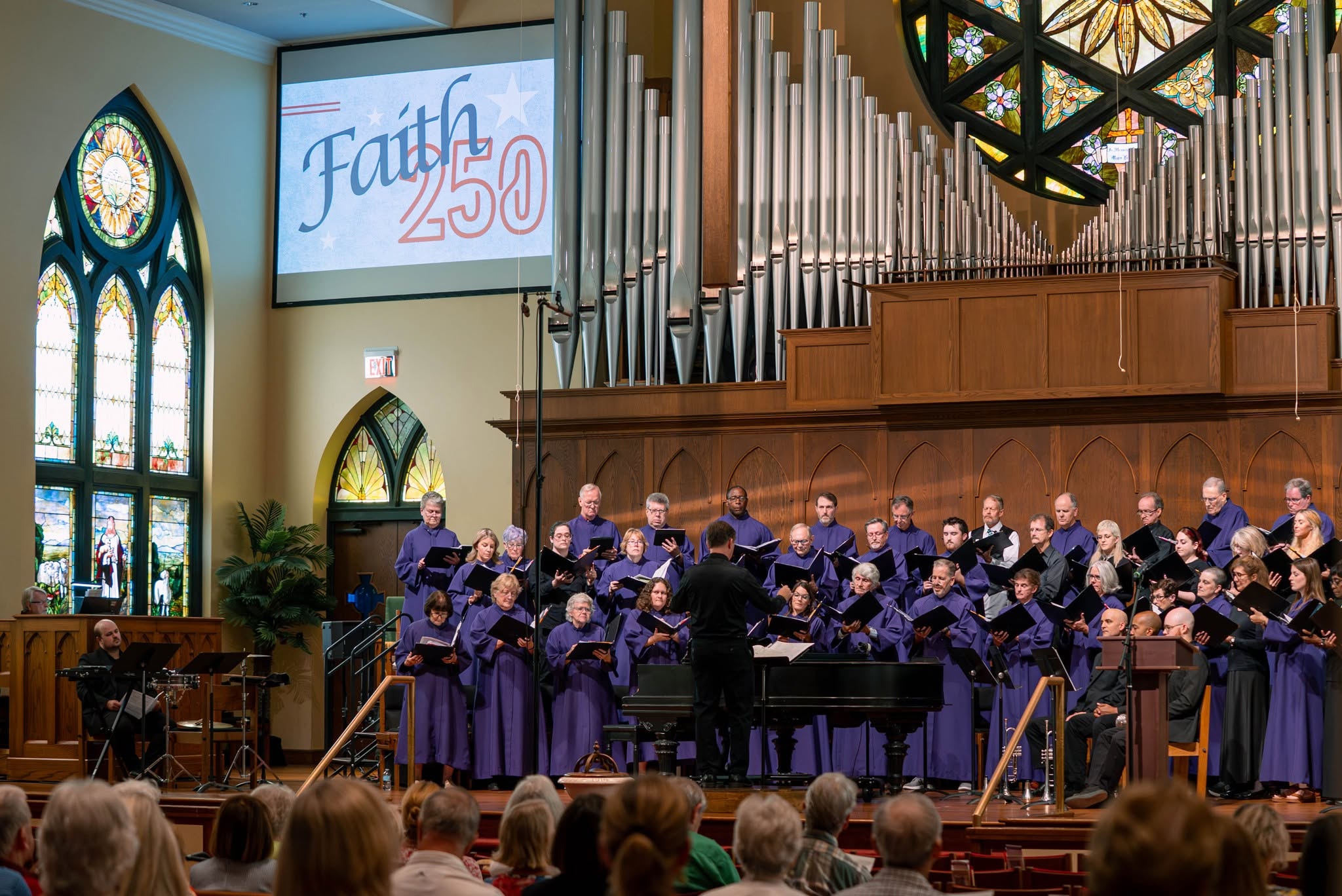 That thought has been with me because of recent events at my church, Hyde Park United Methodist Church Website in Tampa. Our Chancel Choir presented a concert of patriotic music; I organized a Voices for Justice: Using Your Voice through our Voices of Justice work; and over the next few weeks, our church is joining Faith250, an interfaith effort reflecting on America’s founding ideals as we near its 250th anniversary.
That is a lot of civic reflection in a short stretch of church life: patriotic music, training on public engagement, interfaith conversations about America’s future, and this Sunday’s sermon built around Emma Lazarus’s poem “The New Colossus”—words associated with the Statue of Liberty as a statement of welcome.
I do not think all of that landed together by accident. Or at least, it did not feel accidental to me.
The Citizen Engagement event was designed to be practical. We were not there to argue specific policies or turn the room into a partisan brawl. We were there to help people understand how government works, who has authority over what, and how ordinary citizens can speak clearly and effectively to the people who make decisions. That sounds simple, but it matters. Many people care deeply about housing, schools, immigration, inclusion, public safety, health care, and the common good, but they do not always know where to begin. They know something feels wrong. They know they want to help. But the machinery of government can feel distant and confusing.
So we tried to make it less distant. Less mysterious. Less intimidating.
At the heart of the evening was a simple idea: citizenship is ongoing, not just voting every few years. It involves learning who represents you, understanding which level of government can address issues, and writing, calling, showing up, asking questions, and practicing persuasion. Listening may be the part we are worst at right now.
As I thought about that evening, I recalled a line often attributed to the late Congressman Barney Frank: “Government is simply the name we give to the things we choose to do together.” This has become, for me, not just a political observation but the central moral argument of public life.
If government is what we choose to do together, public life becomes a stage where our collective moral choices are made visible. Budgets, laws, and policies express our vision of justice, inclusion, and responsibility. Every decision reveals what and whom we value as a society, connecting politics to our deepest moral commitments.
This is where the idea of Stoicism becomes especially relevant to public life and our moral choices within it, though perhaps not in the way that people often assume.
Many misunderstand Stoicism as withdrawal or apathy toward public affairs, believing it means staying calm and refusing deep concern. According to this misconception, the ideal Stoic might ignore problems, saying, “Well, smoke is outside my control.” However, authentic Stoicism is not passive detachment; it is active discernment.
The Stoics were not teaching us to be indifferent to suffering or injustice. They were teaching us not to be ruled by fear, anger, ego, or despair. That is a very different thing. Marcus Aurelius was an emperor. Seneca lived near power, sometimes too near it. Cato the Younger became a symbol of political resistance and moral conviction. These were not people living in caves, safely above the world’s complications. They were entangled in public life, and they knew how dangerous that entanglement could be.
The key Stoic question is not whether public life matters, but how we can enter politics with integrity, resisting its corrupting tendencies and holding fast to our moral core.
Politics is good at making us worse. It rewards certainty over reflection and outrage over understanding. Contempt feels powerful, gives us enemies, and can turn our moral concern for justice into hatred or vanity.
The Stoics would warn us against that drift.
The Stoic tradition lists justice among its four central virtues, together with wisdom, courage, and temperance. For the Stoics, justice is the active recognition that we are social beings interconnected by nature. A principle vital for public engagement. As Marcus Aurelius observed, “What harms the hive harms the bee,” a succinct expression of Stoic citizenship and mutual responsibility.
If that is true, then a person seeking to live with virtue cannot retreat entirely into private calm. Calm matters, but it is not the whole of goodness. A peaceful heart that never moves toward justice is not yet complete. It may simply be comfortable.
This is where Stoicism begins to sound less like an ancient philosophy and more like the wisdom found across many traditions.
In Judaism, the strongest parallel is probably tikkun olam, the repair of the world, along with the prophetic demand for justice. The Hebrew prophets are relentless about this. Justice is not a decorative virtue. It is the measure of faithfulness. Amos gives us that great line about letting justice roll down like waters. Micah asks what the Lord requires: to do justice, love mercy, and walk humbly. That is not far from a Stoic life ordered around justice, restraint, and humility before what is larger than the self. They do not say, “Think kind thoughts about the poor.” They call people to defend the vulnerable, protect the stranger, and correct systems that crush the weak. Justice is not decoration on the edges of faith. It is part of the structure.
Christianity carries the same demand in its own voice. The Sermon on the Mount blesses the merciful, the peacemakers, and those who hunger and thirst for righteousness. Jesus does not tell the parable of the Good Samaritan so we can admire compassion from a distance. He tells us so we will recognize the neighbor as the wounded person on the road, even when that person falls outside our preferred circle. The moral question is not whether we feel bad for him. The moral question is whether we cross the road.
In the Methodist tradition, this has often been described as the connection between personal holiness and social holiness. Faith is not only what happens in prayer, worship, and private devotion. It also happens in schools, hospitals, prisons, voting booths, community meetings, and public policy. A faith that never touches public life has not fully touched life.
Eastern traditions add another layer. Buddhism teaches compassion with non-attachment. That is an important balance for anyone engaged in politics. We act to reduce suffering but do not tie ourselves to outcomes. We work without letting the work turn us bitter, or our caring become possession. The Bhagavad Gita teaches doing one’s duty without clinging to results: do what is yours, release what is not.
That is almost a perfect description of Stoic citizenship.
We cannot control whether a legislator listens, a council votes our way, or a court acts wisely. But we can control whether we are informed, truthful, prepared, and whether our words clarify or inflame. We can decide if anger sharpens our courage or overcomes us.
That distinction matters. The dichotomy of control does not tell us to stop acting. It tells us where to place our energy. The outcome is not ours. The effort is. The vote may not go our way. The testimony is still ours to give. The letter may not change a mind. The letter is still ours to write. The meeting may not produce the policy we hoped for. Showing up still matters.
This is the discipline of public life: acting for the common good without guarantee of results, guided by the conviction that our moral choices, in public and private, matter collectively.
The upcoming sermon on “The New Colossus” feels like part of this same moral conversation. Emma Lazarus’s poem imagines liberty not as a clenched fist, but as a lamp. Not as conquest, but as welcome. The Statue of Liberty becomes the “Mother of Exiles,” holding light beside a door. That image has power because it asks what kind of nation we believe ourselves to be.
It is easy to make patriotism loud. It is harder to make it honest.
Patriotism that only celebrates itself becomes sentimental. Patriotism that cannot face suffering becomes denial. But patriotism rooted in moral responsibility asks better questions. Who is outside the gate? Who has been told they do not belong? Who is tired, poor, displaced, afraid, or simply unheard? Who has been reduced to a problem when they are, first of all, a person?
Those are not merely political questions. They are spiritual questions. They are Stoic questions too, because they ask whether we truly understand our shared humanity.
The Stoics spoke of being citizens of the world. That phrase can sound lofty, almost too beautiful to be useful. But it has practical consequences. If I am a citizen of the world, then my circle of concern cannot stop at my front door, my church, my party, my race, my class, my country, or my comfort. The circle must widen. Hierocles, another Stoic thinker, imagined our relationships as circles, beginning with the self and expanding outward to family, community, nation, and humanity. The task was to draw the outer circles closer.
That image has stayed with me. It is also what the best forms of politics are meant to do. Not politics as domination. Not politics as a team sport. Not politics as endless grievance. But politics as the practice of drawing more people into the circle of concern.
That was what I saw, in a modest way, at our Citizen Engagement training. People came because they cared. They wanted to know how to use their voices more effectively. They wanted to understand where power sits and how to speak to it. They were not trying to become professional activists or political operatives. They were trying to become better citizens.
That may sound small, but I do not think it is.
Most of the work that sustains a democracy is small. A person learns who represents them. Someone writes an email. A neighbor attends a meeting. A church hosts a forum. A volunteer prints guides, sets up chairs, and makes sure the microphones work. Someone asks a better question. Someone tells a story that puts a human face on a policy. Someone who felt alone realizes there are others in the room who care too.
The loudest moments in politics get the attention, but the quieter ones may do more to hold us together.
Of course, this kind of work can be frustrating. Anyone who has tried to influence government knows that progress is slow, uneven, and often disappointing. People in power do not always listen. Systems protect themselves. Good ideas get buried. Bad ideas move quickly. Sometimes the meeting goes nowhere. Sometimes the vote fails. Sometimes people you thought would stand firm decide it is easier not to.
The Stoic citizen expects this. Not cynically, but realistically. Premeditatio malorum, the Stoic practice of anticipating difficulty, applies here too. Before entering public life, we should expect delay, resistance, misunderstanding, and failure. Not so we can give up, but so we are not shattered when they arrive. If we expect politics to be pure, we will not last long. If we expect it to be human, flawed, and necessary, we may have a chance.
The point is not to avoid disappointment. The point is to avoid being governed by it.
That may be the lesson I need most. I can get angry. I can get impatient. I can look at cruelty dressed up as policy and feel something hot rise in me. Maybe that is not always wrong. Anger can be a signal that something sacred is being violated. But anger is a terrible place to live. If I let it take over, it will make me less useful. It will narrow my vision. It will turn people into categories. It will convince me that being right is enough.
The Stoics remind me that being right is not enough. I also have to be wise. I must be courageous. I must be just. I must be temperate. The manner of my engagement matters because character is not suspended when politics begins. If anything, politics reveals it.
That does not mean being soft in the face of injustice. It does not mean pretending all positions are equally moral or that every argument deserves equal respect. Some policies harm people. Some rhetoric endangers people. Some silence enables harm. The Stoic is not called to be neutral about injustice. The Stoic is called to oppose injustice without becoming unjust.
That is a narrow path. I do not always walk it well. But I think it is the path worth trying to walk.
The patriotic concert, the Citizen Engagement training, Faith250, and the sermon on “The New Colossus” have all pressed the same question into my mind. What do we owe to one another? Not in theory. Not in a slogan. In practice. In the policies we support, the meetings we attend, the letters we write, the votes we cast, the neighbors we notice, and the strangers we decide to welcome.
If government is what we choose to do together, then we should choose with care. We should choose with memory. We should choose with moral seriousness. We should choose knowing that the choices become roads people must walk, doors people may or may not enter, burdens people may or may not be forced to carry.
The Stoic citizen does not control the whole outcome. No one does. But the Stoic citizen can still stand in the public square with a clear mind and a steady heart. They can refuse despair. They can resist cruelty. They can speak the truth without surrendering to hatred. They can work for justice while remembering that the work is larger than one election, one hearing, one sermon, one training, or one life.
That is enough for a beginning.
Maybe that is what I saw on Tuesday evening. Not a grand solution. Not a revolution. Just ordinary people gathering in a church to learn how to take responsibility for the world they share. People trying to understand what is theirs to do.
And maybe that is where hope begins. Not in certainty that we will win, but in the decision to participate with integrity.
To lift a lamp.
To widen the circle.
To choose together, as wisely and justly as we can.

Pingback:Deep Something | Before We Choose Together