
The Decision Was Mine-The Outcome Was Not
Lately, life has been asking me to make too many decisions at once. Not small ones, either. Work. Money. Health insurance. My mother’s care. Her funeral. Her estate. What to keep. What to let go. What to protect. What to release.
Any one of those would have been enough for a season. But they came in a stack. First came the job layoff. Next was the search for work again, after decades in which work had usually found me. Then my mother began slipping away. Each stage of her decline brought its own decisions. After her passing, there were the house, the papers, the furniture, and the artifacts of a well-lived life. Every object seemed to ask if I was keeping it out of love, guilt, memory, or fear.
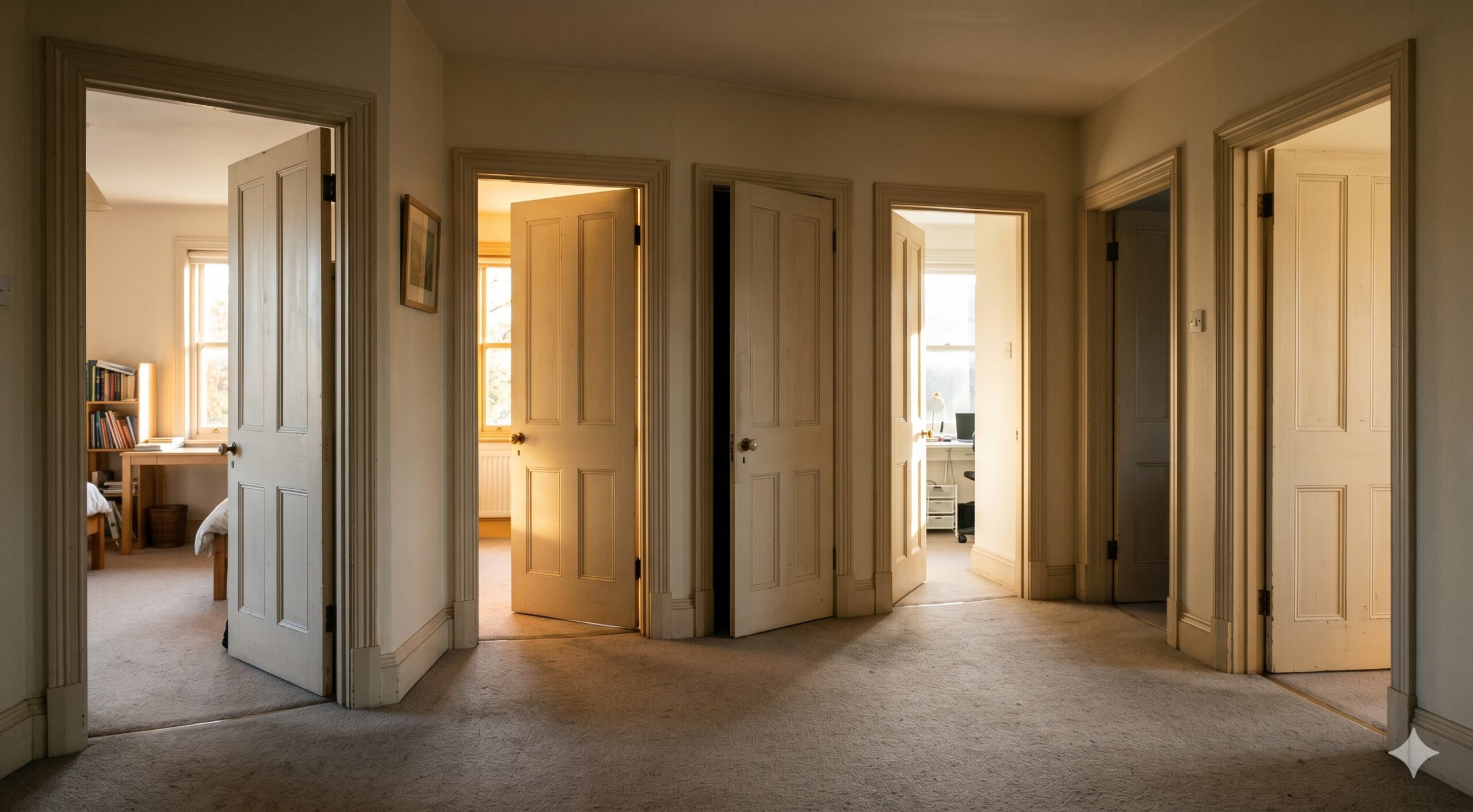 Meanwhile, my husband lost his job. Insurance changed quickly. Money became urgent. The future felt like a hallway of too many open doors.
Decision-making wears you down. Every morning, new job listings arrive from Indeed and LinkedIn. My two previous jobs came through industry connections; this time, I’m applying to impersonal systems before any human sees my résumé. Uncertainty always brings fear. Even when I work to get past it, that work has a cost. The mind can be disciplined, but it still gets tired. Somewhere in the background, decision regret lingers.
Of all these decisions, one keeps coming back to me: early in the job search, I entered a string of interviews with a company and a position that seemed like a very good fit.
Then came the catch.
Before a third interview, they wanted me to present a fully fleshed-out solution idea that would fit their offerings. I have built offerings before. I had already been thinking about bringing them a couple of ideas I had been developing from earlier work. But now they were asking for one of those ideas before hiring me. Fully baked. Presented to a committee. No guarantee. No compensation. Then I learned they had lowered the pay. It had already been on the low side. Now it was lower.
It felt like a bait-and-switch, so I declined.
Some days, I am completely at peace with that decision. Other days, I wonder if I made a mistake. What if the job had worked out? What if it had given us stability? What if I let pride or irritation make the choice for me?
That is where regret begins to whisper. It does not always shout. Sometimes it just sits quietly in the corner of the mind and clears its throat.
The Stoics have something useful to say here. Epictetus taught that some things are within our control and others are not. The Stanford Encyclopedia of Philosophy summarizes this as the distinction between what depends on us and what does not (Seddon, 2023).1
My judgment was mine. My preparation was mine. My willingness to protect the value of my own experience was mine. Whether the company would have hired me was not. Whether the job would have turned into something good was not.
That is the hard edge of decision-making. We have to choose without being granted access to the alternate timeline. We like to judge decisions by their outcomes. If something works out, we call the decision wise. If it goes badly, we call it foolish. But that is not always fair. A decision can be carefully made and still lead to pain. A decision can be reckless and still turn out well through luck.
A better question is whether the decision was prudent. Did I consider the facts available to me? Did I act from fear, ego, resentment, or clarity? Did I honor my values?
In that job situation, I knew the company had lowered the pay. I knew they were asking me to give them a developed business idea before making an offer. I knew my experience had value. I knew desperation could tempt anyone to give away too much of themselves for the chance of being chosen. I also knew that I needed work.
So the decision was not clean. Most important decisions are not. They come mixed with fear, need, hope, irritation, and self-respect. The Stoic task is not to drain the decision of feeling. The task is to prevent feelings from becoming the only voice in the room.
Marcus Aurelius wrote that the happiness and unhappiness of a rational and social being depend not on what he feels, but on what he does (Aurelius, Meditations, Book 9).2
Feelings matter, but they are not the final measure of a life. I can feel anxious and still act with integrity. I can feel regret and still recognize that I made the best decision I could with the information I had.
Wisdom asks us to see clearly. Courage asks us to choose even when clarity is incomplete. Temperance keeps panic from grabbing the wheel. Justice reminds us we owe fairness not only to others, but also to ourselves. We are not required to exploit ourselves simply because we are afraid.
That last sentence is one I have had to learn slowly. Needing work can make almost any request feel like something we should tolerate. The unpaid assignment. The lowered salary. The vague promise. Sometimes we accept less than we want because circumstances require it. That is not failure. But there is a line between flexibility and self-abandonment. I think I saw that line in this case.
Could the outcome have been better if I had made the presentation? Perhaps. Could they have hired me? Perhaps. Could they have taken the idea and still passed? Also, perhaps. The truth is that I do not know. I will never know. That uncertainty is where the mind likes to torture itself.
When regret surfaces, the Stoics encourage me to return to what was mine. Did I act with care? Did I act with reasonable judgment? Did I act in a way I could explain honestly to myself afterward? I think I did.
That does not erase the fatigue of the larger season. I still wake up to job listings. I still weigh financial choices. I still think about insurance, income, and what the next course of my life should be. I still grieve my mother in pieces.
Maybe the work now is not about making perfect decisions, but about making honest ones. Perfect knowledge is impossible. We make choices with limited information, energy, and time, shaped by human fear.
The best we can do is slow down enough to see clearly. We ask what belongs to us, seek counsel when needed, act according to our values, and then release the outcome as best we can. Jobs matter. Money matters. Health insurance matters. Family decisions matter. But the outcome was never fully ours to command.
Regrets can teach. Seneca wrote that we suffer more often in imagination than in reality (Seneca, Letter 13).3
Regret is harmful only when it keeps replaying a past we cannot enter again, or when it refuses to become wisdom.
I can look back at that interview process and ask whether I was guided by prudence or wounded pride. That is a fair question. But an honest review is not the same as self-punishment.
The decision was mine. The outcome was not.
What I can do is meet each decision with as much clarity as I can gather. I can refuse to let fear alone decide for me. I can remember the value of my own experience. I can protect what should not be given away cheaply. I can stay open to correction without handing my whole life over to regret. Maybe that is what a good decision really is. It is not a guarantee of a good outcome. It is an act of fidelity to the person we are trying to become.
If the road bends, I’ll know I thought carefully, acted honestly, and chose as best I could from the place where I stood.
That is all anyone can ever do.

John, I love this analysis of your experience. Many times we move forward, by looking backwards. The secret is in knowing ‘what was’ is not ‘what is.’ I try, as best I can, to stay in that area of purpose and question. So much of your story happened to me in 2017. Am I where I want to be? No, but I am where I need to be. In 2026, I focus on my needs and not my wants. It simplies life and brings peace. My life is finally balanced with no pressure. It’s a good place to be. It’s worh fighting to get there, and when you do, REST!