

The Decision Was Mine-The Outcome Was Not

This entry is in the series Journey Through Stoicism

Lately, life has been asking for more decisions than usual. Not small ones, but the kind that seem to carry a future inside them. Work. Money. Health insurance. A parent’s care. A funeral. An estate. What to keep. What to let go. What to protect. What to release. In this season, I have learned that decision-making is not only a matter of logic. It also carries emotional weight, especially when the outcome remains uncertain.

In this essay, I reflect on a difficult job-search decision that still brings occasional regret, and how Stoic philosophy helps me think about it more clearly. The Stoics remind us that we can control the care, judgment, and integrity we bring to a decision. We cannot control the outcome. That distinction does not eliminate uncertainty, but it does offer a kind of mercy. Sometimes the best we can do is choose honestly from the place where we stand, then release what was never fully ours to command.

Read more
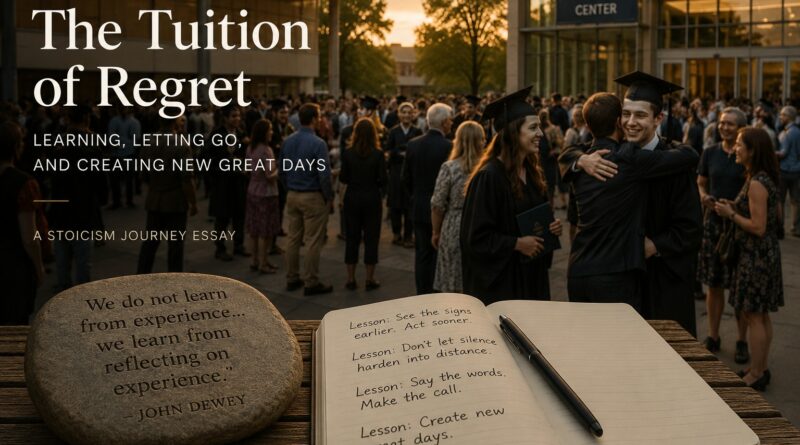
The Tuition of Regret

This entry is in the series Journey Through Stoicism

Most of us have regrets, whether we admit them or not. A word spoken too sharply. A kindness withheld. A friendship allowed to drift. A warning sign ignored until it was too late. We may like the idea of living with “no regrets,” but that has always struck me as too clean. If we have lived fully, loved deeply, failed honestly, or hurt someone along the way, regret eventually finds us.

In this essay, I explore regret through the lens of Stoicism, Daniel Pink’s work on The Power of Regret, and my own recent life. I have come to think of regret as life’s tuition. Nobody wants to pay it. Sometimes it is painfully expensive. But if we refuse to learn the lesson, we pay the tuition and never receive the education.

The Stoics did not ask us to deny regret or drown in it. They asked us to examine it, learn from it, make amends where we can, and then lay it down. Regret is not meant to become a permanent home. It is a classroom. The lesson may be to call the friend, offer the apology, act sooner, speak more gently, or create new great days while we still can.

Read more