
Seneca Would Feel Right at Home Today

Some frustration doesn’t come from a single moment, but builds up slowly. You see decisions that don’t make sense and hear confident words that don’t match reality. Over time, it’s less about disagreement and more about a quiet, steady exhaustion that stays with you.

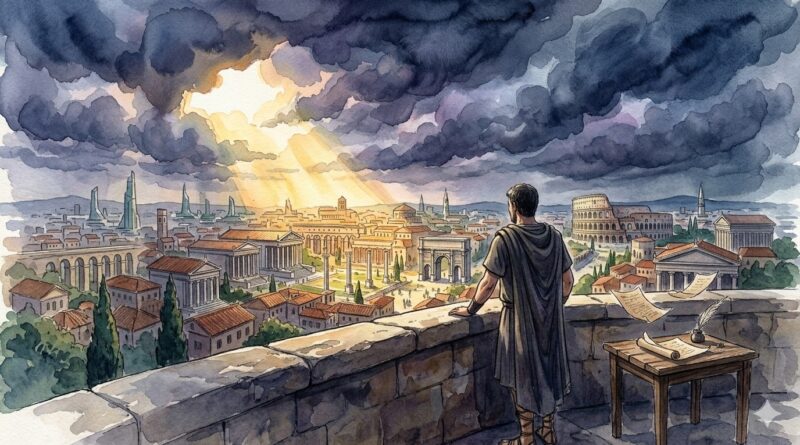
Seneca lived in a world like this. He didn’t write from a safe distance, but from inside a system full of power, instability, and contradiction. He didn’t ignore the chaos or pretend it didn’t matter. Instead, he asked a tougher question: What part of this is really mine to carry? And what if I let go of the rest?

Read more

The Line You Carry Into the Fire

You don’t usually meet a man like Epictetus directly. Sometimes you meet him through someone else’s breaking point. For James Stockdale, it was the moment he realized he was about to spend years in a prison camp. His response wasn’t panic or denial. It was a quiet shift. “I’m leaving the world of technology and entering the world of Epictetus.” That line points to something most of us don’t think about until we have to. What do you carry with you when everything else is stripped away?

Epictetus developed his philosophy in conditions most of us will never face, yet its core principles apply to everyday life. The difference between what you can control and what you can’t sounds simple, but it changes everything once you start living it. If you’ve ever felt pulled in every direction by things outside your control, this perspective is worth sitting with. Read more to see how one quiet idea can change the way you meet your life.

Read more

The Shipwreck That Built a Philosopher

Zeno of Citium did not set out to build a philosophy. He lost everything in a shipwreck and found himself standing in the space that follows when a life no longer makes sense. What came next was not a sudden breakthrough, but a slow rebuilding. One question, one step, one adjustment at a time.

As you read, pause and consider: When has your own life been disrupted? Was there a time when the loss of certainty or a sudden change became the ground for something new to grow? Reflect on what you discovered or how you changed in that space between what was lost and what came next.

This essay explores how that kind of disruption reshapes a life, and how Zeno’s response still speaks to us. When plans fall apart and the story changes without warning, the Stoic path is not about control. It is about learning where to stand when nothing else feels stable.

Read more

Who Are the Stoics?

Let’s be honest: when you hear the word Stoic, maybe you picture a distant figure, an old philosopher in flowing robes, sitting far away from the noise and chaos of real life. But the real heart of Stoicism isn’t about detachment or shutting down your feelings. It’s actually a philosophy for living well in a complicated world. That neat, distant image isn’t just outdated—it completely misses the point.

The Stoics weren’t removed from life—they were in the middle of it. They argued in marketplaces, advised emperors, endured exile, and faced the same uncertainty, loss, and frustration we deal with today. And they weren’t all ancient relics either. Stoicism didn’t disappear with Rome; its ideas have carried forward across the centuries and still shape how we think about resilience, purpose, and how to live well.

This new sub-series begins by asking a simple question: Who were these people, really? We start at the beginning—with Zeno—and begin to see the Stoics not as distant figures, but as companions in a conversation that’s still unfolding.
Read more ?

Read more

The Fortune Cookie Was Half Right

I cracked open a fortune cookie expecting the usual vague wisdom and got this instead: “Your next Chinese meal will bring you more cookies.” Not exactly life-changing. I laughed, told my husband I’d been handed a prank fortune, and almost tossed it aside. But then I flipped it over.

“A fresh perspective on life is near.” That one stuck. Because lately, something has been shifting. Not loud. Not dramatic. Just a quiet realization that time isn’t as endless as it once felt, and that maybe the hardest lesson isn’t holding on tighter, but learning when to let go. Read the full piece>>

Read more

Negative Visualization

Most people deal with uncertainty in one of two ways. They either worry endlessly about everything that might go wrong… or they assume nothing will. Neither approach prepares us very well for real life.

The Stoics practiced something different. They called it premeditatio malorum — the premeditation of difficulties. Instead of imagining every possible disaster, they briefly considered the challenges that might realistically arise and thought about how they would respond.

This simple mental exercise doesn’t increase anxiety. It reduces it. By removing surprise, it helps us meet life’s difficulties with steadiness rather than panic.

Read more

Stoic Practice: Rehearsing Death and Accepting Fate

I grew up with death in the next room. My father managed a funeral home, and for a time our family lived in a small apartment above it. Most kids grew up with kitchen noise and television. I grew up with the quiet hum of grief drifting through the walls. I did not think much about it at the time, but it shaped how I see life. It also shaped how I understand endings. Later, I buried friends during the AIDS crisis. I cared for one of them in my home until he died. Those years taught me that death does not wait for a convenient moment. It just arrives.

The Stoics understood this impulse to drift into denial. They practiced rehearsing death so they could return to what mattered. The practice does not pull you toward fear. It pulls you toward clarity. In my own life, the deaths of family and friends have reminded me of this same truth. We do not control the length of our days. We control how we use the ones we have. If you want to read more about how the practice shaped my own path through grief, transition, and aging, you can find the full essay here.

Read more

Stoic Practices: The Dichotomy of Control

The Dichotomy of Control teaches that some things are up to us and some are not. My own health journey and a job loss taught me that lesson in very different ways. Both proved the same point: act fully where you can, and accept what you cannot change.

Read more

The Graduation Gift

A framed silhouette of my niece, standing before the mountains at sunset, carries a message for her high school graduation: “Behind you, all your memories. Before you, all your dreams. Around you, all who love you. Within you, all you need.” It is a blessing, but also a challenge — to live with gratitude for the past, purpose in the present, and trust in the strength we already carry. In its quiet way, it’s pure Stoic wisdom.

Read more