
What a Real Hillsborough County Efficiency Review Would Look Like
 This is the seventh and final installment of my review of the Hillsborough County DOGE Report (Whew!) This is a short essay noting what a real efficiency review, rather than a partisan attack opportunity, would look like. (Yes, I have an opinion on what this was really all about.)
The Hillsborough County DOGE report identified areas in contracts, software, vehicles, grants, and public programs that deserve closer review.
However, raising questions does not demonstrate actual waste.
An effective efficiency review begins by defining its objective. Is the county aiming to reduce costs, improve service, prevent abuse, eliminate duplication, or assess program continuation? Each goal requires distinct evidence.
Next comes transaction testing.
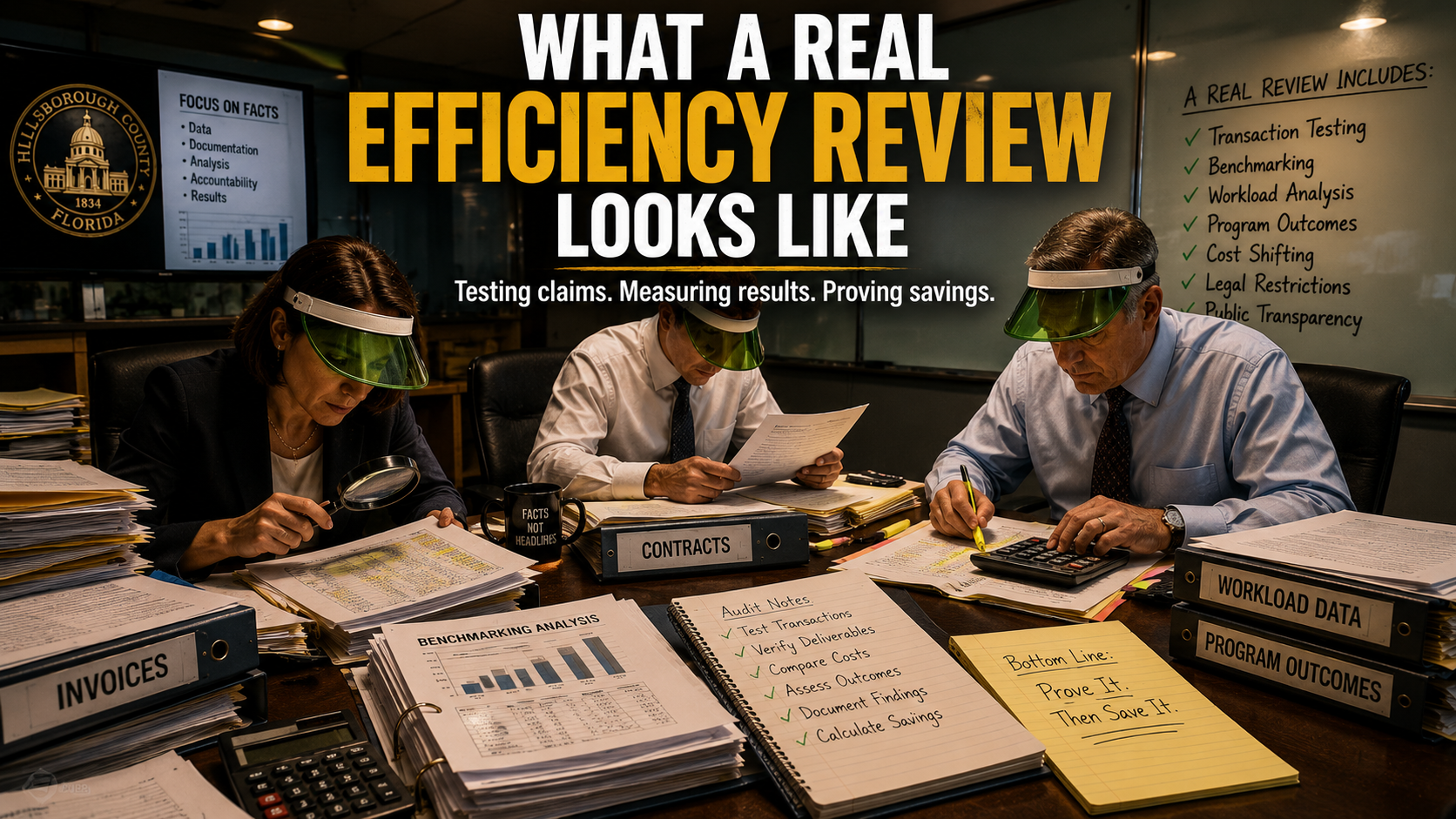 Reviewers should examine invoices, payments, purchase orders, claims, contracts, and deliverables. They must select a representative sample, explain their selection process, trace payments to services, and document findings. A large contract or program budget alone does not prove that money was misspent.
The review should also compare costs.
What do other Florida counties pay for similar software, medical care, fleet services, engineering work, or nonprofit programs? Could Hillsborough achieve the same results for less? Benchmarking provides taxpayers something more useful than an isolated number that merely looks large.
Workload matters, too.
Before recommending staff reductions, reviewers should assess caseloads, service demands, response times, vacancies, overtime, and legal duties. Five positions may be excessive. They may also be carrying work that will land on other employees if eliminated.
Programs should be judged by results.
A serious review must examine cost shifting.
Ending indigent health care does not eliminate illness. Reducing homelessness services does not resolve homelessness. Eliminating outreach does not remove the need for communication. Costs may shift to hospitals, law enforcement, courts, emergency services, charities, families, or other government entities.
Legal limits must also be clear.
Some expenditures are mandated by law, contract, grant terms, bond rules, or dedicated revenue restrictions. Reviewers must distinguish between funds the county can reallocate and those it cannot.
Finally, the process must be public.
The county should publish the review scope, records examined, testing methods, findings, departmental responses, disputed facts, and projected savings. It must differentiate one-time funds from recurring savings and distinguish service cuts from genuine efficiency improvements.
Appendix A indicates the DOGE committee had access to extensive records. However, the report states it did not conduct transaction-level testing or independently verify county data.
That makes the report a useful starting point.
A thorough efficiency review would test claims, measure results, consider consequences, and clearly demonstrate to the public how each dollar would be saved.
That is how government earns trust.
Not by announcing the biggest number. By proving it.
