
Trading Four Votes for One: The Cynical Math Behind Hillsborough’s Commission Power Grab
 If someone came to your door and offered to trade four hundred-dollar bills for a single ten-dollar bill, you would probably close the door and check your security cameras.
Yet that is essentially the transaction being offered to Hillsborough County voters in Charter Referendum 2. Tallahassee politicians and local allies are calling it an expansion of democratic representation. In reality, it is a 75 percent reduction in your personal voting power, wrapped in the glossy packaging of neighborhood empowerment.
To see why this referendum is a bad deal, you need to look beyond the slogans and count the seats.
For forty years, Hillsborough County has governed itself through a balanced hybrid system: four commissioners elected from geographic districts and three commissioners elected countywide at-large. Under that structure, every single voter in this county is represented by four commissioners. When the board convenes to debate policy, allocate your tax dollars, or decide on growth, you have a direct ballot-box check on a four-member governing majority.
Referendum 2 would end that forty-year-old system. It would increase the commission from seven to nine members but get rid of all three countywide at-large seats. Every commissioner would be elected only from a single district.
Think about what this means for your vote:
- You would go from voting for four commissioners to voting for just one.
- You would lose the right to vote for or against eight out of the nine people making decisions for you.
- Those eight commissioners will decide your property taxes, where infrastructure money goes, and approve big development projects. You would have no way to hold them accountable with your vote.
Supporters say Hillsborough’s growth to nearly 1.6 million people means smaller districts would make commissioners more accessible. Growth is real, and adjusting district lines or adding a seat could help. But getting rid of at-large seats does not address growth; it just divides the county further.
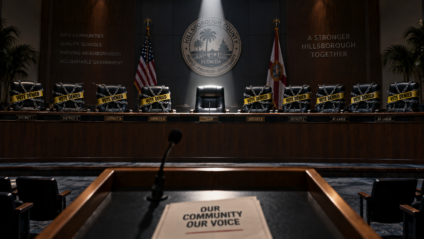 When every commissioner represents only a small territorial slice, county government inevitably devolves into ward politics. Commissioners are incentivized to protect their own turf at all costs, turning budget meetings into a zero-sum scramble of logrolling and horse-trading. You vote for my neighborhood sidewalk, and I will vote for your developer rezoning.
At-large commissioners serve a vital governing purpose: they are the moderating presence in the room. Because they have to run countywide, they cannot afford to retreat into hyper-local squabbles. They must build broad coalitions and protect assets that belong to the entire county, from Port Tampa Bay and Tampa International Airport to regional stormwater basins, transit, and countywide indigent healthcare. Regional assets do not stop at district lines, and our governance shouldn’t either.
The irony is that this entire push didn’t even originate from a local charter review. It was handed down from Tallahassee, courtesy of State Representative Michael Owen, the very same lawmaker trying to force a partisan school superintendent onto our local classrooms. It is the signature Tallahassee playbook: lecture everyone about local control while quietly dismantling Hillsborough’s home-rule charter from afar.
Lowering campaign costs might sound good, but single-member districts just make it easier for special interests to control individual seats. Losing your right to vote for most of the board is too high a price for that.
Do not trade four representatives for one. Vote No on County Referendum 2.
