
Who Controls the Government?
 Part Two of a Six-Part Series on Project 2025
On November 3, American voters handed Democrats control of both houses of Congress. They gained dozens of House seats and nine Senate seats, marking an unusually large shift for a midterm election.
Many people have focused on affordability. Americans are frustrated by rising grocery bills, insurance costs, and other living expenses. But an Associated Press voter survey found that about half of voters also saw government corruption as a key issue in their congressional vote. More Americans are worried about who benefits from government decisions.
This leads to Project 2025, which aims to give the president much more control over the federal government.
The people behind Project 2025 think career civil servants and independent agencies have gained too much power, making it harder for presidents to get things done. Their answer is to give the president more control over federal employees, independent agencies, and public funding. President Trump has begun putting this plan into action.
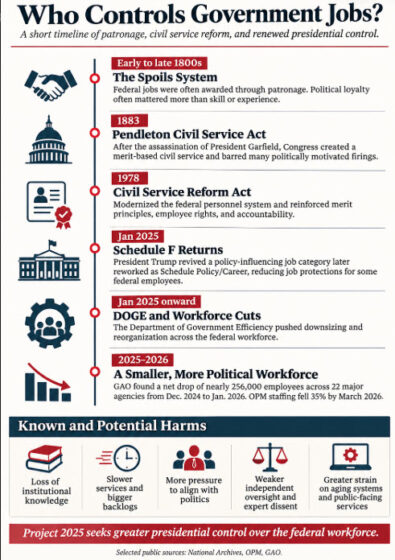 To see what’s changing, it helps to look at why America set up a professional civil service in the first place.
For much of the nineteenth century, winning a presidential election came with a generous employment benefit. The victorious party could distribute thousands of government jobs to supporters. Political loyalty often mattered more than qualifications. This system worked well for those with the right connections who didn’t worry much about how well the government functioned.
Congress started to change this system with the Pendleton Civil Service Act of 1883. After that, federal hiring focused more on qualifications and experience. Career employees got protections so they could do their jobs without worrying about being fired every time political leaders changed.
Project 2025 seeks to alter that arrangement.
In January 2025, Trump signed an executive order bringing back an approach called Schedule F. By February 2026, the Office of Personnel Management finished rules for its replacement, called Schedule Policy/Career. In June, another executive order moved certain jobs into this new category, which meant those employees had fewer protections against dismissal.
The administration says presidents need this power to make sure employees follow lawful policies. Elected officials should indeed set government policy, and career employees should follow legal decisions. But what if a professional’s judgment doesn’t match the president’s?
Imagine an environmental scientist finds that a new policy could put communities at risk from pollution. Or a government lawyer decides that an executive order goes beyond the president’s authority. These professionals are supposed to give honest advice, even if leaders want a different answer. But if sharing bad news could get them fired, they might stay quiet. Leaders might then find that everyone agrees with them, which is convenient. Whether this leads to better decisions is another question.
Next came DOGE, the Department of Government Efficiency, set up in January 2025 to cut spending and reorganize how the government works. Most Americans support cutting waste, but workforce reductions can have effects that don’t always show up in budget reports.
The Government Accountability Office reported that major federal agencies lost almost 256,000 employees between December 2024 and January 2026. At the Office of Personnel Management, staffing dropped by 35 percent by March 2026. Over half of those who left OPM had worked for the federal government for at least eleven years.
That’s a huge loss of experience. Federal agencies rely on people who know complex laws, old computer systems, and the ins and outs of public services. When these employees leave, their knowledge leaves with them.
Take the nationwide aviation disruption on November 13, when a failure in the Federal Aviation Administration’s communications network disrupted air travel across the country. Thousands of flights were canceled, affecting hundreds of thousands of travelers. The FAA was already dealing with outdated technology and too few staff, and earlier in 2026 had lowered its hiring goals for air traffic controllers.
Investigators traced the immediate problem to communications equipment during a network upgrade, though the exact cause is still under review. But when the government cuts staff and relies on old systems, does it become harder to prevent or fix failures? Anyone stuck in an airport that Friday probably cares about the answer.
At the same time, the administration has increased White House influence over agencies that Congress meant to be somewhat independent.
In February 2025, Trump required independent regulatory agencies to send major proposed rules to the White House for review, except for most Federal Reserve monetary policy. These agencies oversee areas such as consumer protection, financial markets, and communications.
Supporters say this change makes government more accountable to elected leaders. Critics are concerned that decisions that should be based on law and expert judgment will depend more on political approval, especially when big companies have money at stake.
The same concern extends to federal grants.
In August 2025, Trump gave top political appointees more control over discretionary grants, requiring that awards support administration priorities when possible. These grants fund things like medical research, universities, local governments, and community programs.
Later, the administration tried to end about $59 million in federal research grants to University of California researchers, saying their projects didn’t fit its diversity policies. On November 16, the Supreme Court declined to hear the administration’s appeal, so the lower-court ruling stood. That ruling said the researchers were likely to prove that canceling the grants violated their free-speech rights.
The question extends beyond university research. Should federal funding depend on the lawful purpose and merit of the work, or on whether political leaders approve of the ideas involved?
These changes show that Project 2025’s idea of giving the president more control is turning into real government policy. Career employees now have fewer protections, the White House is watching independent agencies more closely, and political appointees have more say over public funds.
Now, the November election has shifted the political landscape.
When Democrats take over Congress in January 2027, they’ll be able to investigate executive branch decisions, request records, hold hearings, and look into federal spending. Congress can also push back on administration priorities through new laws and spending choices, though the president still has veto power.
However, the administration seems worried about Congress using those powers.
Just days after the election, Attorney General Todd Blanche wouldn’t rule out prosecuting Democratic lawmakers who plan to investigate the administration. White House Counsel Will Scharf warned that some congressional investigations could be considered criminal. Later, a federal prosecutor sent letters to Democratic senators, asking if their planned oversight might break federal law.
Think about that. Members of Congress who want to investigate the executive branch are being told that the executive branch might investigate them in return.
This is where Project 2025 becomes especially relevant.
Congress has constitutional authority to investigate the executive branch as part of its legislative responsibilities. Threatening criminal prosecution to discourage legitimate oversight would raise serious constitutional concerns, particularly when those investigations involve the administration directing federal prosecutors.
The Constitution splits government power into three branches because its writers knew the risks of putting too much power in one place. The professional civil service, independent agencies, and congressional oversight help protect government decisions from unchecked political influence. Project 2025 aims to change key parts of that system, and the administration has already made a lot of progress.
Voters have now chosen a Congress run by the other party, which can review these decisions and ask for accountability. Whether its members exercise that authority effectively remains to be seen.
Maybe Washington is about to remember why the Constitution gave Congress a job of its own.
Sources
- Associated Press reporting on the November 2026 elections and voter survey;
- Heritage Foundation, Mandate for Leadership, Chapters 2–3;
- Office of Personnel Management’s Schedule Policy/Career guidance;
- Government Accountability Office workforce reports;
- White House executive orders on independent agencies and federal grants;
- November 16, 2026 reporting on the University of California grant case.
- Images are AI generated
