
Who Gets to Decide America’s Future?
 Part Six of a Six-Part Series on Project 2025
On November 3, 2026, Americans voted and sent a clear message to Washington. Democrats took control of both chambers of Congress, ending two years of Republican control of the federal government. Voters expressed frustration with rising costs, government corruption, and the country’s direction.
President Trump will remain in the White House, but voters have chosen a Congress that can challenge his administration. Even before the new members take office, the White House has started warning that congressional investigations could have criminal consequences.
Think about that. The American people elected a Congress capable of investigating the president, and his administration is already raising the possibility of investigating the investigators.
This is the last part of our six-part look at Project 2025. We’ve covered its plans to control federal agencies, weaken civil rights enforcement, cut public services, and shift economic benefits to wealthy Americans and corporations. We’ve also identified officials carrying out these policies and looked at how Congress has helped turn some into law.
Now we come to the main question: Who decides America’s future, and what happens if a president refuses to accept limits on his power?
The people behind Project 2025 have been clear about their goals. They want the president to have much more control over federal agencies, career employees, law enforcement, and government spending. They say presidents need this power to carry out the policies voters chose, seemingly ignoring the fact that voters made a different choice in this recent election.
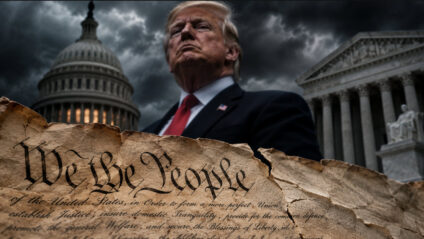 President Trump has embraced much of that approach. Since January 2025, his administration has asserted greater control over independent agencies, removed career officials, challenged congressional spending decisions, and pursued aggressive immigration enforcement. Federal courts have repeatedly intervened, and the administration has repeatedly challenged their authority.
A clear example happened in March 2025, when federal Judge James Boasberg ordered the administration to stop deportation flights carrying Venezuelan migrants to El Salvador. The flights kept going. In April, Boasberg found probable cause to hold administration officials in criminal contempt for violating his order.
The administration questioned the judge’s authority and argued it didn’t have to comply. But Boasberg’s decision raises an important question for everyone: What happens if federal officials think following a court order is optional?
The issue didn’t stop there. In February 2026, Chief Judge Patrick Schiltz of Minnesota found 210 cases where immigration authorities had violated court orders since December 2025. These violations affected people whose freedom depended on the government following court instructions.
For someone in immigration detention, a court order for release or a hearing is not just a legal detail. It can decide whether they go home to their family or stay in jail.
The president has often responded to court decisions by publicly attacking the judges involved. Trump has used speeches and social media to accuse judges who ruled against him of political misconduct, incompetence, and interfering with presidential authority.
Every American, including the president, has the right to criticize court decisions. But the president also leads the federal agencies that must follow those decisions. His public attacks have consequences that ordinary criticism does not.
The courts don’t have their own enforcement power. Their authority relies on government officials respecting the Constitution and following lawful orders. When the executive branch resists, the balance of power established by the Founders becomes dangerously uncertain.
One might have thought that obeying federal court orders was covered somewhere in the president’s oath to faithfully execute the laws.
The Supreme Court’s role adds another concern.
In 2024, the Court decided that presidents have broad immunity from criminal prosecution for official acts. In June 2025, it made it much harder for federal judges to issue nationwide injunctions against executive actions, so a single court can no longer easily protect everyone affected by a possibly unlawful policy.
Then, in June 2026, the Court ruled in Trump v. Slaughter that the president can remove certain officials from independent regulatory agencies. This changed long-standing protections Congress had established to limit political interference.
These decisions have made the president more powerful and reduced some of the legal ways to challenge that power. They also support key parts of Project 2025’s vision for executive control.
The Supreme Court’s record raises an even more troubling concern. In June 2025, the Court sharply restricted federal judges’ power to block potentially unconstitutional policies nationwide. A year later, it ruled that Trump’s attempt to end birthright citizenship violated the Constitution. Meanwhile, the justices have increasingly used emergency orders to allow disputed administration policies to proceed before their legality has been fully decided. These changes represent a significant departure from established judicial practice. They also give presidents greater freedom to act while people harmed by their decisions struggle to obtain relief. By the time the courts finally rule, the damage may already be done.
For everyday Americans, the effects can happen long before judges make a final decision. A federal worker might lose a job, a family could lose services, or an immigrant might be detained while lawyers argue over the government’s authority.
Legal remedies mean considerably less when the damage occurs before anyone can obtain them.
Americans should also pay attention to how the administration is handling elections. In March 2025, Trump signed an executive order asking for new proof-of-citizenship requirements for voter registration. Another order in March 2026 aimed for more federal control over citizenship checks and mailed ballots. Courts blocked or challenged many parts of these orders.
It’s important for the government to protect election integrity. But when registration rules change, eligible voters who don’t have easy access to birth certificates, passports, or other documents can face real problems. This affects older Americans, people with low incomes, and married women whose legal names are different from those on their birth records.
And speaking of women’s voting rights, Defense Secretary Pete Hegseth invited Christian nationalist preacher Doug Wilson to deliver a sermon at the Pentagon in February 2026. Wilson believes the 19th Amendment, which guarantees women the right to vote, should be repealed. The Pentagon insists Hegseth supports women’s voting rights, which makes his choice of guest rather curious. Apparently, some people in this administration’s orbit think America’s election problems began when women got the ballot. Perhaps making it harder for married women to prove their eligibility is their idea of progress.
The administration’s push to change election rules needs careful review because the Constitution gives Congress and the states the main responsibility for setting those rules. The president can’t just take over those powers because he doesn’t like the current procedures.
This brings us back to Congress.
On November 7, four days after the midterm elections, Trump used Truth Social to accuse Democrats planning investigations of extortion and political persecution. He called on the Justice Department to investigate them. The next day, Attorney General Todd Blanche did not rule out criminal investigations of Democratic lawmakers.
On November 10, White House Counsel Will Scharf sent a letter to Representative Robert Garcia, who is expected to lead the House Oversight Committee when Democrats take control in January. Scharf warned that planned investigations and subpoenas could cross into criminal conduct and might need further investigation. The letter questioned the motives and statements of Democratic lawmakers preparing to look into the administration’s actions. But congressional oversight is a constitutional duty. Congress has the power to investigate executive agencies, review public spending, subpoena records, and require officials to explain their actions.
Congress’s powers have limits, and lawmakers must respect constitutional protections. But threatening criminal investigations of new committee leaders before they have even issued subpoenas raises real concerns about whether the administration wants to discourage proper oversight. The timing is telling. For two years, Republican congressional leaders mostly supported the administration’s priorities and did little oversight of its most controversial actions. Now that voters have chosen a new majority, the White House is warning that tough investigations could turn into criminal cases.
Apparently, congressional oversight becomes dangerous when Congress starts asking questions the president would rather avoid.
Americans have a right to know what these investigations uncover.
This is where the whole Project 2025 story comes together. The Heritage Foundation didn’t just suggest changing a few government programs. Its authors created a plan to give the president more power and let political leaders control the institutions that enforce federal law.
The administration has put much of that plan into action. Congress passed laws that support related spending and tax priorities. Federal agencies have changed enforcement policies, removed staff, and cut services. The Supreme Court has increased presidential power in several key decisions, while lower courts have struggled to limit executive actions. Each of these changes affects how well the government can serve the public. Taken together, they raise a bigger question: Can our constitutional system work if the president tries to take more control over the very institutions meant to keep him in check?
That question goes beyond the success or failure of any political party.
The constitutional protections that limit Donald Trump also apply to every future president. Americans should be concerned whenever the government claims powers that could later be used against political opponents, journalists, religious groups, businesses, or everyday people.
When Congress meets in January 2027, its members can look into decisions from the past two years. They can hold hearings, review records, question officials, check spending, and suggest new laws to restore protections they think have been weakened. The president still has the power to veto, and the courts will keep settling disputes about government authority. For Congress to act, it will take persistence, careful investigation, and the courage to face pushback from the executive branch.
Americans also have their own responsibilities. We can ask our representatives to provide real oversight, go to public meetings, look at official records, and support independent reporting that uncovers government wrongdoing. We can also insist that elected officials respect court decisions, even if those decisions go against their political ambitions.
We should also remember the people whose lives are changed when these protections break down. A family split up by immigration enforcement, a federal worker fired for political reasons, a voter facing new registration hurdles, or a community looking for accountability all rely on strong institutions to enforce the law.
Their rights matter because the Constitution belongs to all of us.
Almost 250 years ago, the founders set up a government meant to answer to the people. They split power between different branches because they knew that unchecked authority leads to abuse.
Project 2025 suggests giving more power to the president. The administration’s actions have shown how far this can go, while the courts and Congress have shown both why constitutional checks matter and how fragile they can be.
The 2026 elections gave Americans another chance to shape how their government works. Whether this leads to real accountability depends on what Congress does and what people ask for.
The first three words of the Constitution remain “We the People.” The responsibility for making those words mean something remains ours.
- Associated Press. Calling Control of Congress in the 2026 Midterm Elections (November 2026).
https://www.ap.org/the-definitive-source/behind-the-news/calling-control-of-congress-in-the-2026-midterm-elections/ - Heritage Foundation. Mandate for Leadership: The Conservative Promise (Project 2025, 2023).
https://static.heritage.org/project2025/2025_MandateForLeadership_FULL.pdf - The White House. Ensuring Accountability for All Agencies, Executive Order (February 18, 2025).
https://www.whitehouse.gov/presidential-actions/2025/02/ensuring-accountability-for-all-agencies/ - U.S. District Court for the District of Columbia. J.G.G. v. Trump, Judge James Boasberg’s Opinion and Order Finding Probable Cause for Criminal Contempt (April 16, 2025).
https://www.courthousenews.com/wp-content/uploads/2025/04/boasberg-probable-cause-contempt-venezuelan-deporations-opinion.pdf - Bloomberg Law. Minnesota Judge Threatens ICE With Contempt for Court-Order Violations (February 2026).
https://news.bloomberglaw.com/immigration/minnesota-judge-threatens-ice-with-contempt-for-order-violations - U.S. Supreme Court. Trump v. United States, Presidential Immunity Decision (July 1, 2024).
https://www.supremecourt.gov/opinions/23pdf/23-939_e2pg.pdf - U.S. Supreme Court. Trump v. CASA, Inc., Nationwide Injunctions Decision (June 27, 2025).
https://www.supremecourt.gov/opinions/24pdf/24a884_8n59.pdf - U.S. Supreme Court. Trump v. Slaughter, Presidential Removal Authority (June 29, 2026).
https://www.supremecourt.gov/opinions/25pdf/25-332_new_geil.pdf - U.S. Supreme Court. Trump v. Barbara, Birthright Citizenship Decision (June 30, 2026).
https://www.supremecourt.gov/opinions/25pdf/25-365_4hdj.pdf - The White House. Preserving and Protecting the Integrity of American Elections, Executive Order (March 25, 2025).
https://www.whitehouse.gov/presidential-actions/2025/03/preserving-and-protecting-the-integrity-of-american-elections/ - The White House. Ensuring Citizenship Verification and Integrity in Federal Elections, Executive Order (March 31, 2026).
https://www.whitehouse.gov/presidential-actions/2026/03/ensuring-citizenship-verification-and-integrity-in-federal-elections/ - The Washington Post. After Midterms, the Justice Department Braces for Congressional Scrutiny (November 8, 2026).
https://www.washingtonpost.com/national-security/2026/11/08/after-midterms-justice-dept-braces-barrage-congressional-scrutiny/ - Axios. Todd Blanche Declines to Rule Out Prosecuting Democrats Over Oversight Threats (November 8, 2026).
https://www.axios.com/2026/11/08/todd-blanche-doj-prosecuting-democrats-oversight - White House Counsel Will Scharf. Letter to Representative Robert Garcia (dated November 9, 2026).
https://d3i6fh83elv35t.cloudfront.net/static/2026/11/Garcia-Letter-Signed_11.10.2026.pdf - Reuters. White House Tells Democrats That Investigating Trump Administration Could Be Criminal (November 11, 2026).
https://www.investing.com/news/politics-news/white-house-tells-democrats-that-investigating-trump-administration-could-be-criminal-5019870 - Reuters. Top House Oversight Democrat to Investigate Trump Family Corruption and Epstein Files (November 18, 2026).
https://www.investing.com/news/politics-news/top-house-oversight-democrat-to-investigate-trump-family-corruption-epstein-files-5036606
