
The Tuition of Regret
I do not entirely trust people who say they have no regrets.
That may sound harsh, but I do not mean it as an accusation. Maybe some people say it as a kind of courage. Maybe they mean they have made peace with their lives. I can respect that. But taken literally, the claim has always sounded a little too clean to me. If you have lived long enough, loved deeply enough, failed honestly enough, or hurt someone along the way, regret finds you sooner or later.
James Baldwin put it plainly. “Though we would like to live without regrets, and sometimes proudly insist that we have none, this is not really possible, if only because we are mortal.” That feels true. We are limited creatures moving through limited time. Every choice closes other choices. Every road taken leaves another road unexplored. Every relationship receives either our attention or our neglect. To live is to choose, and to choose is to leave something behind.
The question is not whether we will have regrets. We will. The better question is what we do with them.
Regret can be a brutal companion. It visits at odd hours. It shows up while driving, while trying to sleep, while hearing an old song, while scrolling past the name of someone we once knew well. It can remind us of a word spoken too sharply, a kindness withheld, a conversation avoided, a letter never written, or a friend allowed to drift into silence. Sometimes it comes from things we did. Sometimes it comes from things we fail to do. Both can leave a mark.
The Stoics understood this better than many people assume. Stoicism is often misunderstood as an effort to feel nothing, to become hard, detached, and untouched by life. That was never the point. The Stoics were not trying to erase emotion. They were trying to examine it, discipline it, and keep it from ruling the soul. Regret, then, is not automatically an enemy. It becomes dangerous only when it stops teaching and starts consuming.
Seneca practiced a nightly review of his day. He examined what he had done, what he had said, where he had fallen short, and where he had done well. That was not an exercise in self-loathing. It was moral housekeeping. He was not trying to crawl into bed ashamed of himself. He was trying to wake up a little wiser. The point was not to keep the wound open. The point was to learn where the wound came from and how to avoid making the same cut again.
Daniel Pink, in The Power of Regret, argues that regret is one of our most useful emotions when we handle it well. He identifies common kinds of regret, including foundation regrets, boldness regrets, moral regrets, and connection regrets. I can recognize myself in all of them. Most of us can. The value of that framework is not that it lets us neatly categorize our pain. Life is rarely that tidy. Its value is that it reminds us regret often points toward something we care about deeply.
A moral regret points toward character. A connection regret points toward love. A boldness regret points toward courage. A foundation regret points toward the habits and choices that shape the rest of life. Regret is painful because it reveals a gap between the person we were in a moment and the person we hoped to be. That gap can break us down, or it can become instruction.
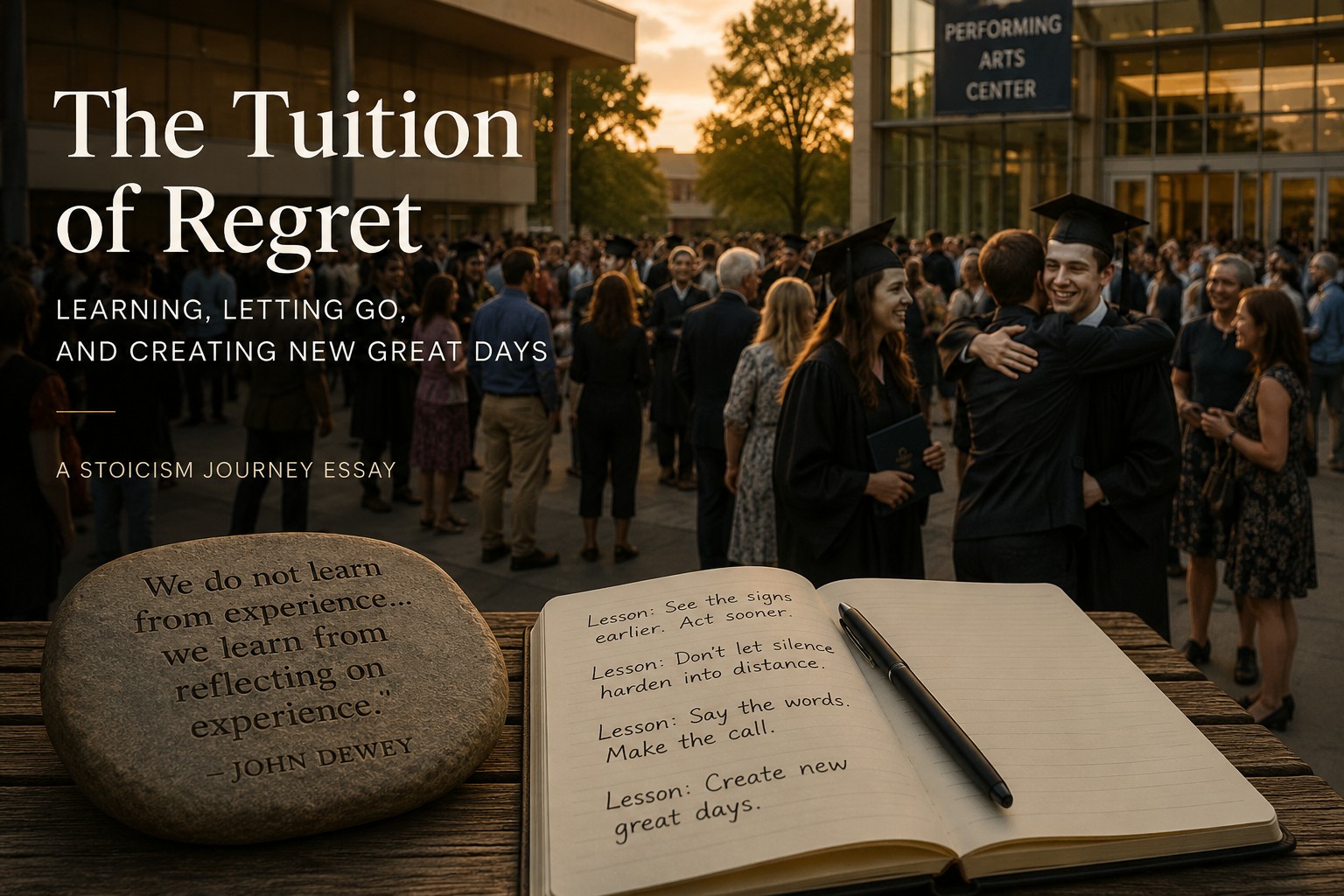 I have been thinking of regret as life’s tuition. Nobody wants to pay it. Sometimes it is painfully expensive. But if we refuse to learn the lesson, we pay the tuition and never receive the education. That image has stayed with me because it feels honest. Some lessons in life arrive gently. Others send a bill. I have paid some tuition. We all have.
One recent example is my job loss. I sensed the possibility before it happened. The signs were there. Funding issues. Organizational uncertainty. The familiar quiet that settles in before decisions are announced. I took some steps, but not enough. I did not move as aggressively as I should have. Part of me kept hoping the situation would stabilize. Part of me thought that if I worked harder, proved more useful, or stayed visible enough, I might hold back the tide.
That was not wisdom. That was reluctance dressed up as loyalty.
The Stoic lesson is not that I should punish myself for that. What good would that do now? The lesson is that when conditions change, I need to see them clearly and act sooner. Epictetus taught that some things are within our control and others are not. I could not control the funding streams, the company’s decisions, or the timing of the layoff. I could control my preparation, my networking, my applications, and my willingness to move before I was forced to move.
Regret is real, but it is not useless. It has already taught me to pay attention to the conditions around me. It has taught me not to wait until the bridge is burning before looking for another road. It has forced me, late in life, to rethink my place in the world and the shape of the years ahead. That is not a small lesson. It is an expensive one, but it is not wasted if I let it change how I live from here.
Other regrets live in a softer but deeper place. I think often about friends I have lost to time, distance, misunderstanding, or silence. Some people leave our lives because of death. Others leave because the years carry them away. Some leave because we fail to ask the question, make the call, or clear up the misunderstanding while there is still time.
I have known the particular regret of misunderstanding someone and then letting the silence harden. Instead of asking for clarity, I have sometimes allowed hurt feelings to become resentment. That is one of regret’s more selfish transformations. We begin with pain, but if we hold it too long, it curdles into a private story in which we are always the wounded party. We stop seeking truth and start defending our version of events. That kind of regret does not make us wiser. It makes us smaller.
The Stoic response is honesty. If an apology is needed, offer it. If clarification is possible, seek it. If harm was done, repair what can be repaired. If the person is gone from our lives and repair is no longer possible, then we carry the lesson forward. The next person we meet should not have to pay the bill for our last mistake.
That may be one of the most practical forms of redemption available to us. We cannot always undo the harm we cause. We cannot always recover the friendship. We cannot always say the words to the person who needed to hear them then. But we can become someone who speaks more gently now. We can become someone who clarifies sooner. We can become someone who does not let pride turn a misunderstanding into a wall.
Kierkegaard wrote that life can only be understood backward, but it must be lived forward. That sentence may be one of the clearest descriptions of regret I know. Regret asks us to look backward, but it becomes destructive when we try to live there. The past can instruct us. It cannot receive us. We are not allowed to move back into it and rearrange the furniture, and if we’re always looking back, we will eventually run into a wall.
This is where my thoughts often return to what I have heard called the last great days. Years ago, I heard Greta Gerwig say that “you do not know when the last time something is happening will be. You do not know the last great day you will spend with your best friend. You only know later, when you realize you never had that day again.” That thought has followed me for years. It has shaped much of my writing and, more importantly, much of my living.
There is sadness in it. Of course there is. I think of old friends from high school and college. I think of easy afternoons in Boone, card games in Tampa, golf rounds in Kings Mountain, lunches with people who once felt like permanent fixtures in my life. Some friendships faded with no dramatic ending. They simply thinned out until they became memory. Others were changed by distance, silence, or the complicated weather of growing older.
That can become regret if I let it. I could sit with those memories and ache over what cannot be restored. Some days, I do. But the better lesson is not to mourn the last great day forever. The better lesson is to create another one while I still can.
So I try now to stay more connected with the people who matter to me. I send the message. I make the call. I set the lunch. I take a walk along the Riverwalk with a friend. I try to hold people near in thought and place as much as life allows. Not every effort succeeds. Some people remain distant. Some doors do not reopen. But the effort matters because it keeps regret from becoming mere nostalgia. It turns memory into action.
My mother’s final season sharpened this lesson. When a parent grows old and frail, time takes on a different shape. Ordinary visits carry more weight. A family reunion is no longer just a family reunion. It may be one of the last times. A drive to Kings Mountain is no longer just a drive. It is a choice to show up while showing up is still possible. There are things I wish I had asked earlier, stories I wish I had written down, conversations I wish I had lingered over. But even there, regret has a task. It reminds me to pay attention now to the living, not only to grieve the dead.
Marcus Aurelius wrote, “Let each thing you would do, say, or intend be like that of a dying person.” That sounds severe until life teaches you what he meant. He was not telling us to be gloomy. He was telling us not to postpone what matters. Say the thing. Offer the kindness. Make the visit. Let the petty irritation pass. The clock is moving whether we approve or not.
Maya Angelou said, “Do the best you can until you know better. Then when you know better, do better.” That may be one of the gentlest summaries of practical wisdom. It leaves room for growth without excusing harm. It acknowledges that we fail, learn, and continue. The point is not to pretend our regrets are noble. Some are not. Some reveal cowardice, carelessness, pride, or neglect. But if we know better now, then the only honorable response is to do better now.
This is where regret becomes connected to the Stoic virtues. Wisdom asks us to see the regret clearly. Courage asks us to face it without denial. Justice asks us to make amends where we can. Temperance asks us not to drown in it. The goal is not to become a person with no regrets. The goal is to become a person whose regrets have been put to use.
There is a difference between carrying wisdom and carrying regret. Wisdom is light enough to travel with. Regret, once its lesson has been learned, becomes too heavy for the road ahead. We are not meant to drag every failure, missed chance, and unspoken word behind us forever. We are meant to learn from them, make what repairs we can, and then return to the work of living.
Regret is a classroom, not a home. We enter because life has something to teach us. We sit with the discomfort long enough to understand the lesson. We make amends if we can. We change what needs changing. Then we get up and leave.
The friend we failed to call teaches us to call the next one. The kindness we failed to offer teaches us to offer it tomorrow. The harsh word teaches us to speak with more care. The job loss teaches us to act sooner when the signs are clear. The last great day teaches us not to cling to the past, but to create new great days while we still can.
That is what regret is for.
Not punishment. Not permanent sorrow. Not resentment.
Regret is life asking whether we are willing to become wiser because of what we can no longer change. If we are, then even our mistakes are not wasted. The tuition may have been high, but the education is real. And with that education in hand, we turn toward the next task, the next friendship, the next apology, the next walk, the next lunch, the next ordinary day that may one day shine in memory as great.
We learn – We lay it down – We keep going.
