
True Joy Is a Serious Thing
For at least seven or eight years, a Latin phrase has appeared in the footer of my personal letterhead. Res severa est verum gaudium. I had come across it while looking through a list of Latin phrases, probably after searching for the meaning of something else. I no longer remember the occasion. I only remember that these particular words stayed with me.
I understood them to mean, “True joy is a serious thing.” That felt immediately right. The phrase gave joy a weight I had not always granted it. It suggested that joy is not merely entertainment or a passing feeling of happiness, but something deeper and more deliberate. Something worth seeking, cultivating, and sharing.
I only recently learned that the words came from Seneca.
That discovery felt like another of those serendipitous confluences of everyday happenstance that have marked my journey into Stoicism. I did not study Seneca and then choose one of his sayings for my letterhead; I chose the words years before I knew their source. In the same way, I had written about accepting what is, enduring hardship, and paying attention to ordinary days before I understood how naturally those ideas fit within Stoic philosophy.
Sometimes we recognize a truth before we know its name.
Seneca wrote the line in his twenty-third letter to Lucilius, where he distinguishes true joy from the shallow cheerfulness that depends upon favorable circumstances. The joy he describes is not always light or easy. It comes from within a person whose life is grounded in wisdom and whose peace does not rise and fall with every change of fortune. It is serious because it rests on something more durable than pleasure.
That does not mean joy must be solemn. Seneca was not asking us to frown our way toward enlightenment. Laughter, celebration, beauty, and pleasure belong in a good life. Even so, there is a difference between being amused and being joyful. Entertainment fills an hour. True joy can remain with us for decades.
I feel that difference most clearly in music.
When I was in high school, our band performed the final two movements of Modest Mussorgsky’s Pictures at an Exhibition in competition. The work ends with “The Great Gate of Kyiv,” one of those pieces that seems to gather everything before it and carry it toward a grand, almost overwhelming conclusion. It required discipline from every person in the ensemble. No one could create the moment alone.
That day, somehow, we found it together. I remember knowing, even as we played, that I had hit every note. It felt as though the whole band had done the same. We had practiced until the music was part of us, and for those final minutes, our separate efforts became one sound. We had reached something that felt like transcendence.
I have heard a professional orchestra perform the complete work twice in recent years. Each time, the grand ending rang in my heart with nostalgia and in my soul with pure joy. I was hearing the orchestra in front of me, and I was also hearing the young musicians we had once been. The music joined the present and the past, reminding me that a beautiful moment does not necessarily disappear when it ends. Sometimes it waits inside us until a familiar sound brings it home.
It is not mere entertainment. It is joy with history in it, shaped by memory, discipline, collaboration, and beauty.
I find the same kind of joy in quieter places. I feel it sitting on the front porch while rain settles over the neighborhood. I feel it when I photograph an extraordinary sunrise over Tampa Bay, knowing that the sky will never arrange itself in quite that way again. I feel it when an old friend reaches out after a long silence. I have been told that, in those moments, I visibly light up.
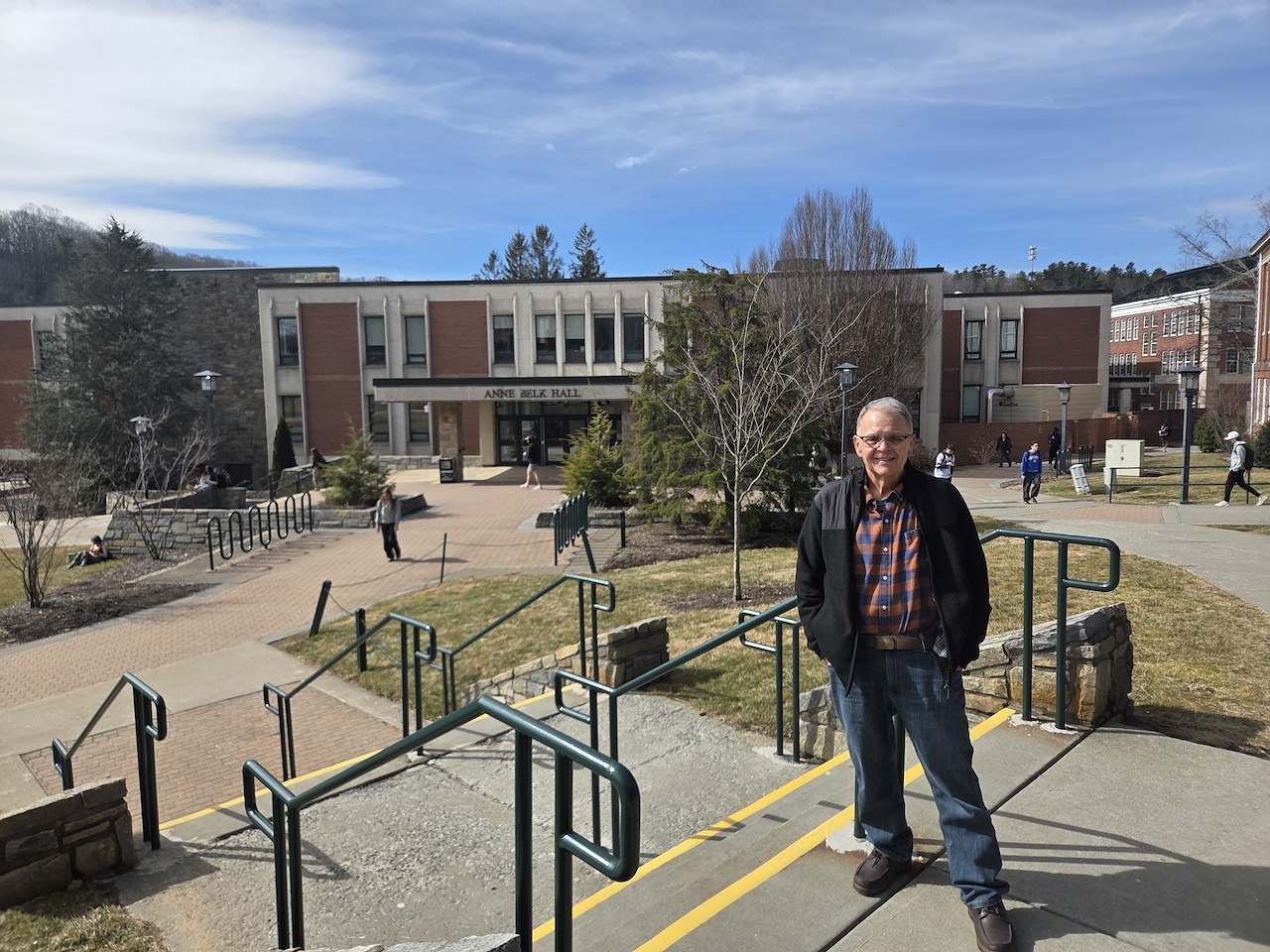 And I feel it in Boone.
Not long ago, during what I knew might be my last visit there for some time, I sat on the bank outside the student union and looked across the grassy commons. Students hurried past in every direction. Some were talking with friends. Others were carrying books, looking at their phones, or moving with the purposeful urgency of people who have somewhere important to be.
I watched their bright faces and thought about the hopes wrapped inside all those lives. Most of them could not yet know where their choices would carry them. I remembered being one of them, walking across that same campus with my own plans, uncertainties, friendships, and dreams. Much of the life ahead of me then could not have been imagined.
The moment was bittersweet. I knew I was leaving a place I loved, and I did not know when I would return. Still, sadness did not cancel the joy. It deepened it. Memory and hope sat together on that hillside. I could be grateful for the life I had lived there while looking warmly upon lives still beginning.
Perhaps that is why Seneca called true joy a serious thing. It can hold more than happiness. It can carry nostalgia without becoming trapped in the past. It can live beside grief without pretending the grief is not there. It allows us to recognize beauty even while knowing that everything beautiful is passing.
True joy requires attention. The orchestra can play, the rain can fall, the old friend can call, and the sun can rise over the bay without our fully noticing any of it. The holiness of ordinary days does not force itself upon us. We have to be present enough to receive it.
That old Latin phrase was never merely decoration at the bottom of my letterhead. Even before I knew who wrote it, it expressed something I wanted my life to honor. Joy matters. It deserves more from us than an occasional pursuit of pleasure. It asks us to notice, to remember, to create, and to share.
Seneca had been quietly sitting at the bottom of my letters all those years, waiting for me to catch up.
And perhaps that is another kind of joy: the joy of being ready to recognize it.

I am going to my hometown, Cincinnati, in August and to my college town, Chicago in September. I miss those places and feel sad occasionally because I am here and not there and because of the time that has past and the people that I lost but I am going to work on remembering the joy and think positive about the future and in particular the future of my child when she begins her second year of university at IU later this summer. Thank you for the realignment!
I’m glad you found meaning in the article. That means a lot.