The Tuition of Regret

This entry is in the series Journey Through Stoicism

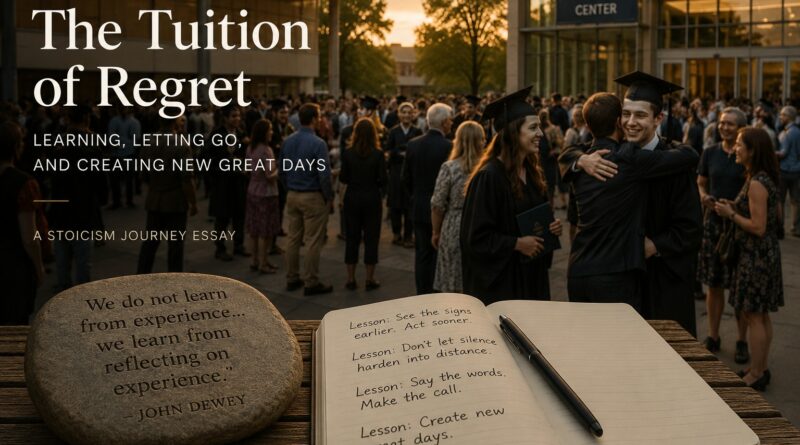
Most of us have regrets, whether we admit them or not. A word spoken too sharply. A kindness withheld. A friendship allowed to drift. A warning sign ignored until it was too late. We may like the idea of living with “no regrets,” but that has always struck me as too clean. If we have lived fully, loved deeply, failed honestly, or hurt someone along the way, regret eventually finds us.

In this essay, I explore regret through the lens of Stoicism, Daniel Pink’s work on The Power of Regret, and my own recent life. I have come to think of regret as life’s tuition. Nobody wants to pay it. Sometimes it is painfully expensive. But if we refuse to learn the lesson, we pay the tuition and never receive the education.

The Stoics did not ask us to deny regret or drown in it. They asked us to examine it, learn from it, make amends where we can, and then lay it down. Regret is not meant to become a permanent home. It is a classroom. The lesson may be to call the friend, offer the apology, act sooner, speak more gently, or create new great days while we still can.

Read more

Nothing Says “This Season of Life” Like a Cremation Luncheon Invite

Yesterday’s mail brought me a milestone. Not a birthday card or a Medicare handbook, but a glossy luncheon invitation from the National Cremation Society. Apparently, once Medicare enters your life, the end-of-life marketing ecosystem wakes up and decides it’s time to talk.

The flyer promised “Personalized Affordable Options” and a “Professional Service Guarantee”—phrases that raise more questions than they answer. Since I grew up in the funeral business, I had to laugh. But underneath the humor is something real. Planning for death isn’t really about logistics; it’s about caring for the people who are left behind.

This essay starts with jokes, but it ends with what matters most: grief, love, and why the way we leave matters more to the living than to the dead.

Read more

Friendship and Impermanence

This entry is in the series Journey Through Stoicism

Friendships are among life’s most unpredictable gifts. Some arrive for only a brief season, while others feel like they’ll last forever. Yet nothing is promised. A letter from an old college friend recently reminded me of this truth with painful clarity: he chose silence, not because of anger, but because life had drained him of the energy to stay connected. His message closed the door on our relationship, and with it came both relief and grief. Relief that I had not harmed the friendship, grief that its time had ended.
The Stoics teach us that everything we hold dear is on loan from fortune and will one day be reclaimed. That includes the people we love and the friendships that sustain us. Loss, they say, is not theft but the return of what was never fully ours. To see relationships this way doesn’t erase sorrow, but it reshapes it. Gratitude can take the place of clinging, and memory can remain as a reminder of both the gift and the impermanence of friendship.

Read more

Boone, Facebook, and Marcus Aurelius…Oh My

This entry is in the series Journey Through Stoicism

I came across a meme that read, “There are two places you need to go often: The place that heals you. The place that inspires you.” It struck me deeply, because for me, one of those places is Boone, North Carolina, where I went to college. But as I reflected on that idea through the lens of Stoic philosophy, I realized the Stoics might offer a very different kind of guidance: to go inward. This essay explores the contrast, and surprising harmony, between modern healing and ancient inner retreat.

Read more