
Kathy Castor Voted Against Hurricane Relief 11 Times? There’s Much More to That Story.
 An article circulating in Tampa Bay says Rep. Kathy Castor often voted against hurricane relief. But congressional records show something quite different.
A September 17 article in West Orlando News claims that Congresswoman Kathy Castor voted 11 times against hurricane relief funding, saying she tried to block $151.43 billion in federal disaster assistance.
The article even suggests Castor opposed funding when Tampa Bay residents desperately needed help recovering from Hurricanes Helene and Milton.
That’s a serious accusation. It deserves a serious look at the facts.
The article uses claims from the National Republican Congressional Committee (NRCC), which backs Castor’s Republican opponent, Mike Beltran. It lists real congressional votes and links to official records, making the story seem credible.
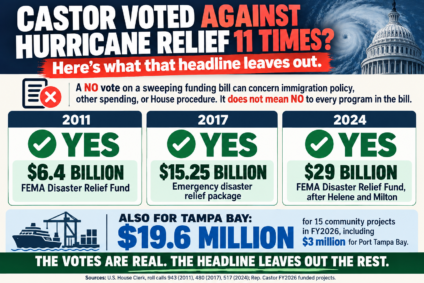 Unfortunately, the article leaves out some key facts, like Castor’s votes in favor of billions for hurricane relief. (West Orlando News)
How to Turn a Budget Vote Into a Hurricane Scandal
Congress almost never votes on just one spending item. Most federal funding comes through large appropriations bills covering numerous agencies and programs.
For example, the Department of Homeland Security includes FEMA, ICE, the Coast Guard, and the TSA. When Congress votes on Homeland Security funding, members have to consider everything in the bill. Someone might support FEMA funding but disagree with parts about immigration enforcement.
Congress also votes on procedures that determine how bills reach the House floor. These votes can affect whether members may offer amendments or alternative proposals.
The West Orlando News article treats Castor’s votes against these larger bills as if she was against FEMA funding itself. This approach produces an impressive accusation, provided readers never examine what Congress was actually voting on.
Let’s Look at Those Votes
2011: An especially inconvenient omission
The article cites Castor’s June 2011 vote against a Homeland Security appropriations bill containing $2.65 billion for disaster relief.
Here’s what it leaves out.
On December 16, 2011, Castor voted YES on H.R. 3672, the Disaster Relief Appropriations Act. That legislation provided $6.4 billion directly to FEMA’s Disaster Relief Fund, including assistance following Hurricane Irene and other major disasters.
Congress passed it, and President Obama signed it into law.
The article points out Castor’s vote against a broad Homeland Security bill but ignores her support for a bill called the Disaster Relief Appropriations Act. That’s quite a feat in selective reporting. (House of Representatives Clerk)
2012 and 2013: More annual spending bills
The next two accusations concern H.R. 5855 and H.R. 2217, annual Homeland Security spending bills.
Both bills included money for FEMA, as well as funding for immigration enforcement, border security, and other federal programs. Castor opposed those House proposals. The records confirm that.
But in January 2014, Castor voted YES on the final consolidated appropriations legislation, H.R. 3547, which funded Homeland Security, including FEMA.
It seems the article found the final funding bill less newsworthy than Castor’s earlier no vote. (House of Representatives Clerk)
2015: The vote that tells the story
This example shows exactly how selective reporting can distort a congressional record.
In January 2015, Castor voted against H.R. 240, a Homeland Security appropriations bill that included provisions intended to block President Obama’s immigration actions. (Roll Call 35)
The dispute continued for weeks. Eventually, Congress removed the controversial immigration provisions and considered a revised funding measure.
On March 3, Castor voted YES to fund Homeland Security, including FEMA. (Roll Call 109) The final bill passed 257-167, with 182 Democrats supporting it and 167 Republicans voting against it.
Castor helped pass the funding bill, but the article only mentions her earlier no vote. (clerk.house.gov)
2017: Another missing disaster relief vote
The article cites Castor’s opposition to H.R. 3354, a broad appropriations package containing FEMA funding.
On September 8, 2017, however, Castor voted YES on H.R. 601. (https://clerk.house.gov/Votes/2017480?utm_source=chatgpt.com)
That bill provided $15.25 billion in emergency disaster assistance following Hurricane Harvey, including substantial funding for FEMA.
President Donald Trump signed it into law.
Castor supported emergency hurricane relief while a Republican was president, and both parties strongly supported the bill. That seems like important information for any article claiming she opposed hurricane relief. (clerk.house.gov)
2023 and June 2024: More budget disputes
These votes concerned annual Homeland Security appropriations.
The June 2024 vote occurred months before Hurricanes Helene and Milton struck Florida.
Both bills included much more than disaster relief, and Castor, along with most House Democrats, voted against them. The article uses these votes to support its claim about her response to hurricanes that, in June 2024, had not yet occurred. (congress.gov)
December 2024: The vote the article really should have mentioned
Following Hurricanes Helene and Milton, Congress considered the American Relief Act.
The legislation included more than $100 billion in disaster-related assistance, with $29 billion specifically appropriated to FEMA’s Disaster Relief Fund.
On December 20, Castor voted YES. The bill passed 366-34.
Every member voting against it was a Republican.
This legislation directly addressed recovery from the hurricanes that devastated Tampa Bay. Yet the article that accuses Castor of blocking hurricane relief overlooks it entirely. (clerk.house.gov)
2025 and 2026: Immigration enforcement becomes the issue
The remaining accusations concern federal spending and a dispute over ICE. In March 2025, Castor opposed a broad government funding bill. In January 2026, she opposed Homeland Security appropriations over concerns about ICE operations and congressional oversight.
Her January statement explicitly explained those concerns. On March 4, 2026, Castor voted against a procedural motion governing consideration of another Homeland Security bill.
The article describes this as an attempt to prevent FEMA funding from reaching a vote.
Castor backed separate bills to fund FEMA, TSA, and the Coast Guard while talks about ICE were still going on.
Then, on March 26, she opposed another Homeland Security funding bill during the partial department shutdown.
Republicans argued their legislation would restore agency funding. Democrats sought to fund other Homeland Security operations separately from ICE.
These disputes centered on how Congress should fund Homeland Security and oversee immigration enforcement. Saying Castor’s votes were meant to shut down FEMA ignores what Congress was really debating. (House of Representatives Clerk)
Meanwhile, What Has Castor Brought Home?
Beyond disaster relief, Castor has secured federal funding for projects throughout Tampa Bay.
Her published community project funding records identify $19.6 million for 15 regional projects in fiscal year 2026. These include $3 million for Port Tampa Bay channel improvements, $2 million for a Hillsborough County Public Schools family resource center, $1.2 million for infrastructure at Robles Park Village, and $1.09 million for converting septic systems to sewer service in Ruskin. Port Tampa Bay separately confirmed that Castor helped secure $10 million for its harbor improvement project, including the $3 million already mentioned. (Kathy Castor)
Her office says about $1.47 billion in federal grants came to Tampa Bay in 2024, helping with transportation, education, infrastructure, and more. These awards involved federal agencies, local partners, and Congress. Castor can’t take all the credit, but these results matter when looking at federal investment in her district. (Kathy Castor)
Reporting the Votes Is Only Half the Job
The NRCC has plenty of political reasons to go after Kathy Castor. That’s what political campaign committees do.
Readers should expect better from a publication that presents itself as a news outlet.
The West Orlando News article accurately identifies several negative votes. Its interpretation of those votes ignores the legislation’s contents, the disputes surrounding it, and Castor’s support for major disaster funding.
Most troubling, it leaves out her votes for billions in emergency aid, including the $29 billion for FEMA after Helene and Milton.
Leaving out those facts changes the story a lot. Congressional records show that Kathy Castor has repeatedly voted to fund hurricane recovery.
Sources
- West Orlando News, “Florida Rep. Castor Voted 11 Times Against Funding for Hurricane Relief”
View source - S. House Clerk, Roll Call 943 (2011), H.R. 3672, Disaster Relief Appropriations Act
View source - S. House Clerk, Roll Call 370 (2012), H.R. 5855, Department of Homeland Security Appropriations
View source - S. House Clerk, Roll Call 35 (2015), H.R. 240, January Homeland Security Appropriations Vote
View source - S. House Clerk, Roll Call 109 (2015), H.R. 240, Final Homeland Security Funding Vote
View source - S. House Clerk, Roll Call 528 (2017), H.R. 3354, Consolidated Appropriations
View source - S. House Clerk, Roll Call 480 (2017), H.R. 601, Emergency Disaster Assistance
View source - gov, House Roll Call 505 (2023), H.R. 4367, Homeland Security Appropriations
View source - S. House Clerk, Roll Call 517 (2024), H.R. 10545, American Relief Act
View source - S. House Clerk, Roll Call 70 (2025), H.R. 1968, Full-Year Continuing Appropriations and Extensions Act
View source - Office of Rep. Kathy Castor, Community Project Funding Records
View source - Office of Rep. Kathy Castor, Federal Grants Awarded to Tampa Bay in 2024
View source - Infographic – AI Generated
