The Books They Don’t Want Our Children to Read
 Growing up, I didn’t have books that helped me understand who I was. People rarely talked openly about being gay, especially with kids. If books about young people struggling with their sexuality existed, I didn’t know where to find them. I spent years trying to make sense of feelings I couldn’t explain, always wondering if anyone else felt the same.
I often wonder how different those years would have been if I’d found a book about someone like me. Maybe it would have spared me some confusion and loneliness. At the very least, I might have realized sooner that I wasn’t alone, that others understood, and that there was nothing wrong with being who I was.
 During Banned Books Week, I keep thinking about how Florida’s politicians, state education officials, and even our own Hillsborough County School Board have worked to limit children’s access to books. It frustrates me to see adults who think their personal beliefs should decide what everyone else’s children can read.
For some kids, finding the right book can make a huge difference. Yet we have adults devoting extraordinary amounts of time and political energy to making sure those books are harder to find.
How Florida Got Here
In 2017, then-state Representative Byron Donalds sponsored HB 989, which helped create the book-challenge system behind much of Florida’s current controversy.
Florida parents already had a legal process for objecting to instructional materials used by their own children. Donalds helped expand that process to allow any county resident to challenge materials, including books in school libraries. The person filing the challenge didn’t even need to have a child attending public schools.
What possible justification is there for allowing someone with no children in a school to decide whether the children who do attend that school should have access to a particular book?
I understand if a parent objects to what their own child reads. Parents have the right to make those choices, and schools should respect that. The problem starts when one parent’s objection turns into a demand to remove the book for everyone else’s kids.
Donalds is now running for governor, and his campaign highlights that 2017 law as an achievement. He may see it as something to celebrate, but I see it as the beginning of a remarkably destructive period for intellectual freedom in Florida’s public schools.
The Republican-controlled Legislature continued down that path with HB 1467 in 2022 and HB 1069 in 2023. Together, these laws expanded state oversight of school library materials and strengthened procedures that could lead to objections, restrictions, or removals. In 2024, legislators passed HB 1285, limiting certain nonparent residents to one challenge per month after even Governor DeSantis acknowledged that people were abusing the process by challenging enormous numbers of books.
Consider the voting records of some politicians seeking to represent Hillsborough County:
Josie Tomkow, now running for the Florida Senate, voted YES on HB 1467, HB 1069, and HB 1285.
Representative Karen Gonzalez-Pittman voted YES on the latter two bills.
Former Representative Jackie Toledo, now running for County Commission, supported HB 1467.
While the 2024 bill limited some of the worst abuses, it kept the main system in place. These lawmakers backed laws that gave the state more power to restrict library access. Their votes matter because thousands of Florida students have been affected.
PEN America reports that Florida had 1,406 school book bans in 2022–23 and 4,561 in 2023–24. Its latest report, released during Banned Books Week 2026, ranks Florida second in the nation with over 3,000 bans last school year. These numbers include temporary bans and repeated removals of the same book in different schools, but they show just how widespread this has become.
The Fiction of Parental Rights
Supporters of these laws often talk about parental rights. That sounds fair until you look at whose rights they’re really talking about.
If a parent objects to a book, they can stop their own child from reading it. But these activists want the power to limit what other families’ kids can find in school libraries. They’re willing to push their own beliefs and views over the choices other parents might make. So this is NOT about “parental rights” if one person can dance into a School Board meeting and prevent every child from accessing a book.
When someone brings this up, the usual reply is that parents can just buy any books they want for their kids.
What an extraordinarily callous thing to say.
Thanks to twenty-plus years of Republican control in Florida, many families in Hillsborough County struggle to pay rent, buy food, and keep the lights on. Some live in their cars. Others work several jobs and still barely get by. For them, buying books that used to be available at school might not be possible.
A public school library should be a place where every child, no matter their family’s income, can access books and information. Telling struggling parents to go buy the books themselves is a harsh and dismissive answer to a problem these activists helped create.
What about the child who can’t safely talk about certain issues at home? A teen struggling with their sexuality, a young person facing abuse, or a student trying to understand a family situation they’ve never seen in a book? That child might rely on the school library for information and comfort they can’t get anywhere else.
I think about Maya Angelou’s I Know Why the Caged Bird Sings, a remarkable work by a remarkable woman. Angelou wrote honestly about racism, sexual violence, trauma, and her struggle to find her voice. Her memoir has faced challenges because some adults object to descriptions of the abuse she experienced. Yet those difficult passages are part of what makes the book so valuable. A young person who has suffered abuse may find reassurance in her survival. Other readers may gain a deeper understanding of racism and the experiences of people whose lives differ from their own.
Taking away a book just because its subject makes some adults uncomfortable does a real disservice to young readers. The same goes for books about LGBTQ youth, whose stories can help students understand themselves and others.
I would have welcomed that opportunity when I was young.
This Is an Organized Political Effort
Organizations such as Moms for Liberty have driven much of this campaign, making school-library challenges a prominent part of its activism. The group provides instructions for identifying books, filing objections, and working with school boards. Its members have helped turn disputes over individual titles into political campaigns.
It’s especially troubling to see this tied to school board elections, and Hillsborough voters should take notice.
The Leadership Institute, a national conservative political training organization, operates a School Board Leaders Program that teaches candidates and activists how to win elections and influence school district policy. The Institute describes its purpose as increasing the number and effectiveness of conservative leaders. It works with organizations such as Moms for Liberty, which directs its own members to Leadership Institute training resources.
This relationship has been publicly documented for years. In 2022, WUSF reported that the Leadership Institute conducted candidate-training sessions at a Moms for Liberty gathering, with some sessions closed to reporters. A separate account published by Illinois Families for Public Schools described a Leadership Institute training event organized with Moms for Liberty and Awake Illinois. According to notes supplied by an attendee, trainers suggested making the removal of what they called pornography from school libraries a campaign issue.
Those notes are just one person’s account of a training session, but they show how book restrictions can be used as an election strategy.
And two names connected to that same training network should be familiar to Hillsborough voters: Bridget Ziegler and Brittany Lyssy.
Ziegler, an early leader of Moms for Liberty and a Sarasota County School Board member, served as Vice President of the Leadership Institute’s School Board Leaders Program. Lyssy, now running for the Hillsborough County School Board District 2 seat, worked in that program as its Director of Communications.
These two didn’t just attend the same conference. Both had professional roles in the same political training group, which worked with Moms for Liberty to prepare conservative school board candidates.
Lyssy points to her Leadership Institute experience as a qualification for public office. That’s fair. It also means the group’s work, its political ties, and the policies it promotes are fair game for public scrutiny.
I have not found evidence that Lyssy personally advocated banning particular books or helped write book-challenge policies. But her professional connection to a network that has worked closely with groups promoting library restrictions raises an obvious question: Does she share their views about removing books from public schools?
She should answer that question clearly, especially before voters decide whether to give her a say over Hillsborough County’s schools and libraries. Some people need to deal with their own issues instead of forcing them on every other family here.
What Happened in Our Own Schools
The Hillsborough County School Board has already shown what happens when elected officials override the judgment of the professionals charged with reviewing books.
In March 2023, the Board voted 4–3 to remove This Book Is Gay from all district middle-school libraries, despite recommendations from two review committees that the book remain available. Lynn Gray, Stacy Hahn, Patti Rendon, and Henry Washington supported removal. Nadia Combs, Karen Perez, and Jessica Vaughn opposed it.
The book covers topics like sexuality, identity, relationships, and sexual health. Some parts raise fair questions about what’s age-appropriate, but the district’s review process already looked at those issues. Still, four School Board members chose to ignore those recommendations.
Then, in September 2025, all seven Board members voted to remove Blankets by Craig Thompson and Identical by Ellen Hopkins, reversing an earlier decision to retain them. Some members cited explicit content, while others pointed to threats of legal action and possible consequences from state officials.
By then, the controversy had grown far beyond individual challenges. In June 2025, Superintendent Van Ayres appeared before the Florida State Board of Education, where members pressed him to remove additional books from Hillsborough libraries. State Board member Dr. Grazie Pozo Christie went so far as to accuse the district’s media specialists of child abuse over materials available to students.
Consider how cruel that accusation is. These are trained professionals whose careers involve helping children learn, encourage reading, and guide students to the right materials. Yet a political appointee publicly accused them of child abuse just because she disagreed with their professional decisions. Frankly, Dr. Christie can just f’ right off. (Yes, I’m angry!)
Following that confrontation, Hillsborough agreed to remove dozens of additional titles, while hundreds more were pulled for review. Some of those books had never faced a formal local challenge. The Florida Freedom to Read Project documented how state pressure bypassed the district’s established procedures and, in at least one instance, undermined an earlier local decision to retain a book.
I’m troubled by the School Board’s actions, but I’m most personally disappointed in Van Ayres.
When Public Officials Give In
I’ve always respected Van Ayres and believed he cares about Hillsborough’s public schools and students. The district has made real progress under his leadership, which makes his response to state pressure even more disappointing.
Ayres stood up for his staff and the district’s review process during the confrontation, and he deserves credit for that. But in the end, he agreed to remove more books instead of insisting the state follow the proper process.
I understand the pressure he faced. The DeSantis administration has repeatedly demonstrated its willingness to punish public officials who resist its demands. But we have also seen that the governor’s authority has limits.
Consider what happened to former Hillsborough State Attorney Andrew Warren, whom DeSantis suspended from his elected position in 2022. A federal judge subsequently found that the governor’s actions violated Warren’s First Amendment rights and the Florida Constitution, although the judge concluded he lacked the authority to reinstate him.
Ayres had no guarantee He would have won if he stood his ground. He could have been removed or faced other consequences. Still, I wish he had made state officials justify their demands legally, instead of agreeing to skip a local process meant to protect students, parents, and professional judgment.
The same goes for School Board members who changed their decisions because of political pressure. I know some faced tough choices, and I respect those who spoke out about the threats they got. But holding public office sometimes means taking personal and professional risks to stand up for your community. Sorry, but this was NOT what “leadership” looks like.
Caving in to bullies rarely ends well. In this case, the consequences fell on children who lost access to books and on the librarians whose professional judgment was cast aside.
The Children Who Needed Those Books
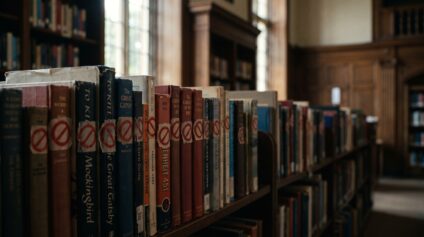 What bothers me most is how little thought these campaigners give to the kids who could benefit from the very books they want to take away.
A student reading about racism may come to understand a classmate’s experiences. A child who has experienced abuse might find reassurance in a survivor’s story. A teenager struggling with sexual identity may discover that someone else has lived through the same confusion and fear.
Books can help children develop compassion, understand tough experiences, and find words for things they’ve never been able to express.
I know something about that last one.
Looking back on my childhood, I wonder how much easier things would have been if I’d found a story that helped me understand being gay. I didn’t need someone to tell me what to think or who to be. I just needed to know people like me existed, that they had good lives, and that I could too.
Today, kids can read books about experiences that older generations rarely talked about. That should be something to celebrate. Instead, some elected officials and political groups are working hard to remove those books from schools.
I’m damned tired of seeing students used as cannon fodder in culture wars by adults who should know better.
The politicians who passed these laws, the groups training candidates to push these fights, and the school officials who give in to pressure should all be held accountable for the results of their choices.
I’d rather see our elected officials focus on kids who can’t read at grade level, schools that need more resources, and teachers who spend their own money on supplies. Those are the problems that deserve real attention and effort.
Banned Books Week should remind us that the freedom to read matters most when a book challenges what we already believe or helps someone whose experience differs from our own.
Sources
- Florida Legislature, HB 989 (2017): Byron Donalds’ legislation expanding who could challenge school materials, including library books. https://www.flsenate.gov/Session/Bill/2017/989
- Byron Donalds, Official Campaign Biography: His campaign’s description of HB 989 as a legislative accomplishment. https://byrondonalds.com/about/
- Florida Legislature, HB 1467 (2022): School library oversight and instructional materials. https://www.flsenate.gov/Session/Bill/2022/1467
- Florida Legislature, HB 1069 (2023): Restrictions and objection procedures for instructional materials. https://www.flsenate.gov/Session/Bill/2023/1069
- Florida Legislature, HB 1285 (2024): Changes to school library objections, including limits on challenges by certain nonparents. https://www.flsenate.gov/Session/Bill/2024/1285
- PEN America, School Book Bans Reports: National and Florida book-ban statistics, including temporary restrictions. https://pen.org/book-bans/
- Moms for Liberty, School Board Resources: Resources for school board activism and training. https://portal.momsforliberty.org/resources/other-topics/school-boards/
- WUSF, Moms for Liberty Aims to Expand Political Influence (2022): Leadership Institute training and its relationship with Moms for Liberty. https://www.wusf.org/politics-issues/2022-07-18/moms-for-liberty-aims-to-expand-political-influence-bolstered-by-trainings-endorsements
- Illinois Families for Public Schools, School Board Training: Report on Leadership Institute training and the use of book removals as a campaign issue. https://www.ilfps.org/extremist_groups_school_board_training
- Leadership Institute, School Board Campaign Training: Training program and organizational background. https://www.leadershipinstitute.training/courses/schoolboardcampaign
- Hillsborough County School Board, Official Meeting Records: Board actions concerning This Book Is Gay, Blankets, and Identical. https://go.boarddocs.com/fl/sdhc/Board.nsf/Public
- PEN America, Hillsborough County’s State-Driven Censorship Campaign: June 2025 confrontation involving Van Ayres and Dr. Grazie Pozo Christie. https://pen.org/floridas-hillsborough-county-faces-a-frightening-state-driven-censorship-campaign/
- Florida Freedom to Read Project, Addressing State Actions in Hillsborough Schools: Details of removals, review procedures, and state pressure. https://www.fftrp.org/addressing_state_actions_in_hillsborough_schools
- U.S. District Court, Warren v. DeSantis: Judicial findings concerning Andrew Warren’s suspension. https://law.justia.com/cases/federal/district-courts/florida/flndce/4:2022cv00302/440164/143/
- Image AI Generated
