
Gus Bilirakis: Who Benefits from His Votes?
 Congressman Gus Bilirakis has served parts of the Tampa Bay area since 2007. After almost 20 years in Washington, he has built a clear record showing whose interests he puts first. Now, thanks to redistricting, Bilirakis wants to represent a new group of Floridians in Congressional District 12, which covers much of Hillsborough and Pasco counties.
It’s important to look closely at his record, since some of his votes raise real questions about whether his priorities fit the needs of his constituents.
Let’s begin with health care.
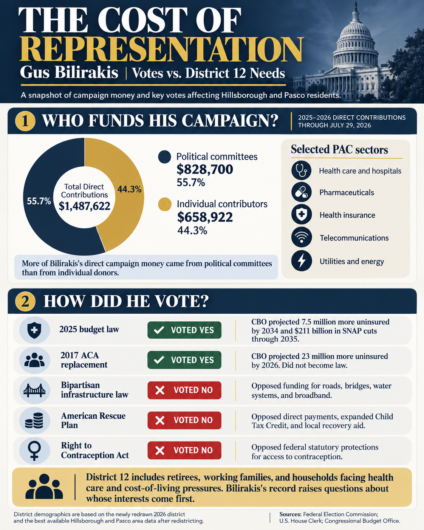
In July 2025, Bilirakis voted for President Trump’s One Big Beautiful Bill Act. The Congressional Budget Office says its Medicaid changes will leave 7.5 million more Americans uninsured by 2034. The law also cuts projected federal spending on food assistance by $211 billion through 2035.
Apparently, making America great again requires making health care considerably harder to obtain for millions of Americans. The CBO also found that the law will take resources away from lower-income households, while those in the middle and upper income brackets will see average gains. Most of these gains come from tax cuts.
This is important in a district where many people live on modest incomes, retirees rely on federal benefits, and families struggle with rising costs.
Because Florida was recently redistricted, detailed Census data doesn’t yet match the new boundaries. So, some demographic estimates are based on the Hillsborough and Pasco communities now included in District 12.
Bilirakis’s record on health care stretches back many years.
In 2017, he voted for the Republican plan to repeal and replace major parts of the Affordable Care Act. The Congressional Budget Office estimated that this bill would have left 23 million more Americans uninsured by 2026. Fortunately for those Americans, the bill never became law.
In November 2021, Bilirakis voted against the bipartisan Infrastructure Investment and Jobs Act. This law provided funding for roads, bridges, water systems, broadband, and other public needs. Anyone who drives in Hillsborough or Pasco knows there is a lot of traffic and a real need for more infrastructure investment. Apparently, Washington had other priorities that day.
He also voted against the 2021 American Rescue Plan, which gave direct financial help to households, expanded the Child Tax Credit, and supported state and local governments as they recovered from the pandemic.
In 2022, Bilirakis also voted against the Right to Contraception Act, which aimed to protect access to contraception under federal law.
 Now, let’s follow the campaign money.
Federal Election Commission records show that by July 29, 2026, Bilirakis’s campaign had received about $1.59 million. Of the $1.49 million in direct contributions, around $659,000 came from individuals, while $829,000 came from political committees. This means that almost 56% of his campaign contributions came from political committees, not from individual donors.
His contributors include political action committees linked to pharmaceutical companies, health insurers, hospitals, telecommunications firms, and energy providers. His campaign finance reports list PACs connected to Pfizer, Johnson & Johnson, Humana, Comcast, AT&T, and Duke Energy. Bilirakis also serves on the House Energy and Commerce Committee, which oversees laws that affect many of these industries, such as health care, communications, and energy.
Campaign contributions do not prove that anyone bought a vote. These companies have the legal right to take part in the political process. But the public also has the right to see who funds their representatives and how those representatives vote.
There is a clear contrast. Bilirakis backed a law that cuts projected Medicaid coverage and food assistance, while his campaign gets significant funding from groups in industries affected by federal policy. He also opposed federal spending on infrastructure and pandemic aid that helped families and communities across Tampa Bay.
After nearly two decades in Congress, Gus Bilirakis has accumulated a substantial legislative record and a well-established network of political contributors.
District 12 residents must ask whether the results of his work in Washington match their needs. His votes and campaign finance reports provide plenty of material for answering it.
Principal sources
- Federal Election Commission: Bilirakis for Congress, 2025–2026
- House Roll Call 190: 2025 budget law
- Congressional Budget Office: Medicaid coverage and SNAP effects
- Congressional Budget Office: Effects on household resources
- House Roll Call 256: 2017 Affordable Care Act replacement
- House Roll Call 369: Bipartisan infrastructure legislation
- House Roll Call 72: American Rescue Plan
- House Roll Call 385: Right to Contraception Act
