
Wisdom: Whittling Away at Uncertainty
 Of the four Stoic virtues, wisdom may be the one I have written about least.
Courage is easy for me to understand. Justice gives me something real to think about. Temperance asks me to look at restraint, balance, and self-control. But wisdom is harder. I am not always sure what it means to be wise, or how anyone becomes wise.
That uncertainty may be the right place to begin.
People often think wisdom comes with age and experience. If you live long enough, make enough mistakes, and learn enough lessons, wisdom should follow. But I do not think it is that simple. I have seen older people repeat the same mistakes for years. I have also met younger people who show impressive judgment.
Experience gives us material to work with. What we do with it matters more.
And then we have to decide.
That last part is important because wisdom does not help much if it stays only in our thoughts. I once wrote in my notes, and it still feels true: “Wisdom is useless if you don’t apply it.”
I learned some of that through decisions I wish I had made differently.
Years ago, I lived in Dayton, Ohio, when a competitor bought the company I worked for. I probably would have been kept on to manage the combined data center, but the new company clearly had a very different culture. I couldn’t know whether I would adapt well.
At about the same time, an industry friend who owned another document conversion company had been talking to me about joining him. He had founded the business, his sons worked there, and the whole arrangement seemed comfortable. They wanted me. I knew the industry. I knew him. Given what was happening at my existing company, the move seemed reasonable.
So I made it.
I soon found out that the older son was stubborn, and I had little control over the part I was supposed to manage. I had responsibility but not much authority. The place I thought would be comfortable turned out to be anything but.
Knowing what I know now, I would not make that decision again.
The phrase “knowing what I know now” sums up a lot of what we mean by wisdom. I did not have the information back then that I have today. Some things only come with experience. Still, experience taught me to ask better questions the next time.
I am doing that now.
In a week, I will start a new job. With my age, the uncertain job market, and my desire to get back to steady work, it would have been easy to take the first good offer and tell myself it was the right choice. Instead, I tried to look one layer deeper.
I spoke with as many people at the company as I could. I asked how long they had worked there. I looked up the company and read what employees said about it. In interviews and meetings, I listened for more than just answers. I tried to see if people seemed honest about the culture. I asked questions to find out things I might have missed otherwise.
I wanted to know whether this was the right place, not just a place. None of that guarantees anything.
Almost every big decision we make has some unknowns. We rarely see the whole picture. We do our best with what we can see, knowing there may be things we cannot know yet.
That used to bother me more than it does now.
I now see decision-making as a bit like a sculptor looking at a big block of stone. First, you study it. You look at its shape and grain. You pick the stone as carefully as you can. Then you start to chip away.
That is what research and reflection do. They whittle away at uncertainty.
You learn something from one talk. Another question removes another small bit of doubt. Experience helps you spot flaws you might have missed before. Slowly, things become clearer. Yet a fault line may still be buried deep in the stone.
You cannot see everything before you begin.
Perhaps that is one of the quieter forms of wisdom.
Lao Tzu once said, “Knowing others is intelligence; knowing yourself is true wisdom.” Self-knowledge is important because we bring ourselves into every decision. Desire comes with us. So does fear. Pride sometimes shows up disguised as principle.
Knowing ourselves well enough to recognize those things helps us judge more clearly.
It also helps to remember that being wrong is survivable.
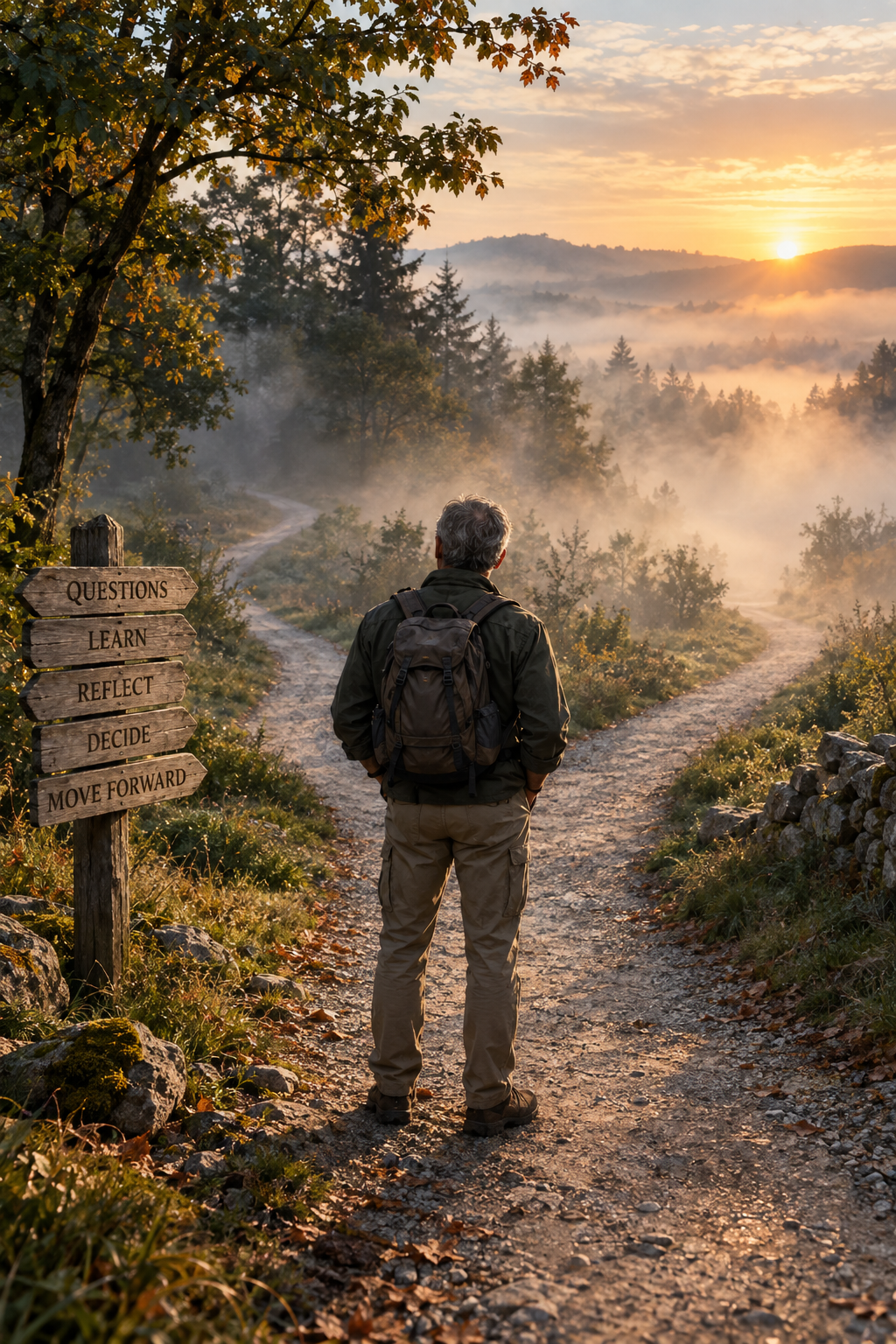 There was a time when making a bad career choice felt like a disaster. Getting older has made that fear less sharp. I have made mistakes, recovered, changed direction, and started over.
If this new job turns out to be the wrong place, I will deal with that when it happens. I found this opportunity. I can find another.
Knowing this does not take away the nerves that come with starting something new. But it does make them easier to handle.
I had a more recent reminder that wisdom is not only about making a good decision at the beginning. Sometimes it is about recognizing when new information has changed the situation. I agreed to help someone I respected with a project when I had more time available. At first, I was glad to do it. But over the next few weeks, I began to notice a pattern in the way people were being treated, and eventually some of that tone was directed toward me.
I waited to be sure I was seeing a real pattern, not just reacting to one bad moment. Once I was sure, I stepped away. I did not need months of extra proof. I had enough to see where things were going, and I knew staying would likely hurt a relationship I cared about. Sometimes wisdom means gathering more information. Other times, it means knowing when you have enough.
Wisdom also requires knowing when to stop gathering information.
This can be tough for me because I enjoy research. When I have a decision to make, I can almost always find another question, another source, or another angle to look at. That habit has helped me in my career.
It can also become analysis paralysis.
There comes a time when more information does not really change the decision. Research starts to go in circles. Looking for certainty can turn into a way to avoid making a choice.
At some point, wisdom has to leave the desk and enter the world. The sculptor eventually has to pick up the chisel and start.
Epictetus said that habits and skills grow stronger when we use them. If you want to be a good reader, read. If you want to be a good writer, write. The same goes for judgment. We get better at making decisions by making them and then noticing what happens next.
That is one reason I value the Stoic practice of evening reflection matters so much to me. We look back on the day and ask where our judgment was good and where it was not. We notice what we missed and think about how we might do better next time.
Wisdom grows through those small corrections.
I see something similar in a local elected official I have come to know and admire. I do not always agree with the decisions he makes. Yet when I talk with him about an issue, I usually leave understanding why he reached his conclusion. Sometimes I even change my mind.
What stands out to me is how he thinks. He gathers information, looks at the data, listens, and asks questions. Then he makes a well-informed decision.
Maybe that is why I pause when someone calls another person wise. Wisdom seems more like a pattern than something you own. It shows up when someone listens longer than they have to. It shows up when someone changes their mind because the evidence changed. It grows when experience makes us more curious about what we might have missed.
And the moment we feel sure of our own wisdom might be the time to question it. A little healthy doubt is good here, especially skepticism about ourselves.
I do not know whether anyone ever reaches a point where they can honestly say, “I am wise.” I am not sure I would trust someone who did.
We can see times when our judgment is better than it used to be. We ask better questions, listen more closely, and notice our own motives sooner. We are less afraid of being wrong. We learn to chip away at uncertainty, even if we cannot get rid of it completely. Then, when we have done what we can, we make a choice.
The stone may still hold surprises. The figure we imagined may change as we work. Experience teaches us that possibility too.
Still, we begin.
Maybe wisdom is found somewhere in that moment, not in knowing everything, and not in waiting for every doubt to go away, but in having enough judgment to know when it is time to put down the questions, pick up the chisel, and start the work.
