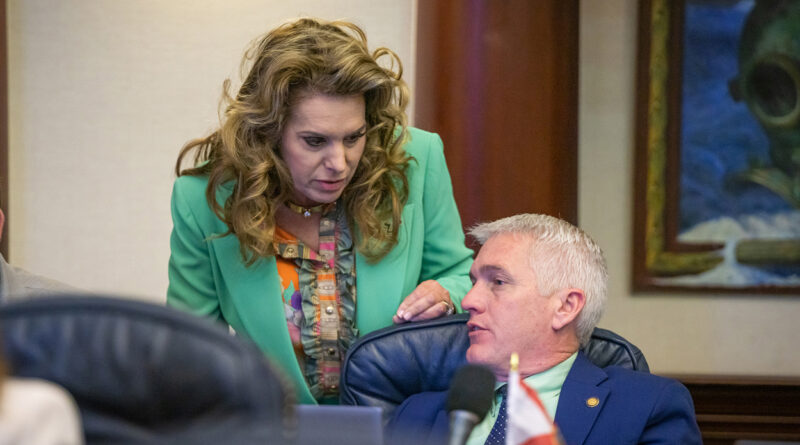
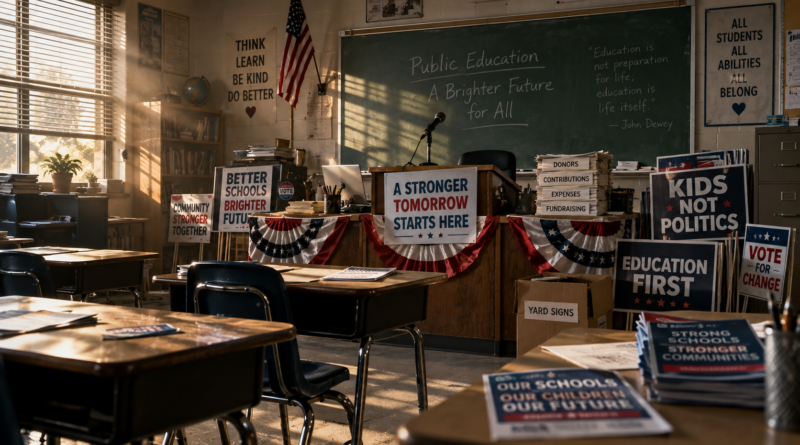
The Ballot-Box Bureaucrat: Why Electing Hillsborough’s Superintendent Is Bad for Business and Worse for Classrooms

This entry is in the series 2026 Elections
This entry is in the series Education
This entry is in the series Florida Amendments and Referenda-2026

Imagine Tampa General Hospital announcing that it will now select its President and CEO through a countywide partisan primary. Picture candidates debating surgical protocols on debate stages, taking a full year off to solicit campaign checks from medical supply reps, and catering to partisan party bosses instead of patient care. No board of trustees would tolerate it, and no major health system would survive it. Yet that is the exact circus Tallahassee politicians want to bring to Hillsborough County Public Schools, the single largest employer in our community.

Proponents dress up the proposal in the language of parental rights and democratic empowerment. But under the current model, the superintendent answers to an elected, seven-member School Board every single day. If the superintendent mishandles district finances, botches bus routes, or mismanages schools, the board can act immediately. Under an elected system, that daily accountability vanishes. The School Board loses its supervisory power, leaving a single partisan politician in charge of a $4 billion budget and 220,000 students, answerable to voters only once every four years.

An even bigger problem is the smaller pool of candidates. Instead of searching the country for experienced school leaders, we would be limited to local registered voters. The best-performing states treat school administration as a professional job, while the only two states that still elect superintendents are not among the top performers.

Injecting culture-war primaries and campaign fundraising into our school system’s executive suite is a disaster waiting to happen. Read the full analysis on why turning school administration into a political prize hurts our students, undermines teachers, and destabilizes our local schools.

Read more
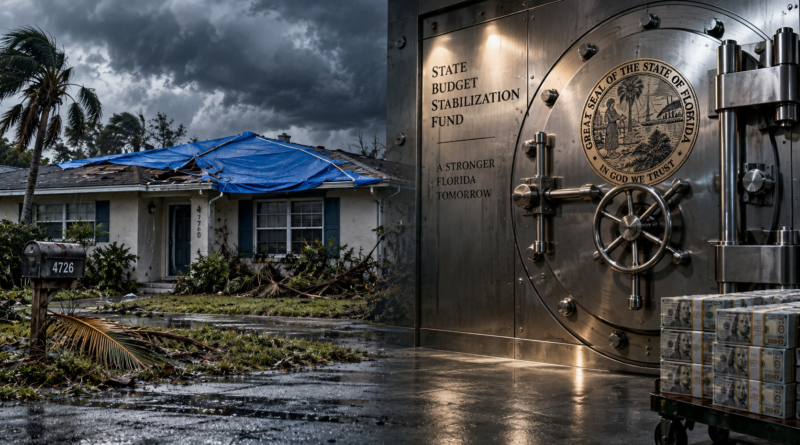
Rainy Days and Blue Tarps: Why Hoarding Billions in Tallahassee Won’t Protect Hillsborough

This entry is in the series Florida Amendments and Referenda-2026
This entry is in the series 2026 Elections

Tallahassee politicians often present Florida Amendment 1 as basic common sense. After all, who would argue with saving for a rainy day? But there’s a big difference between keeping an umbrella handy and locking away billions while your ceiling is falling in.

If you drive through Hillsborough County, you’ll see blue tarps still on roofs from storms years ago. Homeowners are struggling with high insurance costs, classrooms have broken air conditioners, and stormwater ditches need repairs. Yet Amendment 1 would require up to $750 million a year to be set aside in Tallahassee until the fund reaches 25 percent of general revenue.

Florida already has a fully funded emergency reserve at 10 percent. Forcing billions more into storage isn’t smart budgeting; it’s a way to cut local spending now so politicians can brag about a big balance later. Read the full essay to see why we should fix our roofs before Tallahassee builds another vault.

Read more

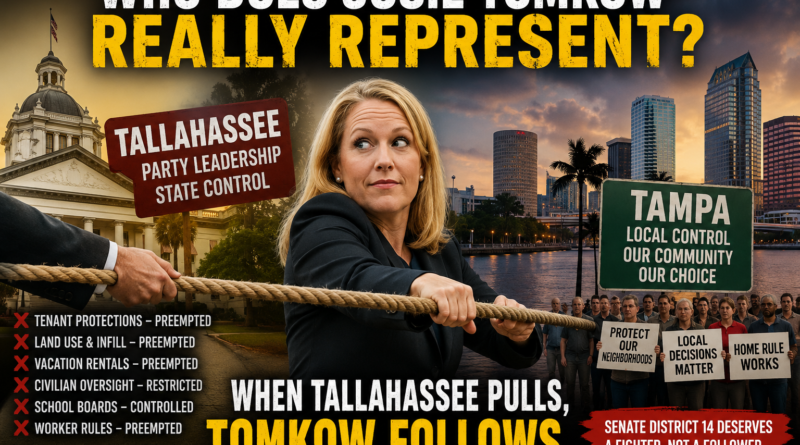
When Tallahassee Called, Josie Tomkow Answered

When Josie Tomkow had the chance to support local communities, she chose Tallahassee instead. This pattern appears throughout her House voting record: tenant protections, land use, infill development, vacation rentals, civilian oversight, worker rules, and school-board governance all go the same way.

This matters because Tomkow now wants to represent Senate District 14, which includes Tampa and Hillsborough County. But her record comes from somewhere else, and it raises an important question for voters here: when local needs clash with party leadership, whose side will she choose?

Her votes seem to answer. Even when another Hillsborough Republican voted no on a major preemption bill, Tomkow voted yes. So the question is not whether she can learn Tampa’s concerns. The question is whether she has already shown us who gets her vote when Tallahassee comes calling.

Read more

Is Karen Gonzalez-Pittman Representing South Tampa or Tallahassee?

This entry is in the series 2026 Elections

Karen Gonzalez-Pittman represents South Tampa, but her voting record raises a fair question: is she representing this community, or carrying Tallahassee’s agenda back home? Again and again, she has voted for bills that take decision-making power away from local governments, local school boards, and local voters.

From housing and tenant protections to infill redevelopment, school policy, civilian oversight, and local employment standards, Gonzalez-Pittman has sided with state preemption over home rule. For South Tampa, where traffic, flooding, housing pressure, schools, and neighborhood character are intensely local concerns, that record deserves much closer scrutiny.

Read more

Josie Tomkow’s Record Shows Tallahassee Comes First

This entry is in the series Florida Legislature
This entry is in the series 2026 Elections

Florida Republicans love to talk about freedom, but their voting records often tell a very different story. Over and over again, Tallahassee politicians have voted to take decision-making power away from local communities, local governments, and local school boards. Josie Tomkow’s record in the Florida House is a clear example.

Tomkow is now running again against Brian Nathan in Senate District 14, asking Tampa-area voters to send her back to Tallahassee. But when she served in the House representing Polk County, she repeatedly voted for state preemption over local control, including on housing, zoning, infill redevelopment, civilian oversight, and public schools.

That matters here. Tampa and Hillsborough County deserve representation rooted in this community, not another vote for Tallahassee control. The question for voters is simple: if Tomkow voted this way in the House, why should anyone expect her to vote differently in the Senate?

Read more