Ken Gay’s Campaign For Hillsborough School Board Deserves a Much Closer Look

This entry is in the series 2026 Elections

Ken Gay brings nearly four decades of experience in Hillsborough County public schools to the District 6 School Board race. His long career gives voters plenty to respect. But a detailed candidate questionnaire offers a much fuller picture of the political and social views he would bring to the Board.

Gay identifies himself as a conservative Republican and has taken clear positions on school choice, transgender students, sex education, books, guns in schools, religion and the federal role in education. These are not assumptions about his politics. They come from answers Gay submitted himself.

His campaign finances add another layer. The campaign is largely self-funded, while a recently formed company called Faith in Policy has received a substantial share of Gay’s campaign spending. I took a closer look at Gay’s record, his own words and where his campaign money is coming from.

Read more
When “School Choice” Stops Meaning Public Education

This entry is in the series Education

Florida’s new Education Commissioner has said the state does not need to run schools at all. That raises a question that goes well beyond vouchers: what happens when “school choice” starts replacing the idea of public education itself?

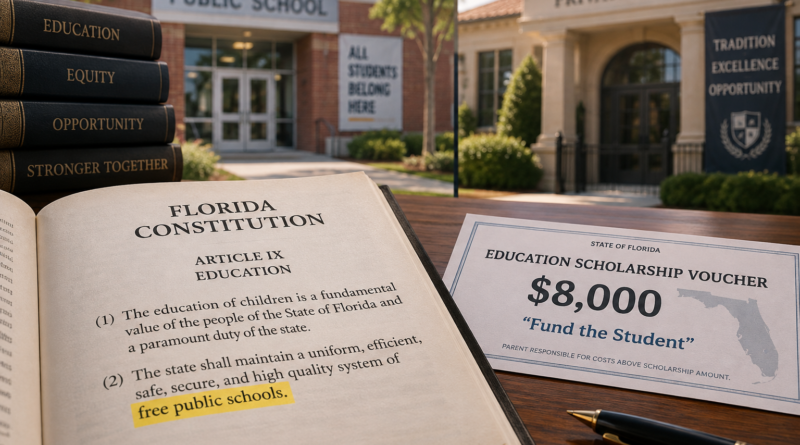
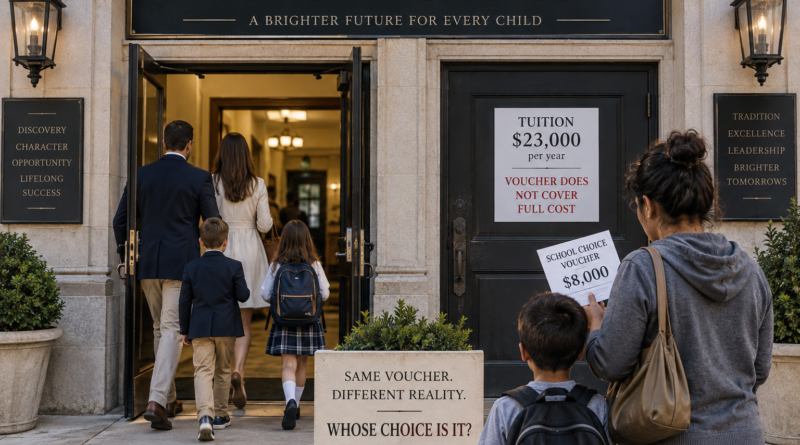
Florida’s Constitution requires a system of free public schools. Yet an $8,000 voucher does not guarantee admission, does not guarantee a free education, and means something very different to a family that can add another $30,000 than it does to one that cannot. That is why the slogan “fund the student” leaves out so much.

At our Voices of Justice: Speak Up for Students program earlier this year, USF education policy professor Dr. Bill Black asked a simple question: “What is public in public education?” With Florida moving further toward publicly funded private education, that question deserves a much closer look.

Read more

Whose Choice Is It?

This entry is in the series Education

Florida calls it school choice. But choice for whom?

An $8,000 voucher may open doors for a family that can add another $10,000 or $15,000. For a family that cannot, the same voucher may leave those doors closed. And even when the money is there, private schools still decide whom they admit. That raises a harder question than the slogan suggests: whose choice is it?

In this essay, I look at what public education was created to do, what Florida is changing, and why the stakes go far beyond schools. Drawing on our March Voices of Justice: Speak Up for Students program at Hyde Park United Methodist Church, including insights from USF education policy professor Dr. Bill Black, I argue that public education is one of the few institutions designed to give every child a claim on shared public wealth. Weakening that promise risks hardening the very class divisions public schools were built to overcome.

Read more

A Polite Version of Josh Wostal Is Still Too Much

This entry is in the series 2026 Elections

Stacy Hahn doesn’t sound much like Josh Postal. She’s thoughtful, qualified, and generally pleasant. But votes count the same whether they come with a scowl or a smile, and Hahn’s eight years on the Hillsborough County School Board show a record that’s much more conservative than her polished image suggests.

Hahn opposed letting voters decide on more funding for teacher pay, voted against defending that referendum when Postal and the County Commission tried to block it, rejected a Pride Month proclamation, and publicly aligned herself with Ron DeSantis’s political group. There are some exceptions in her record, but when it comes to taxes, LGBTQ recognition, sexual-health education, and DeSantis-era politics, the pattern is clear.

Now Hahn is running for the County Commission with a campaign mostly funded by construction, development, real estate, and government-relations groups—including businesses that have worked with Hillsborough County. These contributions don’t prove improper influence, but voters have a right to look at who is supporting a candidate and what choices that candidate might make in office. Dr. Hahn may be a more pleasant version of Josh Postal, but the real question is whether Hillsborough County needs another version at all.

Read more

Ambition, Attendance, and the Race for HCSB District 2

This entry is in the series 2026 Elections

When someone wants to lead a multi-billion-dollar school district, authenticity comes first. Brittany Lyssy’s campaign for Hillsborough School Board District 2 asks voters to believe that a family of five lives in a 680-square-foot, one-bedroom condo while also keeping a homesteaded home in Manatee County. From barely attending advisory board meetings to repeating national talking points, District 2 voters deserve real community representation, not a staged political act.

Read more

What Is the Money For?

This entry is in the series The Stoics

A single mother stops at a traffic light and hands five dollars to a homeless person. Jeff Bezos pledges $10 billion to fight climate change. Bezos will accomplish far more with his gift. Yet the mother may have given up something she needed.

That distinction sits at the heart of my latest essay. The world’s richest people possess more money than they could spend across several lifetimes. Their fortunes keep growing while the planet warms, public institutions weaken, and millions struggle to survive. Their philanthropy does useful work, though it rarely costs them any comfort or power.

So what is all the remaining money for? The answer takes us through the Gilded Age, the widow’s offering, other religious traditions, private bunkers, life extension, and the strange belief that enough wealth can free someone from the fate shared by every human being.

Read more

Real Waste, Fake Waste, and Things Republicans Just Don’t Like

This entry is in the series Hillsborough DOGE Report Analysis

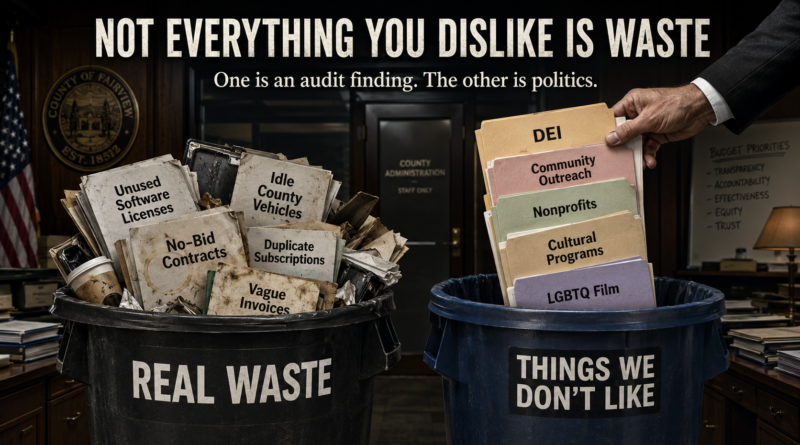
Not every proposed cut is the same. Unused software licenses, underused vehicles, vague contracts, and weak bidding rules are real places to look for waste.

But the Hillsborough County DOGE report also targets nonprofits, equity work, community outreach, and cultural programs. In this essay, I separate genuine control problems from programs that appear to have been labeled “waste” because committee members do not like their purpose.

Political opposition is fair. Calling it financial analysis is not.

Read more

Cutting a Program Is Not the Same as Making Government Efficient

This entry is in the series Hillsborough DOGE Report Analysis

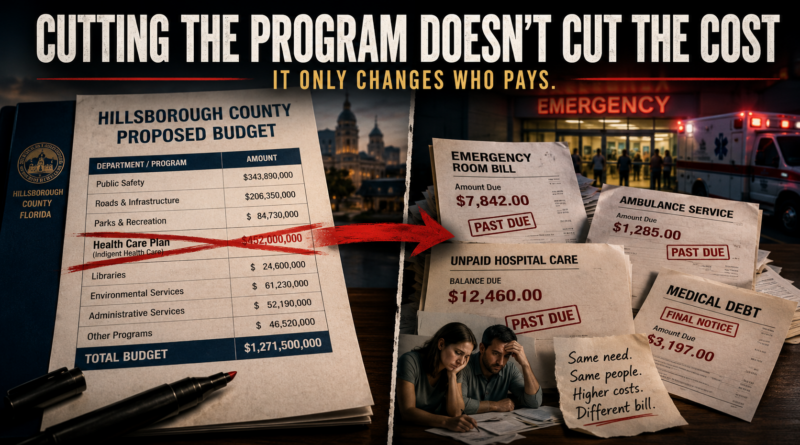
The Hillsborough County DOGE committee calls the county health care plan a source of major savings. But ending care for more than 22,000 low-income residents is not the same as making government more efficient.

This essay looks at what the program actually does, why voters approved the tax that funds it, and what happens when needed care disappears from one budget line only to reappear in emergency rooms, hospitals, charities, and family finances.

Cutting a program may make a spreadsheet look better. The harder question is whether the community pays more when the service is gone.

Read more

They Did Not Find $678 Million in Waste

This entry is in the series Hillsborough DOGE Report Analysis

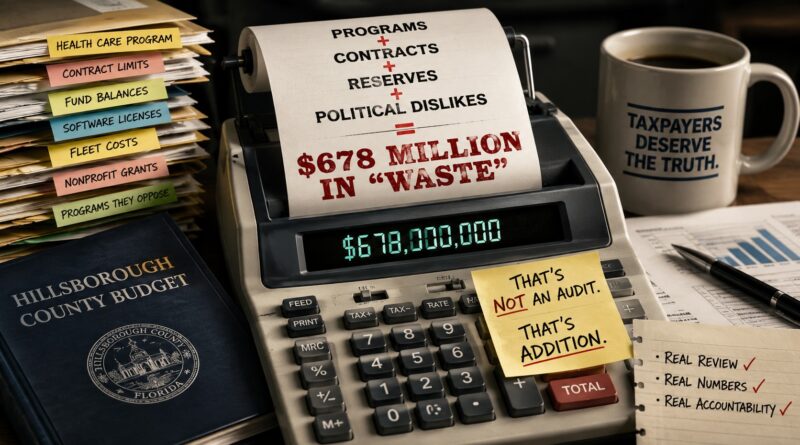
The Hillsborough County DOGE committee says it found roughly $678 million in potential savings. That sounds impressive, until you look at what the number actually includes: entire public programs, contract limits, fund balances, possible management changes, and spending choices committee members simply do not support.

In my latest essay, I take a closer look at the report and the difference between finding real waste and labeling any disliked program as waste. The committee may have raised some fair questions about fleet use, software licenses, contracts, and oversight. But cutting a service is not the same as making government more efficient, and a large number is not proof.

Read more

The Price of Political Playacting: Michael Owen’s Assault on Hillsborough Schools

This entry is in the series Education
This entry is in the series 2026 Elections

Hillsborough County Public Schools, the seventh-largest district in the nation, is facing a top-down assault disguised as “local accountability.” State Representative Michael Owen’s House Bill 4027 calls for a referendum to eliminate our professionally appointed superintendent in favor of a partisan elected office. The schools are already governed by an elected board of education. This change is not about transparency; it is a calculated effort to force a toxic culture-war agenda into our local classrooms and strip our school system of seasoned, professional leadership.

The structural fallout of this power grab is devastatingly clear. Instead of an experienced educational administrator focused on student performance, our district risks being handed over to a political partisan. Under an elected model, policy decisions on curriculum, budgeting, and student safety will inevitably bow to the need for campaign survival, turning every fourth year into a multi-million-dollar reelection spectacle. This essay shows how Owen’s legislative overreach, paired with his habit of distorting local facts for political points, threatens the shared institutions our children rely on.

Read more