Some Things Should Not Be Run for Profit

Florida’s new Education Commissioner, Henry Mack, says the state does not need to run schools. He prefers a simple approach: give families public money, let them pick schools, and let competition decide which ones do well.
There is something appealing about this idea. Competition can reveal waste and push schools to get better. Studies on Florida’s school-choice programs have found some small benefits for students who stayed in public schools when those schools faced more competition from private schools.
But that still leaves a bigger question.
Should we organize K-12 education around market incentives at all?
I do not think capitalism is bad by itself. Markets can be very good at encouraging new ideas, giving people more choices, and rewarding efficiency.
But markets are built for a specific reason. Private businesses need to make money for their owners or investors.
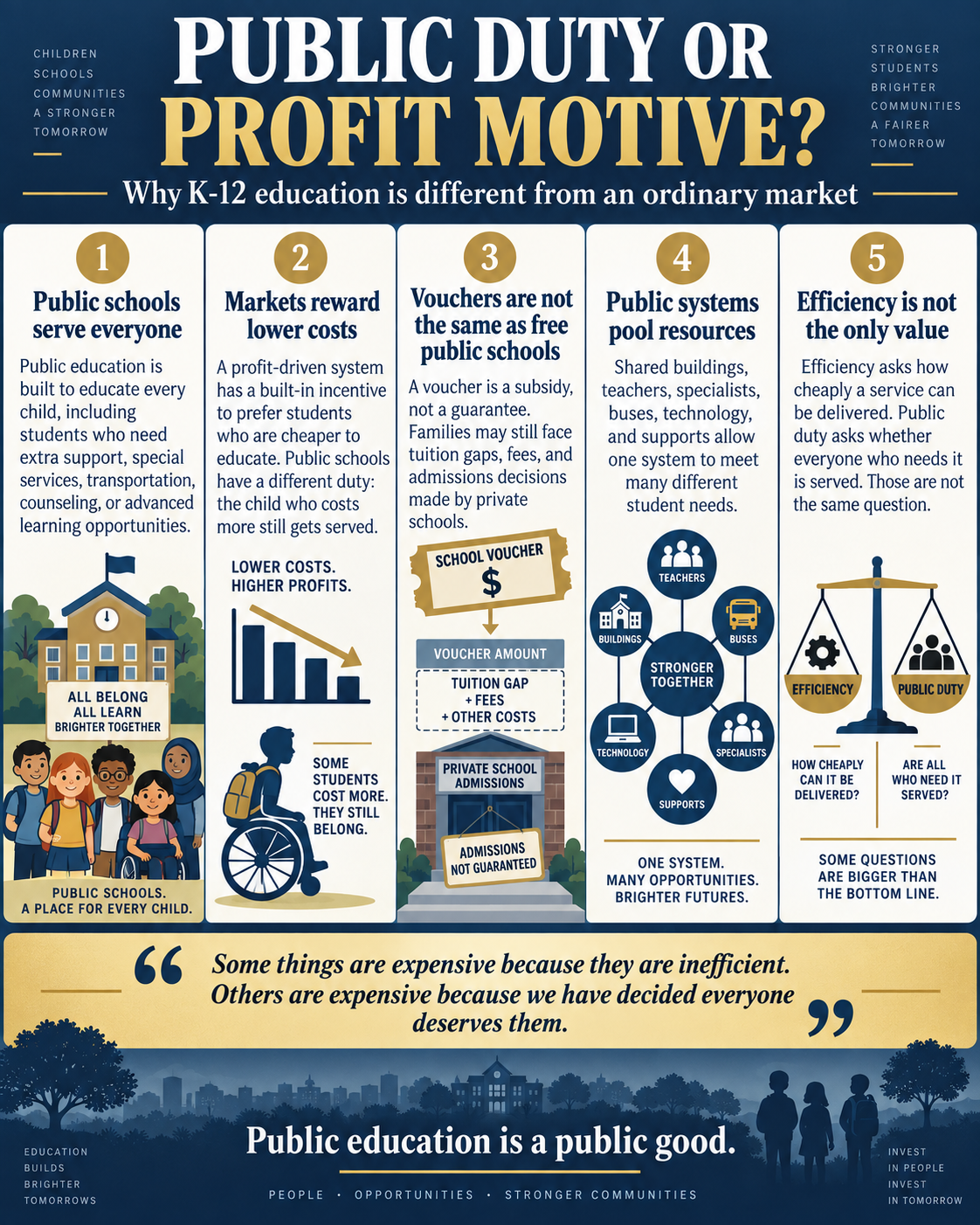
Public education has a different goal. Its job is to make sure every child gets an education. This difference matters because children come to school with different needs and costs. Commissioner Mack may want to keep a copy of Article IX handy. Florida’s Constitution uses some inconveniently specific words: “all children,” “free,” and “public schools.” That sounds less like a suggestion that government write checks and step aside, and more like an actual public obligation.
One student might only need a good teacher and a solid classroom. Another might need speech therapy, help with behavior, special transportation, an aide, extra reading support, counseling, nursing care, or other expensive services. Some students need advanced math, gifted classes, dual enrollment, or other chances to keep learning.
A public school system can share resources among thousands of students. Some children need more resources, while others need less.
The important thing is that they are all part of the same system. That is one of the biggest strengths of public education.
A student who needs a lot of support is not a bad investment. A gifted student who needs harder work is not a problem. The system is there to give each child what they need to learn.
This gets harder when education is set up mainly as a marketplace.
The Problem With the Profit Incentive
A private business has to keep costs down. That is not a moral flaw. It is just how the system works.
But in education, the cost to help one child can be very different from the cost to help another. If two students bring in about the same funding but one needs a lot more services, the financial incentive is clear. The student who costs less is more appealing.
That incentive is there even if everyone means well.
A public system starts with a different premise: the child who costs more still gets an education.
Florida law itself illustrates the difference. Private schools participating in scholarship programs must meet certain health, safety, background-check, and reporting requirements, but their teachers do not necessarily have to hold the same certification required in public schools. Those schools must also tell parents that a privately placed student with a disability does not have an individual right to receive all of the special-education services that student would receive in a public school under federal law.
That is an important difference. It shows why just comparing public and private schools by “cost per student” can be misleading. They do not always have the same obligations.
What Looks Inefficient May Be the Point
This is where I think talking about efficiency can get us into trouble. If one child needs thousands of dollars more in services than another, it raises the average cost of education.
A market analysis might call that inefficient. A public system might see it as meeting its responsibility.
Florida’s Constitution uses the language of obligation. It calls the education of children a “fundamental value” and a “paramount duty of the state.” It requires a uniform, efficient, safe, secure, high-quality system of free public schools.
The word “efficient” is there. But so are the words “all children” and “free public schools.”
Efficiency cannot just mean teaching the cheapest students for the lowest cost. It should mean using public resources wisely while still helping everyone.
That is a much tougher job.
Public Systems Pool More Than Money
We see this idea in other parts of life.
Fire protection works because we all share resources, even though some households will never need a fire truck and others might need help more than once.
Public libraries work because everyone helps pay for them, even though some people visit every week and others hardly ever go.
Emergency management works because the whole community prepares together for risks, even though not every household will be affected the same way.
Public education works in much the same way. We share money, buildings, teachers, specialists, buses, technology, and knowledge because children need different things at different times.
A school can give one child extra reading help while offering advanced classes to another. The same school can serve a student with serious disabilities, a future engineer, a child learning English, an athlete, an artist, and a student who just needs a steady place to learn.
That is not wasteful. That is what gives schools their capacity.
Competition Can Help Without Becoming the Whole System
This is where I think the debate often gets distorted. Evidence shows competition can push public schools to improve. Florida research has found modest gains in test scores, attendance, and disciplinary outcomes when public schools faced more private-school competition.
Fine. Use competition where it helps. Let schools use competition where it makes a difference. Let innovative programs prove themselves.
But just because competition can help in some ways does not mean the whole system should be based on market rules. Markets are good at rewarding those who attract customers and keep costs down. They are not as good at making sure everyone gets served.
That is the critical difference.
The Purpose Comes First
Henry Mack argues that government can finance education without operating schools. That might sound efficient.
But before we change K-12 education to fit that idea, we should ask what problem public schools were meant to solve. They were not set up to make money for investors. They were created to educate everyone.
That includes the child who learns fast and the one who needs years of specialized help. It includes students who are easy to teach and those who are more expensive to teach. It includes children whose parents have money and those whose parents do not. The public system shares those costs among everyone because we have agreed that educating every child helps us all.
That is something a market model cannot easily reproduce. The question is not whether capitalism works. It does.
The real question is whether every human need should be organized around the same incentives.
I do not think so. Some things cost a lot because they are inefficient. Others are expensive because we have decided everyone should have them. Public education belongs in the second category.
And that may be the most important thing to remember as Florida considers replacing public institutions with educational markets:
Efficiency asks how cheaply we can provide a service. Public duty asks if everyone who needs it is served.