
When “School Choice” Stops Meaning Public Education
 Florida’s new Commissioner of Education, Henry Mack, has made his view unusually clear.
“While a free society has a real interest in an educated citizenry,” Mack recently wrote, “that interest does not require the state to run the schools.” I’m not a constitutional scholar, but I think the State Constitution would disagree. His solution is just as clear: give the money to families, let them choose among providers, and “let the market discipline the industry.”
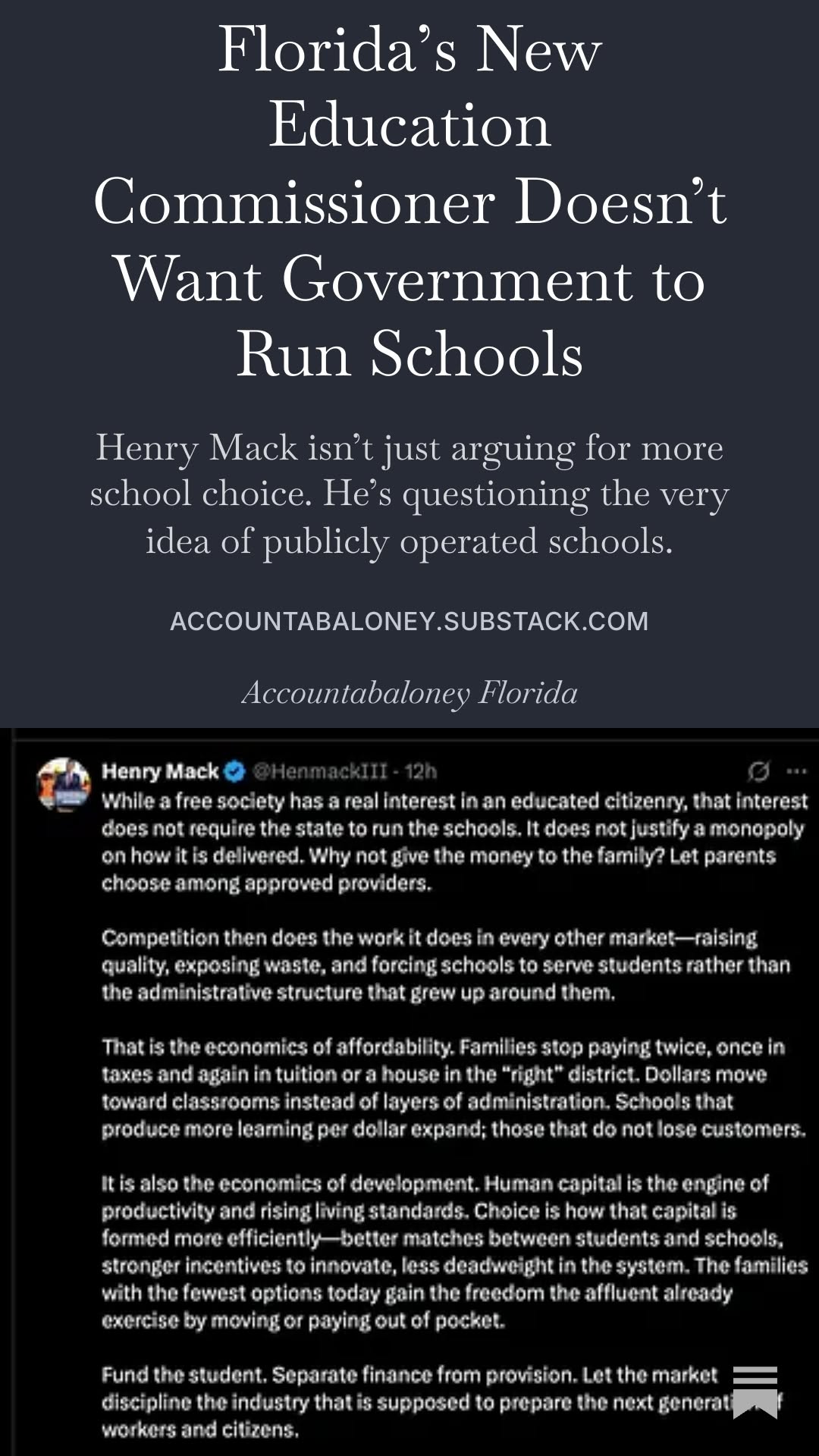 This goes beyond just supporting vouchers. It raises the question of whether Florida should operate public schools at all.
Mack now leads the Florida Department of Education after the State Board of Education unanimously appointed him in July. This isn’t just an abstract debate from a think tank. It’s the actual philosophy of the person in charge of education in Florida. (Florida Department of Education)
There is a problem.
The Florida Constitution doesn’t describe education as a marketplace. It calls educating children a “fundamental value” and a “paramount duty of the state.” It also requires Florida to provide a “uniform, efficient, safe, secure, and high-quality system of free public schools.”
This language brings up an obvious question: how can a system that relies mostly on private providers and market competition meet the constitutional requirement to maintain free public schools?
I keep thinking about something Dr. Bill Black, a USF professor of education policy, asked during our March Voices of Justice: Speak Up for Students event at Hyde Park United Methodist Church:
“What is public in public education?”
Black reminded us that public education has always meant more than just public money. It also means universal access, democratic governance, and a duty to serve the public good.
Mack’s approach keeps the public money but leaves out much of what makes education public.
Florida’s voucher system doesn’t guarantee a spot in a private school. Parents still have to apply, and the school decides whether to accept the student.
A voucher also doesn’t guarantee a free education. Florida law says parents remain responsible for eligible expenses above the scholarship amount. (Florida Statutes 1002.395)
I don’t know of any private school that promises to educate every voucher student for just the voucher amount. If tuition and fees are higher than the scholarship, the family has to pay the rest.
That matters.
An $8,000 voucher means something very different to a family that can add another $15,000 compared to a family that can’t. Both families might get the same subsidy, but they don’t get the same choices.
Consider Berkeley Preparatory School in Tampa. Its 2026-27 upper-school tuition is about $37,000 a year before books, uniforms, transportation, and other costs. (Berkeley Preparatory School)
An $8,000 voucher doesn’t suddenly make Berkeley affordable for a low-income family. Before any other financial aid, it turns a $37,000 school into about a $29,000 school. And if you remember that constitutional language, that still isn’t “free.”
Now let’s look at this from the other side.
Imagine a private school with 1,200 students helps all its current families apply for vouchers worth about $8,000 each. That could mean up to $9.6 million in public money going to students who were already at that school, including families who could already afford private-school tuition.
That raises a question we should be asking much more often:
How much of this voucher spending actually creates new educational opportunities, and how much just shifts costs that families were already paying onto taxpayers?
There’s also an economic question here. If Florida adds billions of dollars in new purchasing power to private education without increasing the number of good private-school seats, basic supply and demand says tuition will likely go up. Some of the subsidy may end up raising prices instead of lowering what families pay.
That’s why the slogan “fund the student” leaves out so much. It sounds fair because every student might get about the same check. But markets don’t work based on equal checks. They work based on total purchasing power.
A family with an $8,000 voucher and another $30,000 to spend has very different options than a family with just the $8,000 voucher.
Private schools receiving scholarship money also operate under different rules from public schools. Florida requires participating schools to meet certain safety, background-check, and reporting standards. Teachers need a bachelor’s degree, three years of teaching experience, or qualifying subject expertise. They do not necessarily need the same certification required of public-school teachers. The law also requires schools to tell parents that a privately placed student with a disability does not necessarily retain the same individual right to special-education services available in public school. (Florida Statutes 1002.421)
This brings me to the part of Mack’s argument that troubles me most.
Markets are built around choice. But providers also get to choose.
A public school can’t decide a child is too expensive to educate. It can’t turn away a student who needs extra help. It can’t just stop serving a neighborhood because it isn’t profitable.
That obligation is precisely why public education exists.
I’m happy to pay taxes for it.
I don’t see those taxes as money taken from me just because I don’t have a child in school. I see them as part of what I owe to a community where every child should have access to education, no matter their parents’ income.
If private schools really are more efficient, we can put that to the test.
Give public schools the same resources. Let them pick their students. Let them turn away students who are difficult or expensive to teach. Let them charge families for anything public funding doesn’t cover.
Of course, we should never want public schools to work like that. And that’s the point.
A constitutional guarantee isn’t the same as a coupon.
Florida’s Constitution requires the state to maintain a system of free public schools. Mack is talking about a system where the government gives families some money and sends them into a marketplace.
Those are two very different promises. Before Florida swaps one for the other, we deserve a much clearer answer to Dr. Black’s question:
What, exactly, will remain public in public education?
