
Whose Choice Is It?
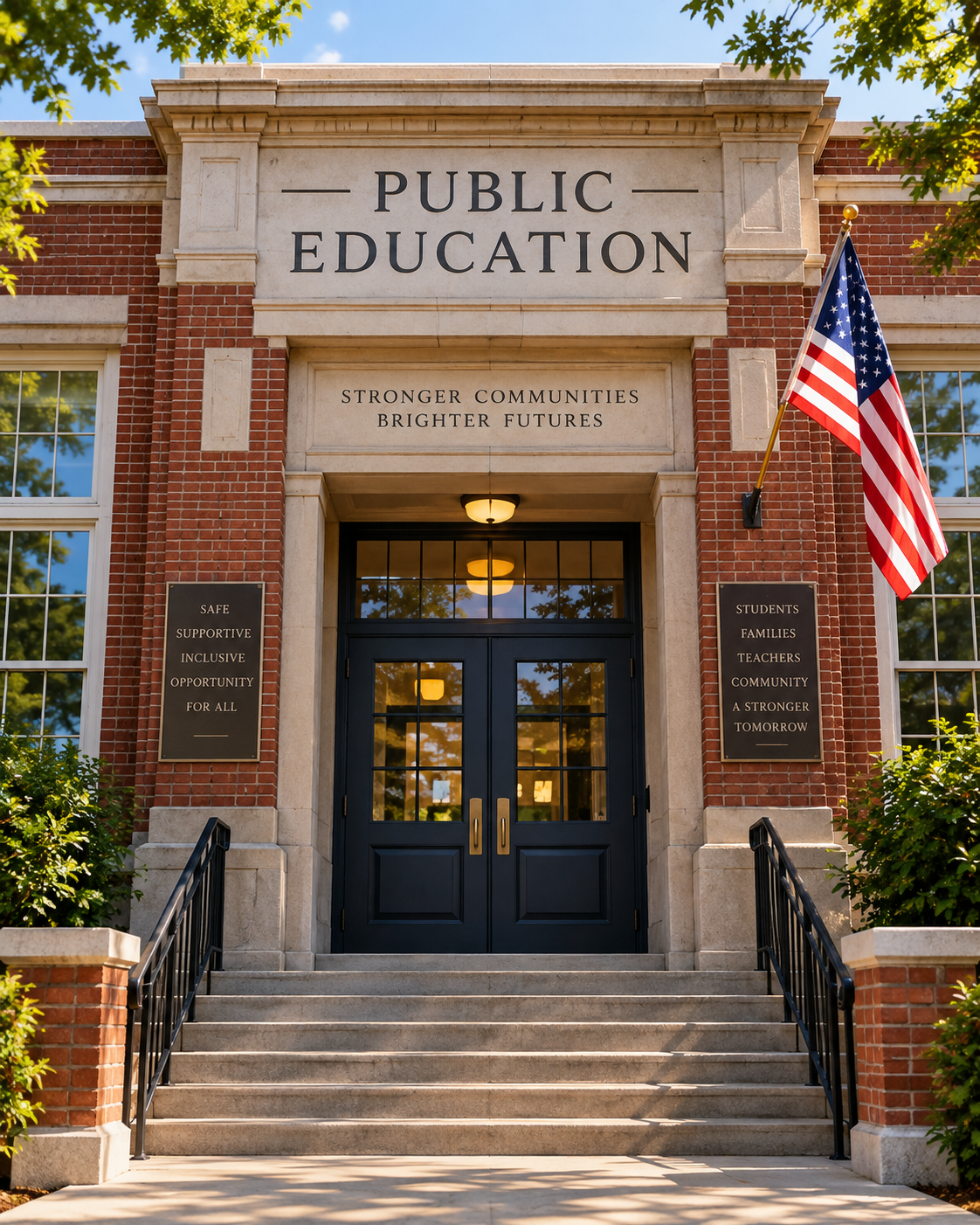 Unlike other government services, Florida’s Constitution gives public education special treatment by describing it as a “fundamental value” and stating that it is a “paramount duty of the state”. Under the Constitution, Florida must maintain a “uniform, efficient, safe, secure, and high-quality system of free public schools”1
That is why those words are included in the Constitution.
Public education is about more than teaching kids to read, do math, or get ready for work. We created public schools because a democracy needs educated citizens. We wanted every child, no matter their background, to have a fair chance at a better future. We also needed places where children from all kinds of families could learn together.
And, increasingly, Florida seems willing to walk away from that idea.
In a recent Sun-Sentinel commentary, Andrew Spar, President of the Florida Education Association, described how public schools are struggling. There are thousands of teacher and staff vacancies, school closures, low teacher pay, fewer resources, and billions of dollars going into the growing voucher system.2
Each of these problems needs attention. But together, they raise a bigger question.
What is public education for?
I have been thinking about that question since March, when our Social Justice Ministry at Hyde Park United Methodist Church hosted Voices of Justice: Speak Up for Students. One of our speakers was Dr. Bill Black, a professor of Educational Leadership and Policy Studies at the University of South Florida.
Dr. Black started by asking two questions: “Is education public?” and “Is education political?”
Then he asked another question that feels even more important now:
“What is public in public education?”
Dr. Black talked about the common-school movement in the 1830s and 1840s. These tax-supported schools were started to help people become literate, build social unity, and bring children from different backgrounds together in a shared civic space. Over time, public schools became places run by elected school boards, open to everyone, funded by the public, and meant to serve the public good.
This history is important because Florida is changing what the word public means.
More and more, the state defines public education by where the money comes from. If tax dollars pay for education, some say that means the public purpose is met.
Dr. Black gave another definition. The common-school tradition connected public education to public funding, access for everyone, and democratic control. It also expected schools to serve the greater good, not just one student or family.
Public education is not the same as private education paid for with public money.
Florida is spending more and more on the latter.
In 2023, the Legislature expanded the Family Empowerment Scholarship so that every Florida K-12 student eligible for public school can qualify, regardless of household income.3 Step Up For Students, one of the organizations that administers the program, says the average private-school scholarship is about $8,000.4
Supporters call this school choice. But that brings up another question.
Whose choice is it?
An $8,000 voucher means one thing to a family that can add another $15,000, and something very different to a family that cannot.
Florida law is clear about what happens when the scholarship doesn’t cover the full cost: the parent is responsible for the rest.5
Imagine two families. Both receive the same $8,000 scholarship.
One family can add $10,000, $15,000, or even $20,000 without worrying about their mortgage. They can pay for tuition, fees, uniforms, transportation, and anything else the school requires.
The other cannot.
They have received the same voucher. But they do not have the same choice. Money is only part of it.
A private school has to admit the child before scholarship payments begin. Florida law itself requires parents to select a private school and apply for admission, and participating schools must confirm that the student has been admitted.6
This means the family can choose the school. But the school also gets to choose.
Public schools have a different responsibility. They are there to educate all children in their community, even if some need more resources, extra staff, special services, or have challenges that other schools might not want to take on.
This changes what ‘choice’ really means. Real choice depends on money, transportation, time, information, open seats, and whether a school will accept your child. Handing every parent an $8,000 voucher does not make those differences disappear.
In fact, it might make some of them even bigger.
A Public Good
I am happy to pay taxes to support public education.
I do not have children in those classrooms, but I still benefit from those schools every day.
I benefit when the nurse treating me can read and reason. I benefit when the electrician working on my house knows math. I benefit when voters understand history and government well enough to make informed choices. I benefit when businesses can hire educated workers and when young people have the chance to see a future for themselves.
A society invests in an educated population for its own good.
Damaris Allen, another speaker at our March program, called public education the “great equalizer.” She made an equally important point: strong public schools benefit the whole community, not just students and their parents.
That is the part of the voucher debate we are forgetting.
Education is slowly turning into a private purchase for families, with taxpayers helping cover the bill.
When we start to see it this way, our sense of public responsibility begins to fade.
We stop asking if every neighborhood has a great school.
Instead, we ask if each family has been given money to shop for a school.
These are two very different promises.
A Transfer of Wealth
Another part of this debate needs to be stated more clearly.
Florida’s universal voucher system shifts the cost of private education onto taxpayers.
The scholarship is available regardless of household income.7
Think about a family whose child already goes to private school and whose parents can already pay the tuition. If taxpayers start giving that family $8,000 for the same tuition, there is no new educational choice.
The family had already made the choice.
The only thing that changed is who pays part of the bill.
Now, the public pays.
At our March program, Chris Taylor told the audience about affluent friends whose children had never attended public school. Their private schools helped them apply for vouchers. The families received the public subsidy for an education they had already chosen and could already afford.
That story does not show how every family uses the program, but it does show what happens when everyone is eligible.
A program that was supposed to help less-affluent families now also gives money to families that never needed help to leave public schools.
I have no problem with a family choosing private school. I do not like being told my tax dollars must help pay for private school while the public school nearby struggles to hire teachers.
That concern becomes harder to dismiss when Florida’s public schools began this school year with more than 3,000 instructional vacancies and another 2,300-plus vacant support positions, according to figures cited by the Florida Education Association. The same commentary noted that inflation-adjusted average teacher pay has fallen over the past decade.8
We are making choices about where public money goes. These choices have real consequences.
Try the Experiment Fairly
People often say that private schools do a better job.
Fine. Let’s test that idea honestly.
Give the local public school the same resources as a well-funded private school. Make classes smaller. Provide enough counselors, psychologists, and social workers. Pay teachers enough to attract and keep great people. Bring back arts, music, libraries, career programs, and enrichment.
Then give the public school the same freedom over enrollment. Let it decline the child whose disability will require expensive services. Let it tell a student with serious behavioral problems to leave. Let it require parents to provide transportation. Let it cap enrollment whenever adding another child becomes inconvenient.
Let it choose among the applicants. Of course, we should never want our public schools to work like that. And that is exactly the point.
We expect different institutions to do different jobs, but then act as if their costs and results can be compared as if they were selling the same product. But they are not. Public schools have a responsibility to everyone.
They educate the child who arrives halfway through the year. They serve children with disabilities. They provide transportation on a massive scale. They employ counselors and social workers. Their buildings serve as polling locations, meeting places, athletic facilities, and, in Florida, hurricane shelters.
At our March program, Allen reminded us of that last point. When the storm comes, the neighborhood public school becomes part of our emergency infrastructure.
That building belongs to the whole community in a way a private school never could.
So before we call private education more ‘efficient,’ we should ask if it has been assigned the same job.
The Children Left Behind
Dr. Black also reminded us that public education has never fully lived up to its own promise.
Florida once required Black and white children to attend separate schools. Desegregation came slowly and often placed heavy burdens on Black communities. Qualified Black teachers and principals lost positions as systems merged. Students with disabilities did not gain a federal right to public education until 1975.
Our history is full of struggles over who gets included in that promise. Over time, more and more children have been included. More children allowed into the classroom. More children given legal protections. More children recognized as worthy of the same public investment.
That is why I am so concerned about the direction Florida is taking now.
We risk building a system where families with the most money, time, transportation, and knowledge are the ones who can leave. Meanwhile, public schools end up serving mostly children whose families have fewer choices.
Taylor talked about this cycle at our March program. Teacher turnover hurts low-income schools the most. Experienced teachers leave, and less-experienced teachers replace them. Other teachers have to take on more work. The results get worse, and critics use those results as proof that public schools are failing. The cycle keeps going.
That is how inequality becomes permanent. No conspiracy is needed.
Create a system in which educational opportunity depends more heavily on family income and access, strip resources and experienced teachers from the schools serving those with fewer alternatives, then allow families with greater resources to buy their way into something else.
If we keep doing this, we should not be surprised by what is left.We will have set up a system where some children are always left behind.
And education does not stay inside the classroom.
Educational inequality leads to income inequality. It leads to health inequality. It creates differences in political power, homeownership, jobs, and the chance to build wealth for the next generation. Then those advantages and disadvantages are passed down to children.
The ‘great equalizer’ starts working in reverse.
What Is Public in Public Education?
Near the end of his presentation in March, Bill Black returned to the question he had started with: “What is public in education right now?” Florida needs to answer this question.
If ‘public’ only means taxpayers pay the bills, then we are heading toward a state-funded education marketplace. Families will shop. Schools will compete. Some schools will choose their students.
Some families will have enough money to buy more than the voucher provides. Others will not. And the local public school will still be responsible for the children the marketplace does not serve well.
I believe our children deserve better than that. I believe public education is still one of the best uses of tax dollars we have ever devised. It gives children born into poverty access to resources their parents could never afford. It puts public money behind children who have little private wealth. It gives all of us a stake in the education of children we may never meet.
Florida’s Constitution calls that responsibility a “paramount duty.”
We should start acting that way.
Because the main question in this debate is bigger than whether parents deserve choices. Of course, parents should have choices. The real question is whether every child will have a meaningful one.
And when an $8,000 voucher helps one family but leaves another behind, we should pause before celebrating ‘school choice’ and ask ourselves:
Whose choice is it?
Florida Senate, https://www.flsenate.gov/Laws/Constitution ↩
From vacancies to vouchers: Florida’s public schools face crisis, https://www.sun-sentinel.com/2026/08/24/from-vacancies-to-vouchers-floridas-public-schools-face-crisis-opinion/?share=cimifti2laohaleocacw ↩
Florida Department of Education, https://www.fldoe.org/schools/school-choice/k-12-scholarship-programs/fes/ ↩
Step Up For Students, https://www.stepupforstudents.org/research-and-reports/ ↩
Florida Senate, https://www.flsenate.gov/Laws/Statutes/2026/1002.395 ↩
Online Sunshine, https://wwwo.leg.state.fl.us/Statutes/index.cfm?App_mode=Display_Statute&Search_String=&URL=1000-1099%2F1002%2FSections%2F1002.394.html ↩
Step Up For Students, https://go.stepupforstudents.org/scholarship-interest-list-2027-28 ↩
Orlando Relocation Report,https://orlandorelocationreport.com/guest-commentary-from-vacancies-to-vouchers-floridas-public-schools-face-crisis/ ↩
