
Justice as Responsibility: A Companion Examination

This entry is part 56 of 56 in the series Journey Through Stoicism
This entry is part 5 of 5 in the series The Stoic Virtues

Justice is one of the most frequently used moral words in public life, and one of the least examined. It appears in politics, religion, social movements, and law. Because it is so familiar, we often assume we mean the same thing when we use it. We usually do not.

Serious moral traditions have resisted reducing justice to feeling or slogan. Stoic philosophy, Christian ethics, and modern research all return to a similar conclusion: Justice is not primarily about emotion or ideology. It is about responsibility. Responsibility to others, to the common good, and to living in a way that keeps belief and behavior aligned.

Seen this way, justice is not a moment or a performance. It is discipline. A steady practice carried out over time. It asks for clarity without cruelty, conviction without self-righteousness, and persistence without spectacle. Justice endures not because it is loud, but because it is rooted.

Read more
Justice as a Way of Life

This entry is part 55 of 56 in the series Journey Through Stoicism
This entry is part 4 of 5 in the series The Stoic Virtues

Justice is a word we hear all the time, but people often understand it differently. It shows up in courtrooms, sermons, protest signs, and political speeches. Before it became a slogan, justice was seen as a way to live. Not just a stance or an opinion, but a mode of living.

For me, justice starts with faith. The prophet Micah says it simply: Do justice. Love mercy. Walk humbly with God. This command is not abstract. Justice is not something to admire from afar. It is something you do, often quietly, sometimes without certainty, and sometimes at a real cost.

I have seen justice take shape in public gatherings and protest marches, but I have also seen it in smaller, steadier acts. Helping someone get a meal. Standing up for a person who cannot speak for themselves. Showing up again when the work seems slow and unfinished. Justice does not always announce itself. Most often, it looks like ordinary people refusing to look away.

Read more

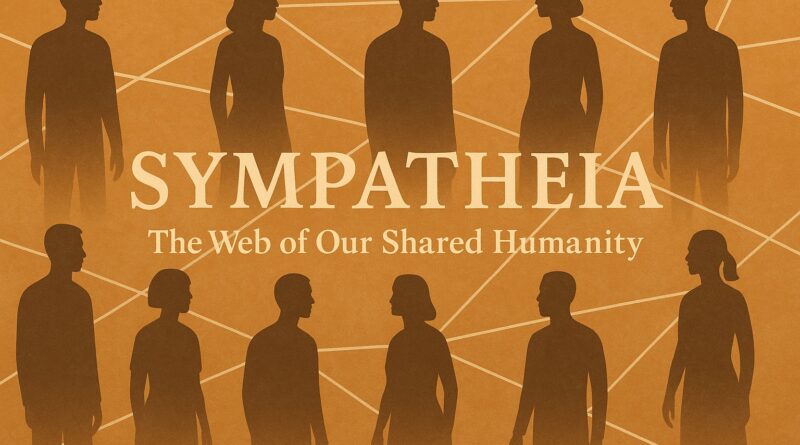
Sympatheia — The Web of Our Shared Humanity

This entry is part 13 of 18 in the series Stoicism Practices
This entry is part 32 of 56 in the series Journey Through Stoicism

There are moments when the illusion of standing alone falls away. Sitting at my mother’s bedside, I watched nurses adjust her blanket, a caregiver whisper encouragement, and my sister lean in to hold her hand. In that small room I saw a truth that philosophy and faith have long tried to teach. Our lives are braided together. The Stoics had a name for this: sympatheia, the recognition that we are bound together in a single web.

Marcus Aurelius urged himself to “meditate often on the interconnectedness and mutual interdependence of all things in the universe.” To him, nothing existed by itself. A hand could not live apart from the body, nor could a person live apart from others. Epictetus called it being a “citizen of the universe.” To forget this bond was to forget who we are.

In our own time, Pope Leo XIV put it this way: “The earth will rest, justice will prevail, the poor will rejoice, and peace will return, once we no longer act as predators but as pilgrims. No longer each of us for ourselves but walking alongside one another.” The Pope’s words echo the Stoics, calling us to remember that the fate of one is tied to the fate of all.

Read more

Upcoming Administrative Council Meeting at Church

I have previously published a resolution I intend to introduce at the next Administrative Council meeting at my church here in Tampa (Palma Ceia United Methodist). I was going to introduce it in June, but the meeting was canceled. It’s now been rescheduled for August 18, so I should be able to attend.

Read more

A Resolution on Social Justice for My Methodist Church

I have prepared a resolution on social justice to be introduced at the next meeting of the Administrative Board of Palma Ceia United Methodist Church here in Tampa. It will create an inclusive statement of non-discrimination. However, it goes a bit further. In an on-line conversation I had with a new acquaintance, he made a statement that caught my interest. He said, “People don’t have to pay a price for discrimination against gay people.” I believe this is a true statement. You can’t really change how people feel, but you can change how they behave in public through laws and through action. People who make racists statements pay a price. If they are business owner, they may be boycotted by people who don’t beleive in racism. At work, they may be ostricized, and it can affect their potential opportunities. But for the most part, people don’t pay a price for discriminating against homosexuals. My resolution requires the church to put its money where its mouth is.

Read more