
McCarthy in the Mangroves: Florida’s High-Tech Return to the Red Scare
In the so-called “Free State of Florida,” the state government is poised to trade the promise of liberty for unprecedented access to citizens’ private beliefs. At the center is Representative Danny Alvarez (R-Riverview) championing HB 945, which would establish a new counterintelligence unit within the Florida Department of Law Enforcement. While promoted as protection against foreign threats, the proposal’s true significance is its broad mandate: it empowers the state to pursue people whose “views or opinions are a threat or are inimical to the interests of this state.” This bill marks a fundamental shift from policing illegal actions to policing private thought, raising concerns about government overreach into personal expression.
Florida is not moving alone in this direction; similar bills have been introduced or advanced in several other states, like Texas and Tennessee, seeking to establish state-level intelligence authorities or expand the monitoring of so-called ideological threats. In Congress and across statehouses, legislative momentum for these “counterintelligence” initiatives is growing, suggesting that what starts in Florida could quickly become a nationwide trend. The liberties at stake are not just local—they are part of a broader, systemic shift unfolding across the country.
The danger of HB 945 lies hidden within a single, surgically precise word: inimical.
Under current First Amendment doctrine, the government can only restrict speech that incites “imminent lawless action,” a high bar set by the Supreme Court in Brandenburg v. Ohio. HB 945, with its vague “inimical” test, abandons that standard entirely, sweeping mere disagreement or criticism into the crosshairs of state surveillance. When a law moves beyond prohibiting actions and begins to monitor unfavorability, the definition of a “threat” becomes a mirror for the Governor’s own insecurities. In this legislative landscape, you don’t have to break a law to become a target; you simply have to hold an opinion that doesn’t flatter the administration. It is a “Chameleon Term” designed to be stretched over any dissenting voice, effectively rebranding “disagreement” as “hostility to the state.”
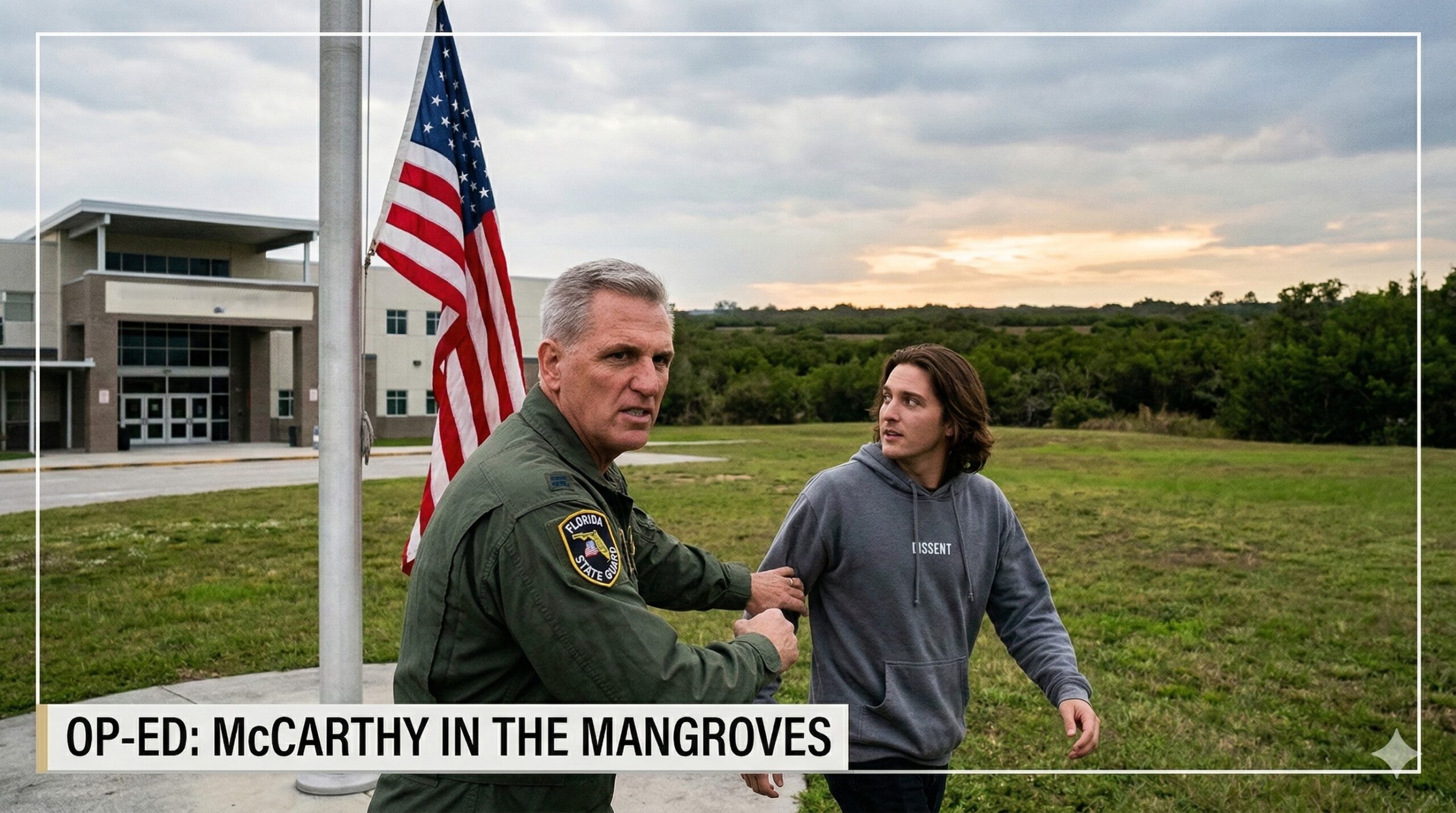 One has to admire the confidence required to request sweeping powers to monitor “patterns of life” when your own record for basic fact-checking is, shall we say, less than stellar. It wasn’t long ago that Rep. Alvarez took to social media demanding a local Hillsborough principal be stripped of his career over a student protest at Lennard High. Alvarez shouted from the digital rooftops that the principal “coordinated” a protest during instructional time. Had he bothered to make a single phone call—perhaps to the School Board Chairperson, for example-he would have learned that the protest happened outside instructional hours, and the principal’s only “coordination” was moving students to a football field for their own safety. But why let a boring thing like “the truth” get in the way of a good old-fashioned Red Scare?
This isn’t just a local blunder; it’s a warning. We are being asked to trust a “Thought Police” unit managed by an administration that can’t distinguish between student safety protocols and a Marxist insurrection. We’ve seen this movie before, and the ending is always in black and white. From the McCarthyism of the 1950s to the Stasi-style “household administrations” that Max Weber warned would replace rational government with the “purely personal authority of the ruler,” the results are always the same: a drained civil service, hounded citizens, and a culture of fear. When the government begins to see “opinions” as “inimical,” it stops being a protector of the people and starts becoming their hunter. History is littered with the wreckage of states that decided “security” required the surveillance of the soul.
A counterintelligence unit also requires enforcement, which is where Governor DeSantis’s so-called “State Guard,” his state-funded militia, enters the scene. Combining surveillance that defines “threats” as “opinions” with a governor-controlled force, the “Free State” can come to resemble a tropical police state. Ironically, the administration fighting “big government” is building a panopticon to keep your “freedom” inside their lines. The infrastructure of authoritarianism is under construction, funded by the taxpayers it seeks to quiet. If the State Guard is the muscle, HB 945 is the control center, twitching whenever a citizen dissents. But surveillance powers outlive the politicians who create them.
Even if you trust DeSantis with these tools, ask yourself: would you feel as comfortable if they landed in the hands of a political rival, or an administration you deeply oppose? History shows that no party keeps power forever, but the machinery of suppression tends to stick around. These are the kinds of powers that, once granted, become temptations for future leaders, no matter which side they come from. That is a risk that should concern every Floridian, regardless of party.
Constitutionally speaking, this is a five-alarm fire. James Madison argued in Federalist No. 51 that “ambition must be made to counteract ambition” for good reason. HB 945 doesn’t just blur the First Amendment—it tries to erase it. Surveillance of “patterns of life” works like a general warrant, the exact tool the founders opposed. Even more telling, Madison warned in his writings that “the censorial power is in the people over the government, and not in the government over the people.” In that sense, dissent is not a disruption of American values but a fulfillment of them; a safeguard hardwired into our founding documents. Criticizing the state when it threatens liberty is not partisan posturing; it is constitutional fidelity, the very sort of vigilance the framers expected of citizens.
When the “state’s interest” means whatever annoys the Governor, we’re left with a personal fiefdom, where citizens become inventory. Yet history doesn’t only deliver warnings. It offers hope. In landmark cases like ACLU v. NSA, ordinary Americans, activists, and legal minds have successfully challenged state overreach and forced government accountability in the courts. When people band together, surveillance can be scaled back, and the Constitution can win. Resistance is not just necessary; it is possible, and precedent shows it can succeed.
The next time a Florida politician tells you how much they value your “liberty,” remember the principal at Lennard High. If they cannot handle the facts of a flagpole gathering in their own backyard without tripping over their own rhetoric, they have absolutely no business mapping your “patterns of life.” History has a soft spot for the “weirdos” who saw these things coming, the ones who recognized that a government empowered to monitor dissent is a government that has already decided dissent is a crime.
It is time to be a little loud, because as Alexander Hamilton warned, the greatest number of those who overturned the liberties of republics began their career by paying “an obsequious court to the people.” We have seen the courtly dance; it is time to stop the music before the State Guard starts the “rounding up” portion of the evening. We must demand a state that fears the people’s judgment, not a people who fear the state’s surveillance. If you want your voice heard, call or email the Chair of the Florida House Judiciary Committee and urge them to reject HB 945, or attend the next public hearing in Tallahassee to speak up for civil liberties. One call, one message, one presence in the room can help make “being a little loud” count.
Before we let this moment drift by, I want to invite legal minds and constitutional scholars to weigh in: Is HB 945 the broadest state surveillance mandate since the heyday of Cold War America? Where is the line between vigilance and violation? I ask those who have studied the arc of our legal history—how should Floridians interpret these new powers? The conversation cannot end here. Your expertise might shape what comes next.
