
The Shipwreck That Built a Philosopher

Zeno did not begin his life as a philosopher; his philosophical journey started only after his sense of coherence was disrupted.
He was a merchant, which meant his world had structure. Ships moved. Goods were traded. There was a rhythm to it, a sense of direction. You could look ahead and see where things were going. Then a shipwreck took it all. Not just the cargo, not just the money, but the underlying assumption that life would continue on the same track.
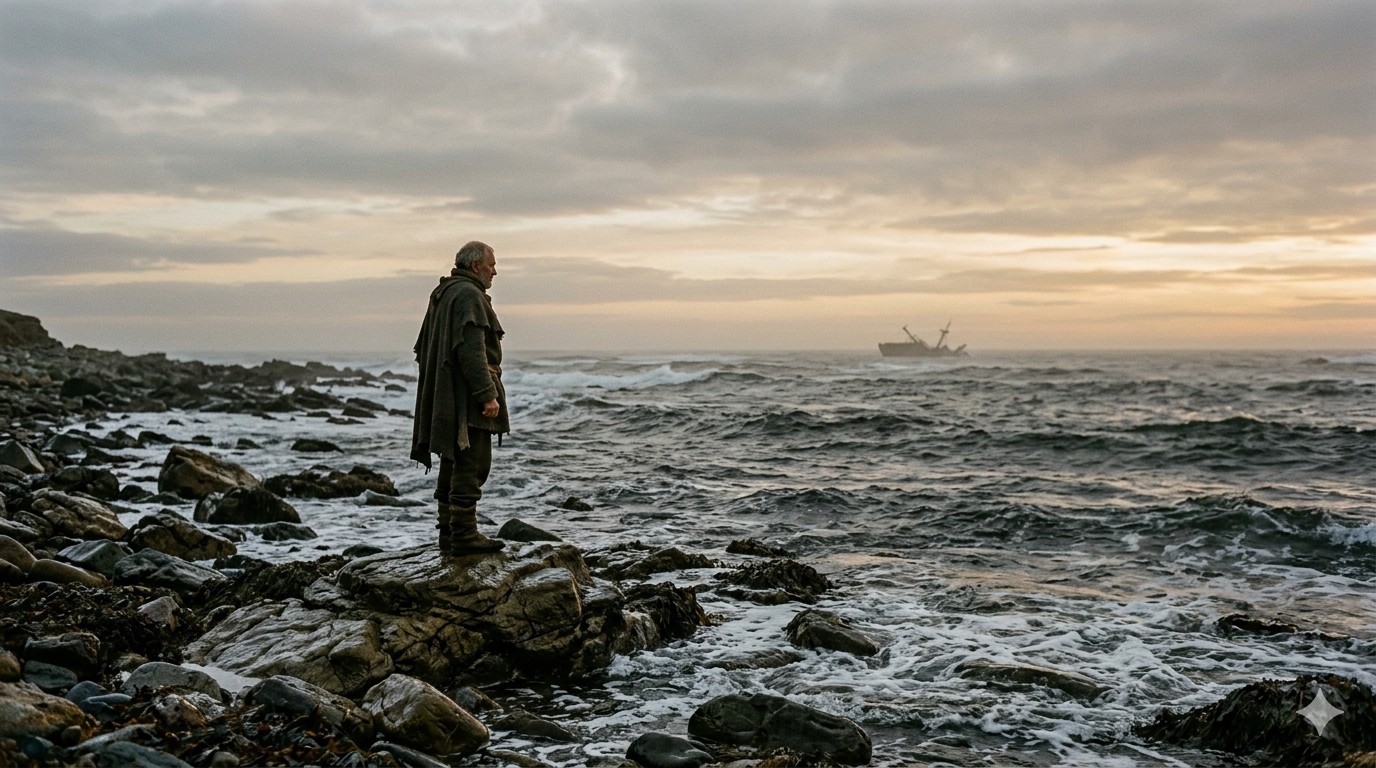 Later, he would say he made a prosperous voyage when he suffered a shipwreck. That sounds like wisdom earned and polished over time. It doesn’t sound like the man standing on the shoreline in the immediate aftermath, trying to grasp what just happened and what comes next.
That moment marks the beginning of Stoicism. Not in a lecture hall, but in the disorientation that follows loss.
There’s something familiar in that kind of disruption. Life rarely unravels in a clean or orderly way. It shifts. Plans that felt solid begin to loosen. Roles that once defined things start to fade. The story that made sense last year, or even a few months ago, no longer fits the shape of what’s happening now.
That kind of shift has a way of forcing a quiet question to the surface. If the old structure is gone, what is left to stand on?
Over the past months, that question has not been theoretical. Work has felt uncertain; direction, less defined. Some days are filled with motion, emails, conversations, and small wins, yet often lack a clear line connecting them to something stable. Still, there is movement. Still, there is the decision to get up, to walk, to apply, to show up where it matters. The story has not stopped, but it has changed, though not entirely on its own terms.
If you find yourself in a similar stretch of uncertainty, take a quiet moment to pause and reflect: What is one thing, however small, that you still choose each day, even when routines and plans are no longer firm? Notice where you apply effort or care and ask yourself what steady ground that offers. This simple question can be a starting point for finding coherence when the old structures have shifted.
Similarly, Zeno didn’t resolve that tension quickly. There was no moment where everything snapped back into place. Instead, there was a period that likely felt unstructured, even aimless. He wandered into a bookshop and picked up a text about Socrates. Something in it held his attention long enough for him to ask a simple question. Where can I find men like this?
That question did more for him than any plan could have.
He followed it, studying under different teachers: the Cynics, who stripped life down to essentials, and the Megarians, who prized logic and argument. Each offered something, but none offered everything. What emerged wasn’t borrowed wholesale from any one school. It was shaped slowly, through exposure, rejection, and refinement.
It was not a clean path. It was a human one.
That same pattern tends to repeat in quieter, less dramatic ways. A morning that starts poorly but still leads to a walk. A conversation that turns into something meaningful without being planned. A small piece of work completed in the middle of uncertainty. The kind of steady movement that doesn’t announce itself as progress but builds something underneath the surface.
Zeno’s central insight is simple: control your response, not events themselves. Consider a modern example: Imagine you’re stuck in traffic on the way to an important meeting. The cars ahead refuse to budge, horns blare, and frustration bubbles. You cannot control the traffic, but you can choose your response—whether it’s anger and anxiety, or taking a breath, listening to a podcast, or using the extra time to gather your thoughts. That shift, small as it feels, puts experience back in your hands. This is the heart of the Stoic principle: choosing how to engage with what you cannot change.
It’s simple enough to say. It is much harder to live when things are unsettled. Epictetus would later refine it into something even sharper. Don’t seek for things to happen as you wish, but wish them to happen as they do, and your life will go well.
Taken at face value, that can sound like resignation. It isn’t. It’s a shift in where effort is placed. If the external world is unstable, then building a sense of stability there is always going to be fragile. The only place that can hold under pressure is internal, in judgment, in choice, in response.
Zeno learned that because he had to. The shipwreck removed the illusion that anything external was guaranteed.
There’s another thread that runs alongside this, quieter but just as important. Not just the way things change, but the way they end without announcing themselves.
In “The Last Great Day,” there is a reflection on how certain moments only reveal their weight in hindsight. A trip that felt ordinary at the time. A conversation that didn’t seem like it needed to be remembered. A day that passed without ceremony. Then, gradually, it becomes clear that it was the last time that particular combination of people and circumstances would come together. That realization carries a kind of ache, but it also carries instruction.
Zeno lived by that principle in a more abrupt form. He did not know the last day of his old life was the last day. He did not get to prepare for it or appreciate it in real time. It simply ended, and only afterward could it be understood as something that would not return.
So, after this realization, a choice appears. One path is to tighten the grip, to try to hold things in place, to resist change as long as possible. The other is to adjust the way attention is given to the present. This means recognizing that what is here now is not permanent but is still worth fully experiencing.
The Stoic answer leans toward that second path, emphasizing presence over resistance. One way to put this into practice is surprisingly simple: pause for a moment, notice your breath, and let yourself become aware of a single detail in your surroundings, the feel of air on your skin, the color of the room, the sound in the background. This quiet attention, even if held for just a minute, creates a small anchor in the present. It is not about escaping uncertainty, but about showing up fully for the life unfolding right now.
Be present for what is here. Do not assume or depend on its permanence. But do not miss it either.
Seneca captured that balance with a kind of clarity that feels almost modern. True happiness is to enjoy the present without anxious dependence on the future.
That is easier to agree with than to practice. Especially when the future feels uncertain. The instinct is to solve ahead of time, to stabilize what has not yet settled. But most of life resists that kind of control. It unfolds on its own timeline, not ours.
Zeno eventually began teaching in the Stoa, a public colonnade in Athens. It was not a formal academy. People came and went. Conversations happened in the open. There was nothing particularly grand about the setting.
There was something steady about the man. He was not known for flair or performance. He was known for consistency. For living in a way that matched what he taught. For being difficult to shake, even when circumstances shifted. That steadiness is what drew people in.
Not perfection. Not certainty. Just a way of standing that held.
There is a tendency to think of philosophy as something abstract, something separate from daily life. But Zeno’s example pushes in the opposite direction. For him, the philosophy came after the disruption. It was built to answer real conditions, not ideal ones. That makes it useful.
There is a line that surfaces again and again across Stoic thought.
We suffer more often in imagination than in reality.
That choice did not erase the loss. It shaped what came next. And that is where the philosophy moves from history into something more personal.
It shows up in ordinary days. In continuing to take steps without full clarity. In allowing the story to change without treating that change as failure. In recognizing that some of the best moments are already behind us, some are still ahead, and neither fact diminishes the value of what is here now. There is a quiet discipline in that. Not dramatic. Not immediate. Built over time.
Zeno’s way forward: rebuild not by regaining what was lost, but by redefining what matters. For example, instead of measuring his worth by his former wealth or business success, he began to value qualities like self-control, wisdom, and resilience. Someone following the Stoic path might let go of chasing recognition or external status and focus instead on developing inner strength. On cultivating patience during difficult times, or finding satisfaction in acting with integrity, even when no one else notices. This shift in focus, from external trophies to internal growth, is at the heart of the Stoic approach.
That is a more difficult path. It is also the one that endures.
