
Who Are the Stoics?

When we hear Stoic, most picture a distant, marble version of a man—bearded, robed, and removed from the world. He stands in a courtyard somewhere in ancient Greece or Rome, calmly contemplating the universe while the rest of life goes on around him. It’s a tidy image. It’s also mostly wrong.
In reality, the Stoics were never removed from life. They were in the middle of it.
They argued in marketplaces, advised emperors, endured exile, built careers, lost fortunes, buried children, and navigated political chaos that would feel uncomfortably familiar today. Whatever else they were, they were not detached observers of life. They were participants trying to figure out how to live it well.
Importantly, the Stoics were not all cut from the same cloth.
Epictetus was born a slave. Seneca was a wealthy statesman navigating the dangerous orbit of imperial power. Marcus Aurelius ruled an empire while writing private reflections to himself at night. If Stoicism were only for quiet scholars in sheltered places, it would not have survived them. It survived because it proved useful in the hardest conditions life could offer.
That alone should make us pause before we dismiss Stoicism as something ancient and impractical. In fact, Stoicism offers practical tools for handling stress, setbacks, and uncertainty—providing strategies that are just as relevant for navigating everyday challenges now as they were two thousand years ago.
Yet, there’s another misconception worth clearing up: Stoicism is not frozen in time.
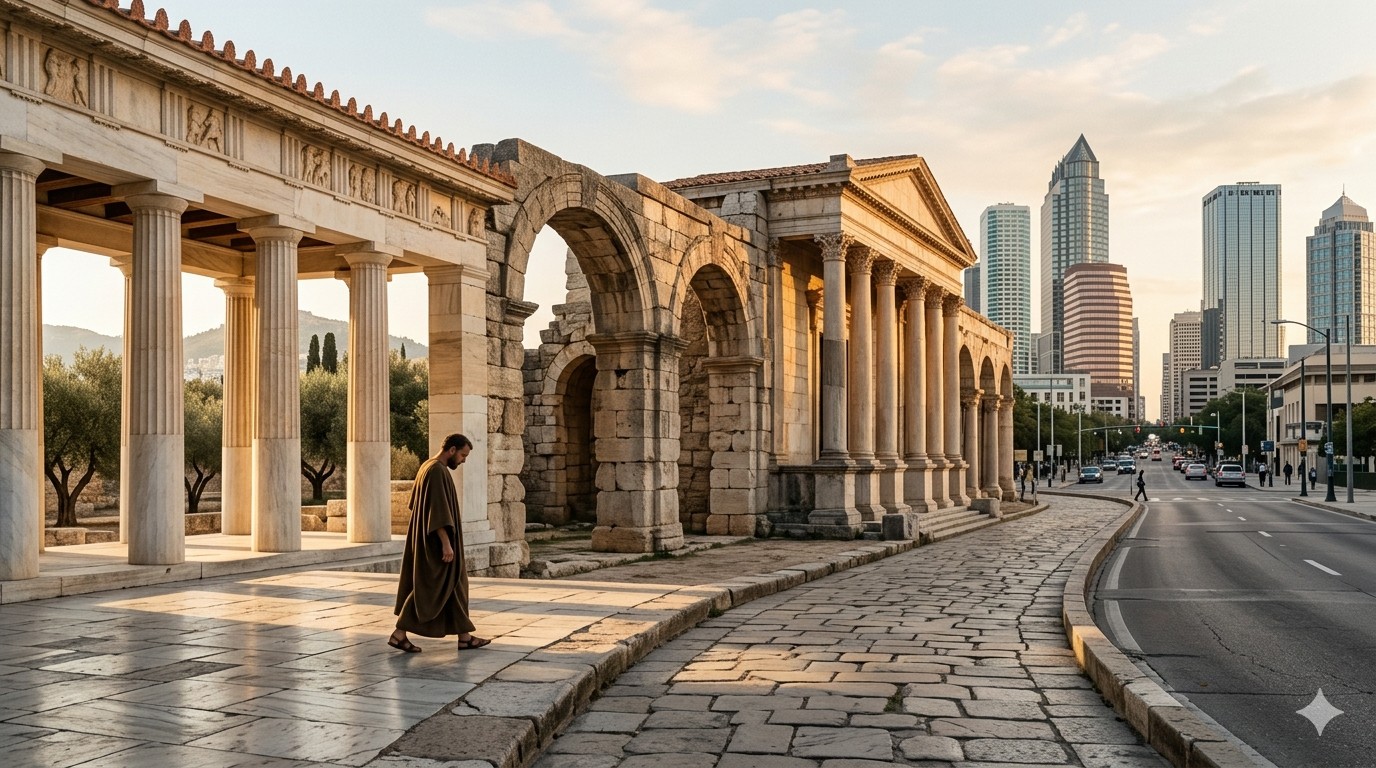 It didn’t end with the fall of Rome, and it didn’t stay locked in dusty books waiting for modern readers to rediscover it. Across the centuries, its ideas have surfaced again and again—sometimes directly, sometimes under different names. You can hear echoes of it in Renaissance humanists, in Enlightenment thinkers, in soldiers, prisoners, clergy, psychologists, and writers trying to make sense of a complicated world.
Even now, Stoicism hasn’t faded. It shows up in conversations about resilience, in cognitive behavioral therapy, in leadership thinking, and in the quiet ways people try to steady themselves when life doesn’t go according to plan.
So, the Stoics were never just “those ancient guys.” They were part of a much longer conversation about how to live.
So what actually ties them together?
At its core, Stoicism is not about suppressing emotion or becoming indifferent to life. That’s the popular caricature, and it misses the point entirely. The Stoics were not trying to feel less. They were trying to live better—more clearly, more deliberately, and with a steadiness that didn’t collapse every time circumstances shifted.
They asked questions that feel just as relevant now as they did two thousand years ago. What is actually within my control? What is not? What does it mean to live a good life? How do I respond when things fall apart? How do I deal with other people, especially when they’re difficult, unfair, or just human in all the frustrating ways we recognize too well?
If you want to try the Stoic approach for yourself, start by taking a moment today to reflect on a simple question: What can I control right now, and what is outside my control? Notice how your mindset shifts as you separate what you can influence from what you cannot. This small exercise is a practical way to begin engaging with Stoic ideas in your own life.
Those are not ancient questions. They’re Tuesday afternoon questions.
And maybe that’s the real surprise when you begin to read the Stoics. They don’t feel distant. They feel familiar. Sometimes uncomfortably so. You recognize the situations. You recognize the struggles. And if you’re paying attention, you recognize yourself.
This series isn’t about turning them into historical artifacts. Instead, it’s about meeting them as people—each with a story, a context, and a perspective shaped by the lives they actually lived. In the coming weeks, we’ll explore figures like Zeno, the founder of Stoicism, Epictetus, the former slave who became a great teacher, Seneca, the philosopher and statesman, and Marcus Aurelius, the emperor who kept a private journal. Along the way, we’ll also look at key Stoic themes such as resilience, the power of perspective, and the art of focusing on what we can truly control. Each installment will introduce new voices and questions, building a fuller picture of what Stoicism has to offer.
Once you see them that way, something shifts.
Epictetus isn’t just a philosopher. He’s a man who started with nothing and built a framework for inner freedom. Seneca isn’t just a writer. He’s someone trying to reconcile wealth, power, and morality in a world where those things rarely sit comfortably together. Marcus Aurelius isn’t just an emperor. He’s a human being trying to hold himself together while everything around him threatens to come apart.
They stop being distant figures. They become companions in the conversation. And that’s where this is headed. Not a lecture on Stoicism, but a closer look at the people who lived it, wrestled with it, and passed it along—often without knowing just how far their words would travel.
We’ll begin where Stoicism itself began—with Zeno, standing in the marketplace, trying to make sense of a world that had already knocked him off course.
He might be the least likely Stoic of them all—and, because of that, one of the most important.
