
Seneca Would Feel Right at Home Today

This entry is in the series The Stoics
This entry is in the series Journey Through Stoicism

Some frustration doesn’t come from a single moment, but builds up slowly. You see decisions that don’t make sense and hear confident words that don’t match reality. Over time, it’s less about disagreement and more about a quiet, steady exhaustion that stays with you.

Seneca lived in a world like this. He didn’t write from a safe distance, but from inside a system full of power, instability, and contradiction. He didn’t ignore the chaos or pretend it didn’t matter. Instead, he asked a tougher question: What part of this is really mine to carry? And what if I let go of the rest?

Read more

A Philosophy for Ordinary Days

This entry is in the series The Stoics
This entry is in the series Journey Through Stoicism

Most days don’t fall apart at once. They wear you down slowly. A delayed response. A shifting plan. A handful of small irritations that, by themselves, don’t seem worth mentioning. But by the end of the day, something feels off. Not broken, just diminished.

We think Stoicism is for big moments: war, loss, crisis. But what if it’s really for ordinary days? This essay explores how Massimo Pigliucci brings Stoicism out of ancient Rome and into the daily friction where character is tested.

Read more

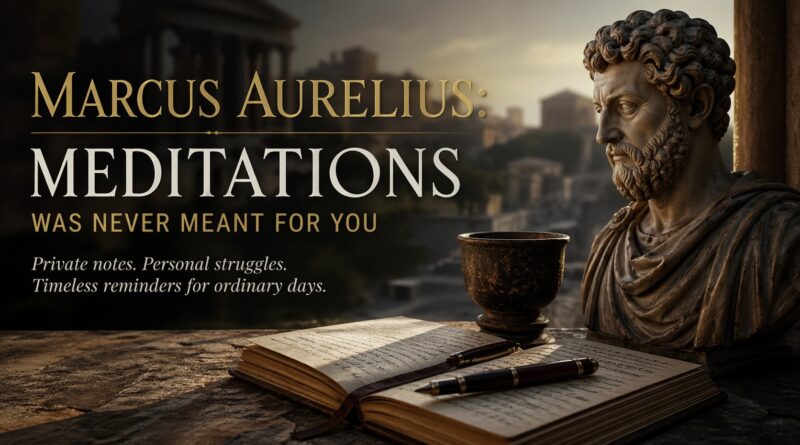
Marcus Aurelius: Meditations Was Never Meant for You

This entry is in the series Journey Through Stoicism
This entry is in the series The Stoics

Most of us think philosophy is meant for big moments like crisis, loss, and life-altering decisions. But what if it’s actually meant for something quieter? The ordinary days when nothing falls apart, but something still feels off. The slow drift of attention, the small irritations that take more than they should, the moments where we lose our footing without even realizing it.

Marcus Aurelius never intended his Meditations to be read by anyone. They were private notes. Reminders to himself to stay grounded, to respond better, to return to what he knew mattered. In this essay, I explore how those quiet, personal corrections still speak to us today, and why we don’t need an empire to govern, just a Tuesday to get through. Read more.

Read more

Musonius Rufus: The Stoic Who Made It Practical

This entry is in the series Journey Through Stoicism
This entry is in the series The Stoics

It is easy to agree with good ideas. It is much harder to live them. Most of us know what matters. We know how to respond, what to prioritize, and what kind of discipline leads to a better life. The challenge is not understanding. It is carrying that understanding into the ordinary moments where it is easiest to let it slip.

In this essay, I explore the Stoic philosopher Musonius Rufus, who believed philosophy should be visible in how we live, not just in what we think. Through his practical approach and my own experience with long-term health and discipline, this piece looks at what it means to stay aligned with what we believe, especially when it would be easier not to. Read more.

Read more

Hierocles: Expanding the Circle

This entry is in the series Journey Through Stoicism
This entry is in the series The Stoics

Stoicism often begins as a philosophy of the self. What I control. How I respond. How I stay steady when life shifts in ways I didn’t expect. But the Stoics never intended it to stop there. At some point, the question changes from how I manage myself to how I show up for other people.

In this essay, I introduce the Stoic philosopher Hierocles and his idea of expanding circles of concern. It’s a simple image with challenging implications. Through his teaching and my own experience, I explore what it means to move beyond inward discipline and begin living with a broader sense of responsibility. Read more.

Read more