
The Second Declaration
 NOTE: This article is longer than my usual writing, but it is a story that has been growing for nearly a month now as I’ve contemplated this 250th Fourth of July. I found it a fascinating exercise, and yes, I had help from AI in attempting to capture Jefferson’s voice near the end of the article. Agree with the concepts or not, I hope you find this as interesting an exercise to read as I did in writing it. -John
The old man appeared just after sunrise.
No one seemed to notice him at first. The city had awakened long before he had, its streets already crowded with men and women moving with the brisk impatience of a people pursued by invisible clocks. Carriages without horses rushed past him with a speed and noise that would once have seemed unnatural, perhaps even profane. Great towers of glass and stone rose where modest brick buildings had once stood. Lamps burned without flame. Voices traveled through small devices held in the hand. The world, it appeared, had taught itself to move faster than thought.
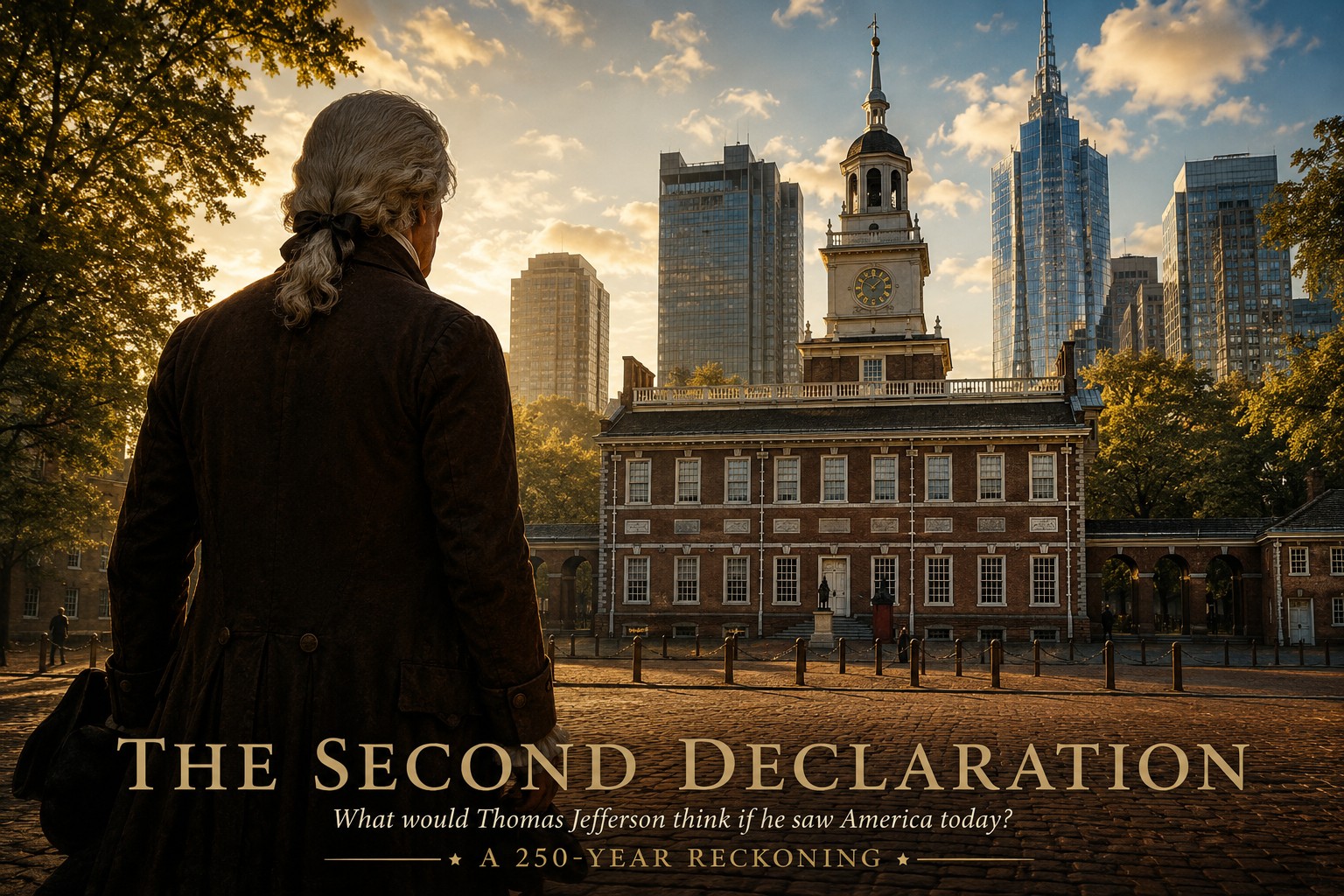 He stood upon the pavement in plain Virginia broadcloth, his hat tucked beneath one arm, his silver hair gathered neatly. Nothing about him belonged to the hour, and yet he regarded the scene not with terror but with curiosity. His eyes moved carefully, as if each object were a proposition awaiting examination.
Then he saw a familiar steeple. Christ Church.
A little farther off stood Independence Hall, its red brick still dignified after two hundred and fifty years of weather, war, celebration, and neglect. The old man crossed the square slowly and placed one hand against the building. The walls had endured better than most of the men who once argued inside them.
“So,” he whispered, “she yet stands.”
For a moment, the voices returned to him: Adams with his fire, Franklin with his wit, Sherman with his patience, Livingston with his caution, and the whole anxious assembly of men who had dared to sever one world before knowing whether another could be born. He remembered the heat, the flies, the arguments, the edits, and the burden of finding words strong enough to justify rebellion and broad enough to outlive it.
A young guide approached him with professional kindness. “Sir, are you with one of the historical programs?” The old man turned, studying the young man’s face as though it were a map.
“I am not certain,” he replied, “with whom I am.” The guide smiled politely, the way one smiles at eccentric tourists and harmless old men. “May I help you?”
The old man looked back at the hall. “I wonder,” he said, “whether you might first tell me what has become of our Republic.” The guide laughed softly, then stopped when he saw that the old man was not joking. There was something in the stranger’s bearing that made irony seem impertinent. He was not stern, exactly, but he possessed the stillness of one accustomed to being heard.
“That is a large question,” the guide said.
“So it was when last I asked it.”
They walked together through the rooms where independence had once been debated into existence. The old man moved slowly, pausing not at the famous objects but at the ordinary ones: a chair, a window latch, a worn plank in the floor. He looked longest at the room where the Declaration had been approved. The guide began his practiced account, but the old man scarcely seemed to hear. His attention was fixed upon an empty place at a table.
“Mr. Jefferson wrote the first draft,” the guide said. The old man’s expression did not change.
“So I have been told.”
Outside, the city roared with life. The guide spoke of the intervening centuries as best he could: the Constitution, the early republic, the Louisiana Purchase, the Civil War, emancipation, the long struggle for civil rights, women’s suffrage, world wars, moon landings, computers, medicine, industry, immigration, and the astonishing expansion of the American people beyond anything the men of 1776 had imagined.
The old man listened without interruption. When told that slavery had been abolished, he closed his eyes. When told that women voted, he looked toward a mother crossing the square with her daughter and said quietly, “We should have perceived this sooner.” When told that Black Americans had served in Congress, on the Supreme Court, and even in the presidency, he removed his hat. “They carried the argument farther than we did,” he said.
For several days, he traveled.
He went first to Monticello.
There, he walked the grounds in silence. He stood before the house he had designed, a monument to symmetry, learning, ambition, and contradiction. He saw the rooms through which visitors now passed with reverence. He saw the books, the instruments, the gardens, the clever devices, and the evidence of a mind that had loved order and inquiry. Then he saw the names of the enslaved, preserved where once they had been hidden by custom, profit, and pride.
He read them slowly. Hemings. Granger. Fossett. Hubbard.
A curator, not recognizing him, explained how the plantation had depended upon the labor of those denied the liberty he had declared universal. She spoke with care, neither excusing nor embellishing, and the old man listened as a defendant might listen to the reading of charges he had long known to be true.
At last, he said, “History has been kinder to my words than to my deeds.”
He lingered there longer than at any monument he would later visit, for there is no harsher judge than one’s own conscience when history has stripped away every excuse. No one answered. There was no answer to give.
He went next to Gettysburg, where he stood among the stones of the dead and read Lincoln’s address. He read it once, then again, then a third time. The words were fewer than his own, but they had done what his had not fully accomplished. They had returned the nation to its first promise and made equality not merely an assertion but a test.
“Mr. Lincoln,” he said, “understood my sentence better than I.”
From there, he went to Selma.
He walked the Edmund Pettus Bridge slowly, his hand resting upon the rail, his face turned toward the Alabama River below. He had seen war. He had seen ambition dressed in the garments of principle. He had known men who spoke eloquently of liberty while fearing its consequences. But on that bridge, he seemed to understand something different. The Declaration had not been completed in Philadelphia. It had been rewritten by feet, by blood, by songs, by jail cells, and by bodies moving forward when power commanded them to stop.
He stood there a long while. A historian accompanying him spoke quietly. “There was another who crossed this bridge nearly two centuries after you wrote those words.” The old man listened. “He was beaten here. His skull was fractured. He was jailed more than forty times in the cause of equal justice. Yet he never surrendered either his conviction or his hope.”
“And what became of him?” “He endured. He served his country in Congress for more than thirty years. Near the end of his life, he left these words for the Nation.”
The historian recited them from memory.
“Do not get lost in a sea of despair. Do not become bitter or hostile. Be hopeful. Be optimistic. Never, ever be afraid to make some noise and get in good trouble, necessary trouble. We will find a way to make a way out of no way.”
The old man remained silent. The breeze carried only the distant sounds of traffic. Finally, he spoke. “He was one of ours.”
The historian looked at him curiously. “A Founder?” Jefferson shook his head. “No.” A faint smile crossed his face. “A Founder of every generation.”
He visited Washington, where monuments had risen to men who never knew they would become marble. He walked beneath Lincoln’s gaze, past the long reflecting pool, and toward the memorial for Dr. King. He read the words carved there and seemed less astonished that such a man had arisen than that America had needed so long to hear him.
He visited the National Archives and looked upon the faded parchment. Crowds moved past it quickly, some reverent, some distracted, some treating the document as an artifact rather than an accusation. He leaned close to the glass, studying the words with the discomfort of one reading a younger version of himself.
“We hold these truths,” he murmured. Then he stopped.
“Do you still?”
No one heard him.
He also traveled to places that would have confounded his century: hospitals where once-fatal diseases were treated as inconveniences, universities where women and men of every race studied together, laboratories where knowledge seemed to have outrun imagination, and great machines that lifted human beings into the sky. He learned that men had walked upon the moon, and for the first time since his arrival, he laughed aloud.
“Had Dr. Franklin known this,” he said, “he would have become insufferable.”
For a time, he was encouraged.
The Republic had grown vast. Its people had multiplied in number and variety beyond any eighteenth-century imagination. The franchise had widened. The nation had survived civil war, depression, invasion, scandal, and the repeated folly of men who mistook office for wisdom. It had produced poets, inventors, reformers, soldiers, teachers, physicians, farmers, laborers, and citizens whose names would never be remembered but whose work had kept the experiment alive.
Then he began to read the news.
At first, he struggled with its abundance. In his day, pamphlets and newspapers had already been unruly enough. Now accusation traveled at the speed of lightning, and opinion dressed itself as fact before breakfast. The people possessed more information than any generation in history, yet seemed less certain whom to trust. They spoke constantly, but listened poorly. They had built instruments capable of connecting the continent and then used them to sharpen the division into sport.
He watched government assemblies and found them noisy but often weak. He saw representatives less interested in deliberation than performance, less bound by judgment than faction, less fearful of corruption than of displeasing their patrons. He saw money flow through politics with the force of a river after a storm, shaping outcomes while leaving few fingerprints. He saw citizens persuaded that their neighbors were enemies and that cruelty toward the vulnerable could be mistaken for strength.
He saw the executive power swollen beyond the anxieties of 1787. He saw men applaud what they would once have condemned, provided the hand committing the offense belonged to their own party. He saw courts speak of liberty while narrowing its shelter. He saw legislatures yield their authority and then complain of weakness. He saw public office treated not always as a trust, but too often as an inheritance, a spectacle, or a marketplace.
Most of all, he saw the old danger wearing new clothes.
Power had again learned to speak the people’s language while teaching them to surrender power. Ambition had again wrapped itself in patriotism. Faction had again discovered that fear is easier to cultivate than virtue. The forms of republican government remained, but the spirit that animated them seemed uncertain.
One evening, after many days of travel, the historian who had become his companion asked the question others had been afraid to ask.
“Mr. Jefferson, after all you have seen, are you encouraged or discouraged?”
The old man sat beside a window overlooking a restless city. Below, the streets glowed with artificial light. Sirens sounded in the distance. Somewhere nearby, fireworks began early for the approaching anniversary.
He considered for a long time before answering.
“Both,” he said. “Your Nation has exceeded our dreams, and endangered them in equal measure.”
The historian remained silent. The old man continued.
“You have done what we did not. You have widened the circle of citizenship. You have given substance to words we left too much in abstraction. You have crossed rivers we feared even to approach. Yet you have also permitted power to gather where it ought to be restrained, wealth to command where it ought to petition, and faction to inflame where reason ought to govern.”
“Then what would you say to us?” Jefferson looked toward the window.
“I would say that a republic is never inherited whole. It is received in trust and either enlarged or diminished by those who hold it for a time.”
“Again?”
“A new declaration.” Jefferson did not answer immediately.
Instead, he walked to the desk where paper had been laid before him. Beside it rested a modern pen of polished metal. He examined it with quiet fascination, turning it once between his fingers before setting it gently back upon the desk.
“Have you ink?” he asked. The historian smiled. “I believe we can manage that.”
The blank page remained untouched.
He dipped the pen. Slowly, he wrote several lines. He read them once. Then, without the slightest hint of frustration, he folded the page over and set it aside.
The historian watched but said nothing.
“The words came more easily in my youth,” Jefferson said at last. “Age has taught me that the first sentence is seldom the truest.” Again, he reached for the pen. Again, he paused.
This time his eyes wandered not to the paper but to the window, where the last light of day lingered over a city whose existence would once have exceeded imagination.
He had seen triumph. He had seen failure. He had seen his own contradictions preserved alongside his achievements. He had watched generations complete work; his own had scarcely begun. He had also seen how quickly liberty, once secured, could become assumed.
He drew a slow breath.
“Not eloquence,” he whispered almost to himself. “Honesty.”
He touched the pen to the paper once more. Slowly, deliberately, he wrote across the top of the page:
The Second Declaration
He paused after the title, then he began.
When, in the course of human events, a free People find themselves endangered not by a foreign Crown, but by corruptions arising within their own councils, a decent respect for posterity requires that they declare the causes which compel their concern.
We hold that the rights of Man are not secured by parchment alone, nor by the proud recollection of former victories, but by the constant vigilance of the People, the restraint of Magistrates, the independence of laws, the diffusion of knowledge, and the preservation of public virtue.
Governments are instituted to secure these rights, deriving their just powers from the consent of the governed. Whenever those entrusted with authority seek to raise themselves above the law, to convert public office into private advantage, to inflame faction for personal dominion, or to weaken the means by which the People may judge and correct them, they betray the purpose for which government exists.
Prudence, indeed, will dictate that governments long established should not be disturbed for light and transient causes. Human affairs are ever imperfect, and no Republic is free from error, passion, or injustice. Yet when a course of conduct tends steadily toward the concentration of power, the corruption of representation, the abasement of truth, and the division of the People into hostile camps, it is the right and duty of citizens to name the danger while remedy remains possible.
Let facts be submitted to a candid world.
He hath sought to persuade the People that loyalty to a person is superior to fidelity to the Constitution, and that the measure of patriotism is not devotion to liberty, but obedience to his will.
He hath labored to sow jealousies among the People, teaching neighbor to distrust neighbor, and citizen to regard fellow citizen not as companion in the public good, but as enemy to be subdued.
He hath treated the law not as a rule binding the high and low alike, but as an instrument to shield allies, punish opponents, and excuse in himself what he condemns in others.
He hath regarded the public Treasury not as a sacred trust, but as an engine for private advantage, confounding the interests of the Republic with those of his own House.
He hath encouraged contempt for the press, for learning, for science, and for all institutions by which citizens may become informed, preferring a People inflamed by suspicion to a People armed with knowledge.
He hath weakened the confidence of the People in elections, courts, assemblies, and public servants, not to repair those institutions, but to make himself appear the only remedy for the disorder he has enlarged.
He hath permitted cruelty to be called strength, mercy to be called weakness, and the stranger, the poor, the dissenter, and the vulnerable to be used as instruments for exciting fear.
He hath endeavored to bend the officers of government from service to the laws into service to himself, thereby converting a Republic of offices into a court of dependents.
He hath accepted, and at times demanded, from the representatives of the People a submission unworthy of their trust, so that those elected to guard liberty have too often become spectators to its diminution.
He hath profited from the confusion of public duty and private interest, and by his example taught that shame is no longer a restraint upon ambition.
He hath made spectacle a substitute for deliberation, resentment a substitute for policy, and triumph over adversaries a substitute for the common good.
He hath forgotten that no man is the Republic.
Nor are these dangers the work of one man alone. A People may be deceived, but they may also consent to deception when it flatters their grievances. Legislators may be intimidated, but they may also prefer safety to honor. Judges may err, but they may also mistake power for order. Citizens may lament corruption while rewarding it, condemn falsehood while repeating it, and praise liberty while denying it to those whom they dislike.
We therefore speak not only against the ambition of rulers, but against the decay of republican virtue wherever it is found.
Let no generation boast too proudly of its fathers. We who declared equality did not fully practice it. We who spoke of liberty denied it to multitudes. We who resisted distant tyranny tolerated domestic bondage. If our words have endured, it is not because we were pure, but because the principles we imperfectly proclaimed were truer than the men who proclaimed them.
The duty of the present age is not to worship the founding, nor to despise it, but to complete what justice in every age reveals to be unfinished.
A Republic cannot be preserved by ceremonies alone. Flags, songs, monuments, and anniversaries may stir the heart, but they do not secure liberty. That task belongs to citizens who read, argue, vote, assemble, teach, dissent, organize, and hold power accountable. The tree of liberty is not nourished by applause for itself, but by the courage of those willing to defend its roots.
We therefore appeal not to arms, but to conscience; not to separation, but to renewal; not to the destruction of our institutions, but to their recovery.
Let the People remember that they are not subjects. Let representatives remember that they are not courtiers. Let judges remember that law is not the servant of ambition. Let presidents remember that they are temporary officers of a permanent Republic. Let every citizen remember that liberty, once neglected, is seldom restored without cost.
And for the support of this Declaration, with a firm reliance not upon the virtue of leaders alone, but upon the awakened conscience of the People, we mutually pledge our attention, our labor, and our sacred responsibility to posterity.
For the consideration of the American People.
When he finished, the room remained silent. The historian had not moved. Outside, fireworks bloomed above the city, red and white against the darkening sky.
Jefferson folded the pages carefully and rested his hand upon them. He seemed weary, not from age alone, but from the burden of seeing both the magnificence and fragility of what had grown from the words of his earlier time.
“Will it be enough?” the historian asked.
Jefferson looked toward Independence Hall, where the first Declaration remained under glass, honored by millions and obeyed by fewer than it deserved.
“No declaration is enough,” he said. “It can only declare. The People must decide whether it shall live.”
He stood then, leaving the pages upon the desk.
Outside, the fireworks continued. The crowds cheered. The nation celebrated two hundred and fifty years of independence, still unfinished, still magnificent, still imperiled, still capable of becoming either more or less than it had promised to be.
At the doorway, the old man paused.
“The experiment,” he said, almost to himself, “is not over.”
Nor, he thought, was the Declaration. It had never been merely a document. It had always been an invitation.
Then he was gone, leaving behind not a perfect nation, not a settled argument, not comfort, not despair, but another declaration and the same question every generation inherits:
What will you do with it?
Author’s Note:
This essay is a work of historical fiction. The words attributed to Thomas Jefferson are my own, though they are informed by his writings, correspondence, and the principles expressed in the Declaration of Independence. My hope is not to place modern opinions in Jefferson’s mouth, but to imagine how one of America’s founders might wrestle with the enduring promises and unfinished work of the Republic he helped create.
