
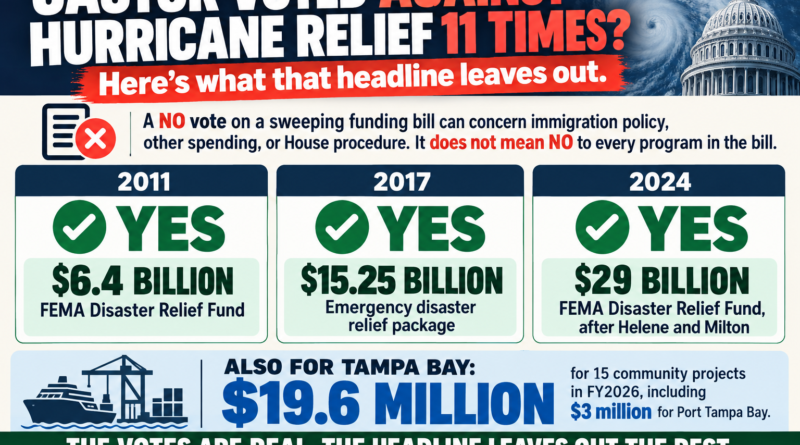
Kathy Castor Voted Against Hurricane Relief 11 Times? There’s Much More to That Story.

This entry is in the series 2026 Elections

Kathy Castor voted against hurricane relief 11 times, supposedly blocking $151.43 billion in federal disaster assistance. That’s the accusation circulating in an article from West Orlando News, courtesy of the National Republican Congressional Committee. Eleven votes. More than $151 billion. You can almost hear the ominous music playing behind the next Republican campaign commercial.

There’s just one problem. When you examine the actual congressional records, the story begins to fall apart. The article counts votes against massive spending bills covering everything from FEMA to immigration enforcement, along with a procedural vote that had little to do with disaster relief itself. Apparently, voting against a bill containing dozens of provisions means you oppose every dollar in it. Congressional voting records are wonderfully useful things, particularly when you select only the votes that support your accusation.

Here’s what the article conveniently forgot to mention. Castor voted FOR $6.4 billion in FEMA disaster funding in 2011, FOR $15.25 billion in emergency disaster assistance in 2017, and FOR legislation providing $29 billion to FEMA following Hurricanes Helene and Milton in 2024. That last bill passed 366–34. Every single vote against it came from a Republican. Funny how that little detail escaped the article’s attention.

The NRCC is entitled to campaign against Kathy Castor. Voters are entitled to know what Congress actually did. We’ve examined the votes, the bills, and the facts the original article left out. Before accepting the claim that Castor repeatedly voted against hurricane relief, read the full article. The congressional record tells a much different story, and the facts are considerably less flattering to the people spreading this accusation.

Read more


The Books They Don’t Want Our Children to Read

This entry is in the series 2026 Elections
This entry is in the series Hate Groups
This entry is in the series Deep Questions
This entry is in the series Florida Legislature

Growing up, I didn’t have books that helped me understand who I was. People rarely talked openly about being gay,

Read more

Gus Bilirakis: Who Benefits from His Votes?

This entry is in the series 2026 Elections

After nearly 20 years in Congress, Gus Bilirakis has had plenty of opportunities to demonstrate whose interests he represents. Now, with Florida’s newly drawn Congressional District 12 stretching across parts of Hillsborough and Pasco counties, it’s worth looking at his record. For residents worried about health care, household expenses, and the rising cost of living, some of his votes raise uncomfortable questions.

Bilirakis supported legislation that the Congressional Budget Office projects will leave millions more Americans uninsured and reduce federal food assistance. He opposed bipartisan infrastructure funding and pandemic relief that provided direct help to families and communities. Apparently, there’s plenty of room in Washington to cut taxes, but far less enthusiasm for helping people pay their medical bills.

Then there’s the campaign money. Nearly 56% of Bilirakis’s direct campaign contributions come from political committees, including PACs associated with pharmaceutical manufacturers, health insurers, utilities, and telecommunications companies. Many of those industries have business before the congressional committee on which he serves. Campaign contributions don’t prove influence, of course. But after two decades in Washington, voters have every reason to ask a simple question: Who is Gus Bilirakis working for?

Read more

Who Is Building Stacy Hahn’s Campaign?

This entry is in the series 2026 Elections

Campaign finance reports rarely contain a smoking gun. Mostly, they contain checks—and Stacy Hahn’s reports include many from industries most affected by County Commission decisions. At least $63,850, or about 38% of her total contributions, came from construction, development, real estate, engineering, and architecture interests.

There is also the Tampa Bay Rays’ new ownership group. After Commissioner Donna Cameron Cepeda questioned public funding for a new stadium, more than $40,000 was donated by Rays owners and related companies to Hahn, her Republican primary opponent. It seems all those builders and developers decided on their own that Hillsborough County really needed Hahn on the Commission. Sometimes, civic enthusiasm spreads quickly.

Legal contributions do not prove corruption. But campaign money is not charity, either. With roads crowded, schools full, and neighborhoods often asked to make way for new projects, voters should ask a simple question: Can Hillsborough County afford more development-at-any-cost government, and who is paying for it?

Read more

Following the Money Behind Josie Tomkow

This entry is in the series 2026 Elections

Campaign finance is so complicated that most voters give up before they get to the interesting part. That may be part of the point. Josie Tomkow has a regular campaign account and two political committees, with millions of dollars coming from business groups, health care interests, developers, insurers, political committees, and party organizations—often with names that don’t reveal who is really behind them.

Insurance stands out. About $92,500 came from companies, organizations, and people involved in property, auto, and casualty insurance. That’s notable on its own, but it’s even more interesting since Tomkow is now running as a candidate who wants to reform insurance, even though her voting record shows support for laws that reduced legal protections for policyholders. Her version of insurance reform has, at times, looked suspiciously like an aid package for the insurance industry.

There’s also at least $94,500 from donors directly connected to data centers, cloud computing, energy, or the infrastructure behind them. Add in big business and development money, plus $50,000 from Publix, and the donor list gets even more interesting. Maybe Publix just expects Tomkow to buy a lot of groceries. The rest of us might want to keep an eye on where the money goes.

Read more