
Rainy Days and Blue Tarps: Why Hoarding Billions in Tallahassee Won’t Protect Hillsborough

This entry is in the series 2026 Elections
This entry is in the series Florida Amendments and Referenda-2026

Tallahassee politicians often present Florida Amendment 1 as basic common sense. After all, who would argue with saving for a rainy day? But there’s a big difference between keeping an umbrella handy and locking away billions while your ceiling is falling in.

If you drive through Hillsborough County, you’ll see blue tarps still on roofs from storms years ago. Homeowners are struggling with high insurance costs, classrooms have broken air conditioners, and stormwater ditches need repairs. Yet Amendment 1 would require up to $750 million a year to be set aside in Tallahassee until the fund reaches 25 percent of general revenue.

Florida already has a fully funded emergency reserve at 10 percent. Forcing billions more into storage isn’t smart budgeting; it’s a way to cut local spending now so politicians can brag about a big balance later. Read the full essay to see why we should fix our roofs before Tallahassee builds another vault.

Read more
The Ballot-Box Bureaucrat: Why Electing Hillsborough’s Superintendent Is Bad for Business and Worse for Classrooms

This entry is in the series 2026 Elections
This entry is in the series Education
This entry is in the series Florida Amendments and Referenda-2026

Imagine Tampa General Hospital announcing that it will now select its President and CEO through a countywide partisan primary. Picture candidates debating surgical protocols on debate stages, taking a full year off to solicit campaign checks from medical supply reps, and catering to partisan party bosses instead of patient care. No board of trustees would tolerate it, and no major health system would survive it. Yet that is the exact circus Tallahassee politicians want to bring to Hillsborough County Public Schools, the single largest employer in our community.

Proponents dress up the proposal in the language of parental rights and democratic empowerment. But under the current model, the superintendent answers to an elected, seven-member School Board every single day. If the superintendent mishandles district finances, botches bus routes, or mismanages schools, the board can act immediately. Under an elected system, that daily accountability vanishes. The School Board loses its supervisory power, leaving a single partisan politician in charge of a $4 billion budget and 220,000 students, answerable to voters only once every four years.

An even bigger problem is the smaller pool of candidates. Instead of searching the country for experienced school leaders, we would be limited to local registered voters. The best-performing states treat school administration as a professional job, while the only two states that still elect superintendents are not among the top performers.

Injecting culture-war primaries and campaign fundraising into our school system’s executive suite is a disaster waiting to happen. Read the full analysis on why turning school administration into a political prize hurts our students, undermines teachers, and destabilizes our local schools.

Read more

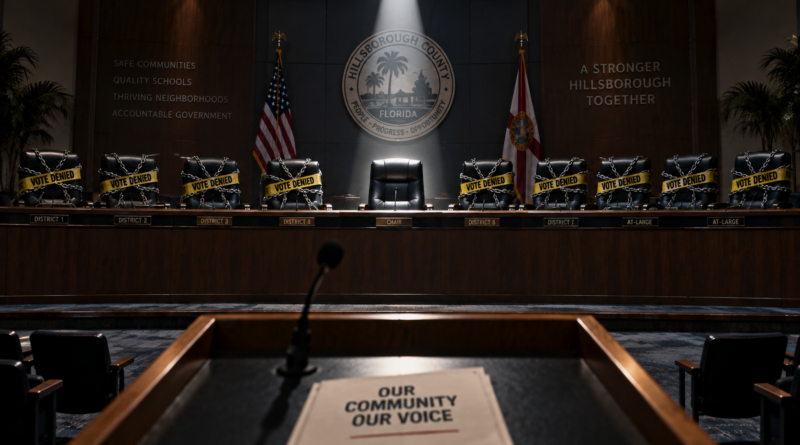
Trading Four Votes for One: The Cynical Math Behind Hillsborough’s Commission Power Grab

This entry is in the series 2026 Elections
This entry is in the series Florida Amendments and Referenda-2026

If someone came to your door and offered to trade four hundred-dollar bills for a ten-dollar bill, you would quickly close the door and check your security cameras. That is exactly the kind of deal behind Hillsborough County Charter Referendum 2, a Tallahassee plan that would undo forty years of balanced local government.

For forty years, Hillsborough has used a mix of four district commissioners and three countywide at-large commissioners. This lets every voter choose four out of seven seats, giving people a say in the majority. Referendum 2 would end this system by expanding the board to nine and removing all at-large seats.

Think about what this means for your representation. You would go from voting for four commissioners to just one. You would not be able to vote for or against the other eight, even though they decide on taxes, infrastructure, and big development projects. Single-member districts encourage commissioners to trade favors for their own areas and ignore countywide needs like Port Tampa Bay and regional transit.

Tallahassee politicians love to lecture local communities about neighborhood control while quietly shrinking our democratic leverage from afar. Read the full commentary to see why trading away four seats for one is a bad trade for Hillsborough taxpayers, and why we must vote No on Charter Referendum 2.

Read more

Cool Classrooms and Common Sense: Why Hillsborough Must Renew the Half-Penny Promise

This entry is in the series Florida Amendments and Referenda-2026
This entry is in the series 2026 Elections
This entry is in the series Education

Florida summer heat is not theoretical. It is a relentless physical reality. Anyone who expects children to concentrate on algebra or reading in an eighty-eight-degree classroom with a dead air conditioner and water dripping into plastic buckets has never spent an afternoon inside an aging Florida school building. You cannot build academic excellence when students and teachers are simply trying to survive the humidity.

Hillsborough Referendum 3 asks voters to renew the half-cent sales tax for another ten years to pay for air conditioning, roof repairs, and security at schools. Opponents talk about tax fatigue, but this is not a new tax. It keeps the same rate as in 2018. If it ends, your grocery bill will not go down, but school maintenance will lose $120 million a year.

The results speak for themselves. Since 2018, the Half-Penny Promise has funded over 750 projects, including air conditioning upgrades at 177 schools, all overseen by an independent Citizen Oversight Committee. Tourists pay about a quarter of the cost, and over $716 million has gone to local contractors and workers in Hillsborough County.

While the state Capitol stays busy manufacturing political culture wars and diverting public funds into private vouchers, local communities must take care of their own. Read the complete breakdown on why renewing this capital surtax is an investment in our kids, our local workforce, and our neighborhood schools.

Read more

Can You Be a Stoic and a Political Activist?

This entry is in the series Journey Through Stoicism
This entry is in the series 2026 Elections

Can you be a Stoic and still be politically active? I think the answer is not only yes, but that Stoicism gives us a better way to do it. The ancient Stoics did not confuse acceptance with surrender. They accepted what could not be changed, while challenging injustice when action was still possible.

That question feels especially urgent now. We are living in a time when division itself has become a political tool. Culture war fights can dominate attention while people are still struggling with housing, health care, violence, war, and the basic question of whether government can still solve real problems. Anger may be useful in campaigns. It is rarely enough to build a decent society.

Stoicism asks something harder of us. Stay engaged without becoming consumed. Think clearly when others are trying to provoke you. Act with courage when something is wrong. Keep justice at the center. And remember that the people on the other side of a political argument are still part of the same community.

Politics, at its best, is what we choose to do together. This essay asks what Stoicism can teach us about showing up for that shared life, especially when the temptation is to give up, tune out, or shout louder.

Read more

Two Campaigns, Two Very Different Funding Models

This entry is in the series 2026 Elections
This entry is in the series Education

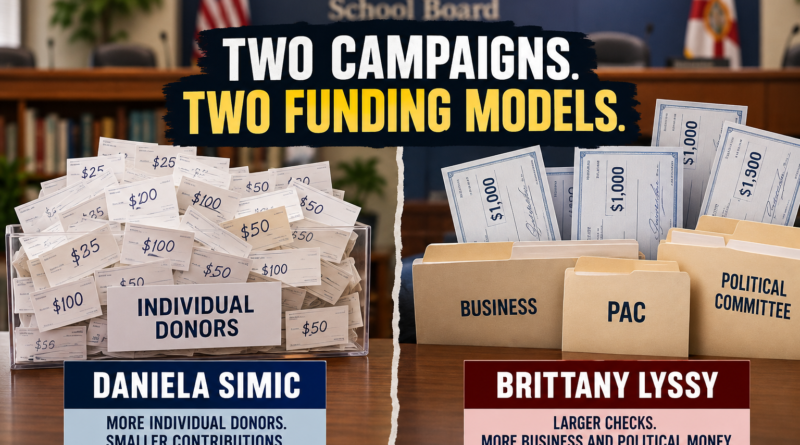
Campaign finance reports can be tedious, but the District 2 numbers tell a fairly simple story. Daniela Simic’s campaign is driven much more by individual donors and smaller contributions. Brittany Lyssy’s campaign relies far more heavily on large checks, businesses, and political committees. Her latest filings also include direct support from a Hillsborough County Republican organization in a race that is formally nonpartisan.

There is another layer. Lyssy also chairs a separate political committee bearing her name, while part of the education-policy experience she cites comes from the conservative Leadership Institute’s school-board program. That same program has featured Bridget Ziegler in a leadership and training role.

The full article strips away the financial-report clutter and examines who is funding these two campaigns, the political networks surrounding them, and the very different professional backgrounds the candidates would bring to the Hillsborough County School Board.

Read more

Jackie Toledo and the Curious Case of Local Control

This entry is in the series 2026 Elections

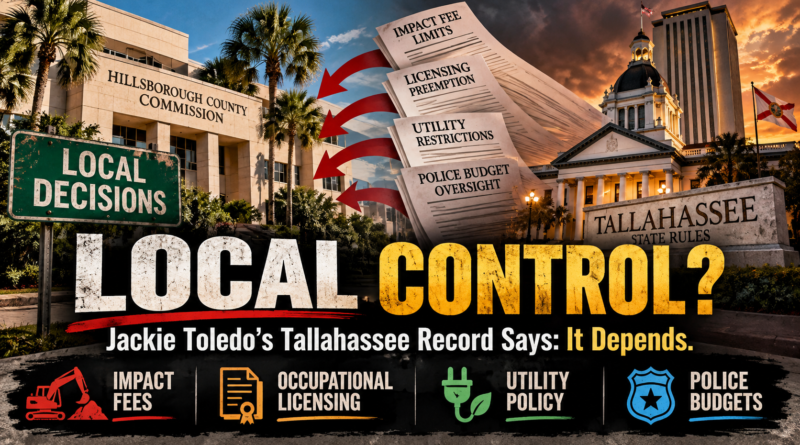
Jackie Toledo is now seeking a seat on the Hillsborough County Commission, where local officials decide on growth, infrastructure, public safety, and county policy. This makes her time in Tallahassee especially interesting, because she repeatedly supported laws that limited what counties and cities could decide for themselves.

Toledo supported state intervention in areas like impact fees, occupational licensing, utility policy, and even local police budgets; Toledo backed state intervention in matters normally handled close to home. In one case, Tallahassee could even review and overturn a local decision about a police budget.

There is a certain irony in spending years helping state government restrict local author

Read more

When Four Times the Votes Doesn’t Mean Four Times the Support

This entry is in the series 2026 Elections
This entry is in the series Daily Douche-Bag

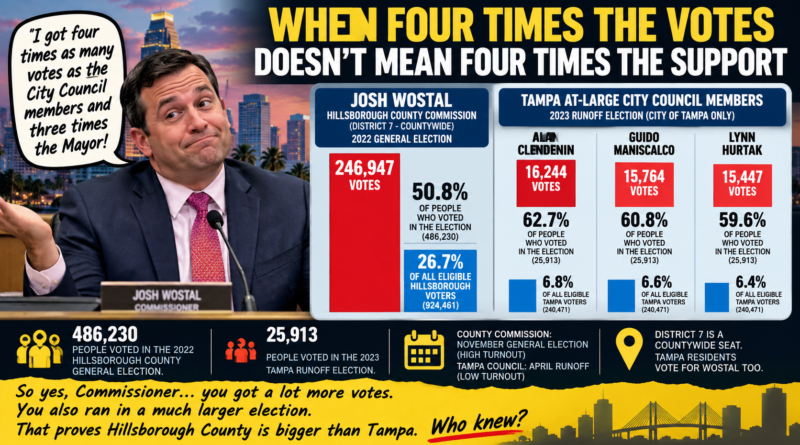
Josh Wostal has a unique way of measuring political influence. When people said Hillsborough County doesn’t treat Tampa fairly, he noted that he got far more votes than Tampa’s mayor and at-large City Council members. That sounds impressive until you consider the size of the electorate and voter turnout.

Wostal ran in a countywide November election where 486,230 people voted. Tampa’s at-large council members won their seats in an April runoff with only 25,913 voters. If you compare each candidate to the people who voted in their election, Wostal’s supposed advantage goes away. In fact, some of the votes he mentions came from Tampa residents. So, Hillsborough County is bigger than Tampa. Who would have thought?

Read more

Jackie Toledo’s Romance With “School Choice” – Right Temperament for County Commission?

This entry is in the series 2026 Elections

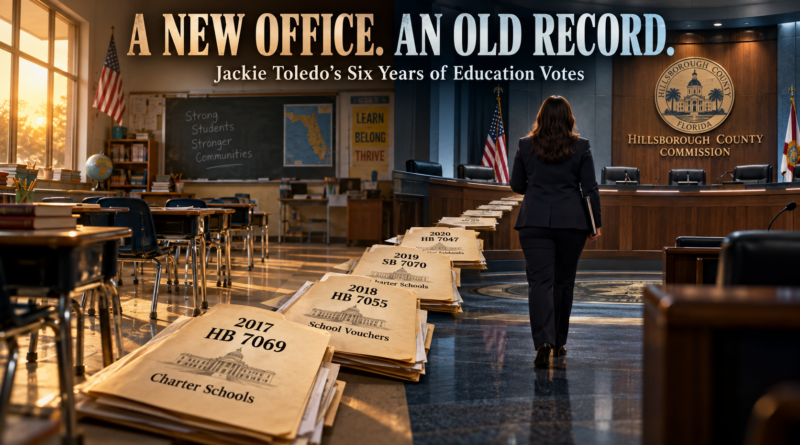
Jackie Toledo spent six years in the Florida House, where she repeatedly supported legislation expanding charter schools and private-school scholarship programs. Her voting record shows how Florida’s school-choice system grew during her time in Tallahassee.

The changes came almost every year. In 2017, Toledo supported legislation to expand charter schools and share certain local school construction funds with them. By 2021, she had also voted to create and expand the Family Empowerment Scholarship, broaden eligibility, and increase scholarship awards. Meanwhile, traditional public schools remained responsible for educating every enrolled child.

Now Toledo wants to serve on the Hillsborough County Commission. Her legislative record raises questions about her approach to public funding and local responsibility. The full article follows five years of education legislation and examines the choices she made along the way.

Read more

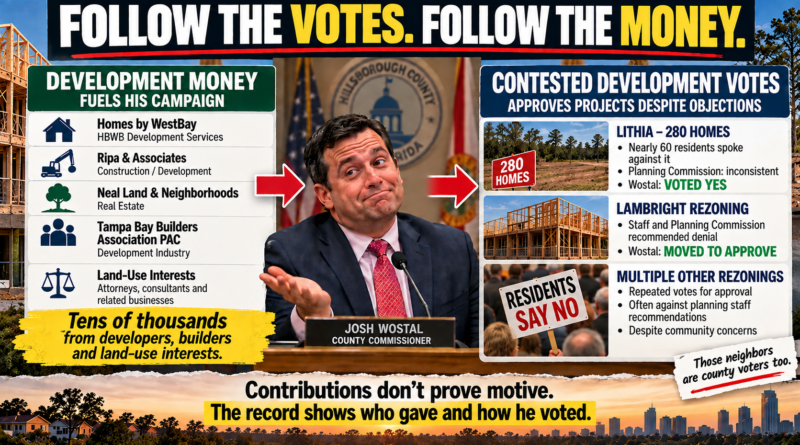
Follow the Votes. Follow the Money.

This entry is in the series 2026 Elections

Josh Wostal likes to remind people that he represents voters across Hillsborough County. Some of those voters have shown up at County Commission meetings, asking commissioners to slow development in their neighborhoods. In several cases, Wostal voted the other way, even when county planning officials recommended denial or found the proposed development inconsistent with the comprehensive plan.

Then there is the money. Builders, developers, construction firms and land-use interests have contributed substantial sums to Wostal’s political operation. In at least two cases, contributors or business networks tied to his campaign also had development matters come before the commission. None of that proves why Wostal cast a particular vote. It does give voters a reason to look closely at who funds his political operation and what happens when development interests come before him.

And those residents standing at the podium asking him to listen? They are countywide voters too.

Read more

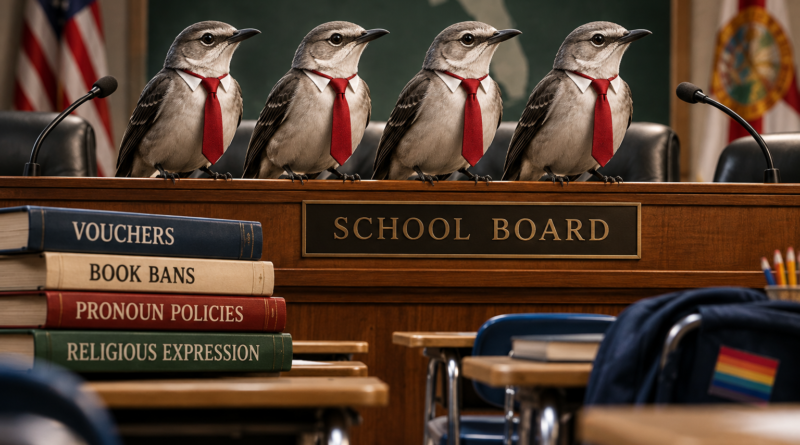
Birds of a Feather

This entry is in the series 2026 Elections
This entry is in the series Education

Ken Gay’s latest supporter graphic features Republican state representatives Danny Alvarez, Traci Koster and Michael Owen. Once you look at their education records, the endorsements require very little explanation. Alvarez and Koster backed Florida’s expansion of private-school scholarships and HB 1069, with its restrictions on sexual-orientation and gender-identity instruction and pronoun use. Owen has supported similar school-choice policies and legislation expanding religious expression in public schools.

The consequences of those LGBTQ-related policies are harder to shrug off as another Tallahassee culture-war hobby. Trevor Project research found that LGBTQ+ students attending schools with even one anti-LGBTQ+ policy reported higher rates of anxiety, depression and suicide attempts. Its 2023 research also found lower suicide-attempt rates among students with affirming school supports, including teachers who respected transgender and nonbinary students’ pronouns. Apparently, treating children with dignity has measurable benefits. Who knew?

So “birds of a feather” seems an apt description of the policy overlap. The same group supporting Gay has repeatedly backed moving education dollars toward private alternatives while supporting restrictions that fall particularly hard on LGBTQ+ students. The question behind the endorsements is worth examining: what does that agenda mean inside a public-school system charged with educating every child who walks through its doors?

Read more